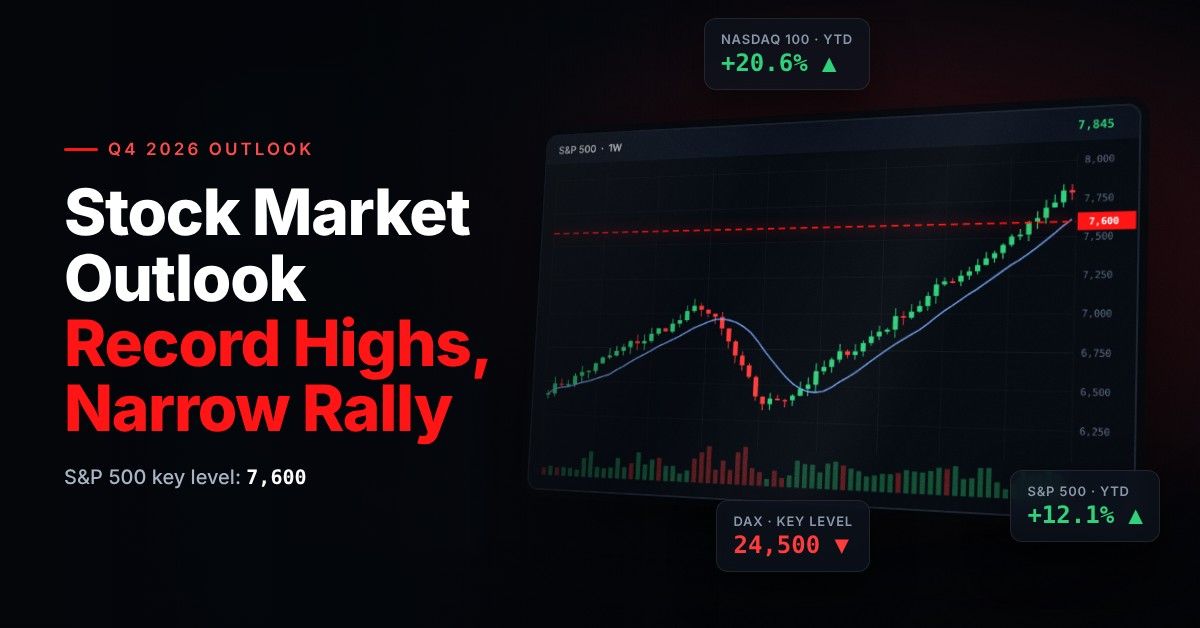




The DAX 30 index is trading between its low of the year and its record close of 26,569.99, set on 28 August. Most year-end 2026 targets from German banks published or reaffirmed since August sit between 26,000 (Berenberg) and 27,500 (DZ Bank and M.M. Warburg). The next catalysts are the US Federal Reserve decision on 28 October, the ECB decision on 29 October, Germany's third-quarter GDP flash estimate on 30 October and the November earnings season.
Frank Walbaum, Market Analyst at NAGA and a former hedge fund manager, in his Q4 2026 Market Outlook, is more cautious about Germany than about Wall Street: "The German equity market looks less convincing than the US market. The DAX has lagged the strongest US indices and remains more exposed to a deterioration in global risk sentiment."
DAX 40 Forecast 2026–2027 — Summary
- DAX forecast for year-end 2026: Most published bank targets for the end of 2026 sit between 26,000 and 27,500, between about 2% and 7.5% above the end of October price. Whether the DAX gets there depends mostly on oil and the Strait of Hormuz, on how far the ECB raises rates, and on whether third-quarter earnings keep analysts' estimates rising.
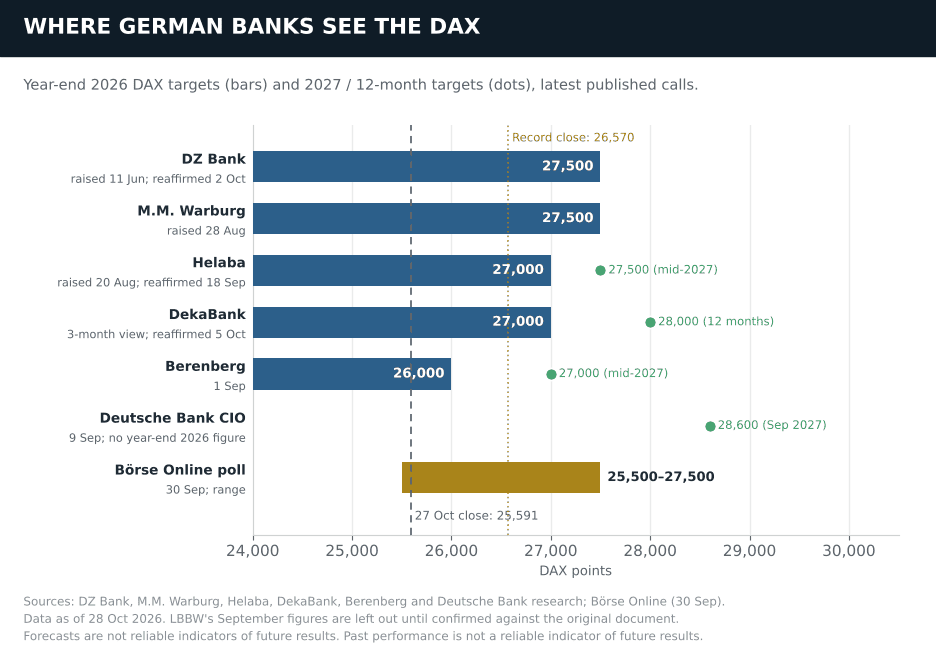
- BASE CASE (bank targets) — 26,000–27,500: If oil stabilises, the ECB stops after one more hike and earnings estimates keep rising, the DAX could end the year in the range where German banks see it: Berenberg at 26,000, Helaba at 27,000 (DekaBank also 27,000 on a three-month view), and DZ Bank and M.M. Warburg at 27,500. That range runs from about 2% below the August record close to about 3.5% above it, so this scenario implies a retest of the record and, at the top end, modest new highs.
- BULL CASE (illustrative) — 27,500–28,000: A lasting de-escalation around the Strait of Hormuz that pulls oil well below $100, an ECB that pauses after October and continued earnings upgrades could take the DAX through its record towards the top of the bank range: DZ Bank's and M.M. Warburg's 27,500 for year-end and DekaBank's 28,000 on a six-month view.
- BEAR CASE (illustrative) — 23,000–24,800: Renewed escalation in the Gulf that sends oil higher again, a faster series of ECB hikes or a weak earnings season could push the DAX back below 25,000. The 8 October low of 24,807 is the first reference point, then the area between the lower rail of the long-term channel (around 23,150 and rising) and the May low of 23,951. Frank Walbaum sees the German market as the more fragile one: "If global risk appetite remains strong, the DAX can continue to participate. If sentiment deteriorates, however, the German market could weaken more significantly than the major US indices."
- DAX forecast 2027: The first 2027 targets are already out and sit higher: Berenberg sees 27,000 and Helaba 27,500 by mid-2027, DekaBank 28,000 on a twelve-month view and Deutsche Bank's Private Bank CIO office 28,600 for September 2027. That would put the index roughly 5–12% above the 27 October close. Most banks publish their full 2027 outlooks in November, so expect this range to move.
- Next 5 Years — DAX to 2030 and Beyond: No bank publishes a DAX target for 2030. Algorithmic forecasting sites do: CoinPriceForecast shows about 34,500 for the end of 2030 and WalletInvestor about 35,600 for October 2031, while LongForecast's model reaches about 44,400 by November 2030. These are model outputs that change with every update, not analyst research. The structural case rests on Germany's fiscal spending on infrastructure and defence, the DAX's global revenue base and earnings growth; the main long-term risks are energy costs and the pressure on Germany's car industry.
DAX 40 Fundamental Analysis 2026
The DAX's 2026 story has been driven far more by energy and interest rates than by trade. The war with Iran and the disruption in the Strait of Hormuz turned oil from a tailwind into the main headwind, the ECB has responded with two rate hikes, and US tariffs, the dominant theme of 2025, have become a background risk. Against that, Germany's fiscal expansion and the index's global revenue base continue to support earnings.
US Tariffs and German Exports in 2026
Tariffs have not gone away, but their shape has changed. In February the US Supreme Court struck down the tariffs imposed under emergency powers (IEEPA). Washington replaced them with a temporary global tariff under Section 122, which expired on 24 July, and then with Section 301 'forced-labour' duties under which EU goods face a 10% floor. According to the German American Chambers of Commerce (AHK USA), EU pharmaceuticals remain capped at 15% under the 2025 US–EU framework, and the same 15% ceiling is reported to apply to EU cars, while steel, aluminium and copper themselves face 50%. German exports to the US fell 9.4% in 2025 to €146.2 billion and a further 6.1% year on year in the first half of 2026, according to Destatis.
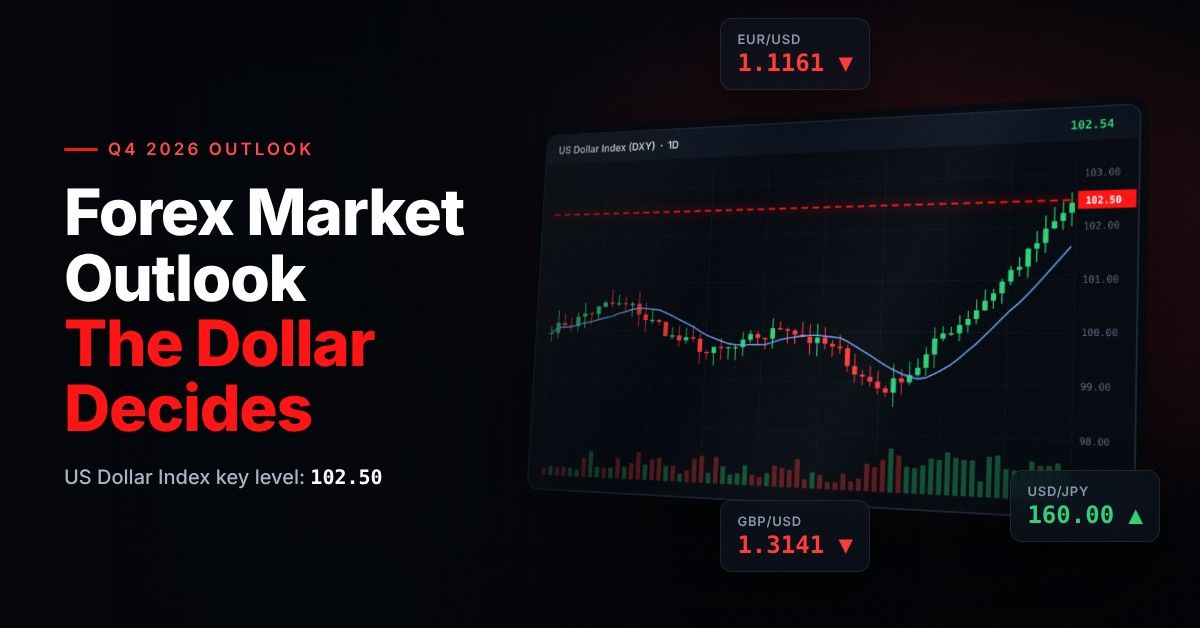
The currency has moved the other way from what many expected at the start of the year. The euro peaked near $1.20 in late January and has since slipped to about $1.115, its lowest level since April 2025. A weaker euro raises the euro value of the dollar revenue that DAX exporters earn, which partly offsets the drag from tariffs and slower US demand. Even so, Mercedes-Benz's cut to its 2026 margin guidance on 27 October shows that car makers remain the weak spot.
ECB Rate Hikes and What Comes Next
The European Central Bank has raised its deposit rate twice this year: by 25 basis points to 2.25% on 11 June and to 2.50% on 10 September, its first hikes since 2023. Both moves were driven by the energy shock. The ECB's September projections see euro area inflation at 3.0% in 2026 and GDP growth of only 0.9%, and headline inflation reached 3.8% in September. ECB President Christine Lagarde said in September that "Inflation is set to remain well above target for an extended period."
The ECB decides again on 29 October. A hold is almost fully priced, but 64 of 73 economists polled by Reuters expect another hike to 2.75% in December, and markets price close to three hikes by the end of 2027. Bundesbank President Joachim Nagel said on 16 October that he could not rule out another move. For the DAX, a central bank that is still raising rates removes a tailwind and keeps pressure on valuations, although higher rates also help lenders: Deutsche Bank reported a record third-quarter profit on 28 October.
Fiscal Stimulus and the Infrastructure/Defence Programme
Germany's decision in March 2025 to loosen its debt brake for defence and infrastructure remains one of the most important supports for the DAX. The government raised its 2026 growth forecast to 1.3% on 9 October, in line with the leading economic institutes' autumn joint forecast and the IMF, and Berenberg estimates that higher state spending adds about 0.4 percentage points to growth in both 2026 and 2027. The joint forecast also expects the general government deficit to reach 4.1% of GDP in 2026, so the support comes with a growing consolidation problem later in the decade.
The defence trade has not been one-way for investors. Rheinmetall was the DAX's best performer in 2025, up about 154%, but it has been the worst performer of 2026 so far, down 36% year to date by mid-September. With a weight of about 3%, it no longer drives the index; the DAX's direction depends far more on its heavyweights Siemens, SAP and Allianz, which together make up nearly a third of the index.
Global Revenue Exposure — The DAX's Structural Advantage
Most DAX companies are multinationals that earn the bulk of their revenue outside Germany. That is why the index can hold up while the domestic economy struggles: German GDP grew only 0.3% quarter on quarter in the second quarter, and Helaba says even a slight contraction in the third quarter cannot be ruled out. Third-quarter results show the split. SAP now expects cloud revenue at the top of its guidance range after growth of 26%, and Deutsche Bank reported a record quarterly profit, while Mercedes-Benz cut its margin guidance and the property group Vonovia and carmaker BMW are among the year's laggards.
That global base cuts both ways. It insulates the index from weak German demand, but it leaves the DAX exposed to global shocks such as an oil spike, a slowdown in US technology spending or new trade barriers. At home, the ifo business climate rose to 90.2 in October while ZEW expectations fell to 28.1, so the recovery is still fragile; Germany's third-quarter GDP flash estimate is due on 30 October.
Oil, Gas and the Strait of Hormuz
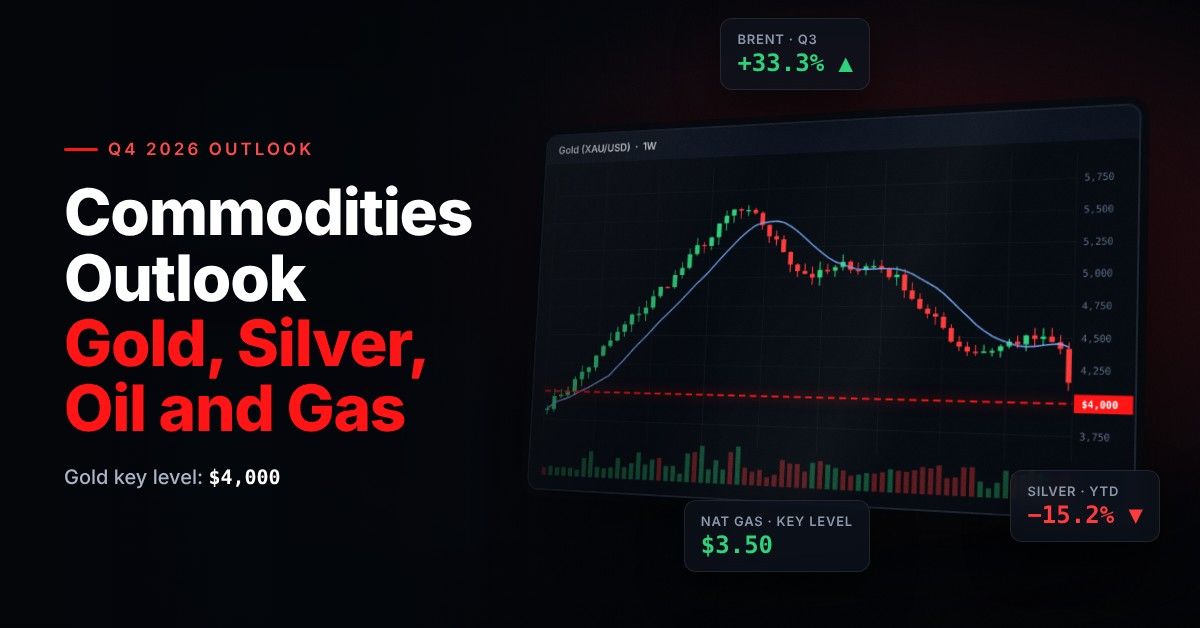
Energy is the single biggest macro risk for the DAX in 2026, given Germany's dependence on imported energy. Brent crude climbed to around $120 a barrel in March, when the war with Iran disrupted traffic through the Strait of Hormuz. It fell to the low $70s after the June framework deal between the US and Iran, but the truce collapsed on 8 July, oil moved back above $100 on 9 September and Brent climbed above $117 in late October, its highest level since April, before settling at $113.88 on 27 October.
Regional talks in Tehran on 26 October have raised hopes of de-escalation. As with the EUR/USD and the wider European equity market, the DAX's path into year-end depends heavily on oil: lower energy costs would relieve energy-intensive sectors such as chemicals and take pressure off the ECB, while another spike would hit both earnings and rate expectations.
Discover Top German Stocks to Watch Now
DAX 40 Technical Analysis
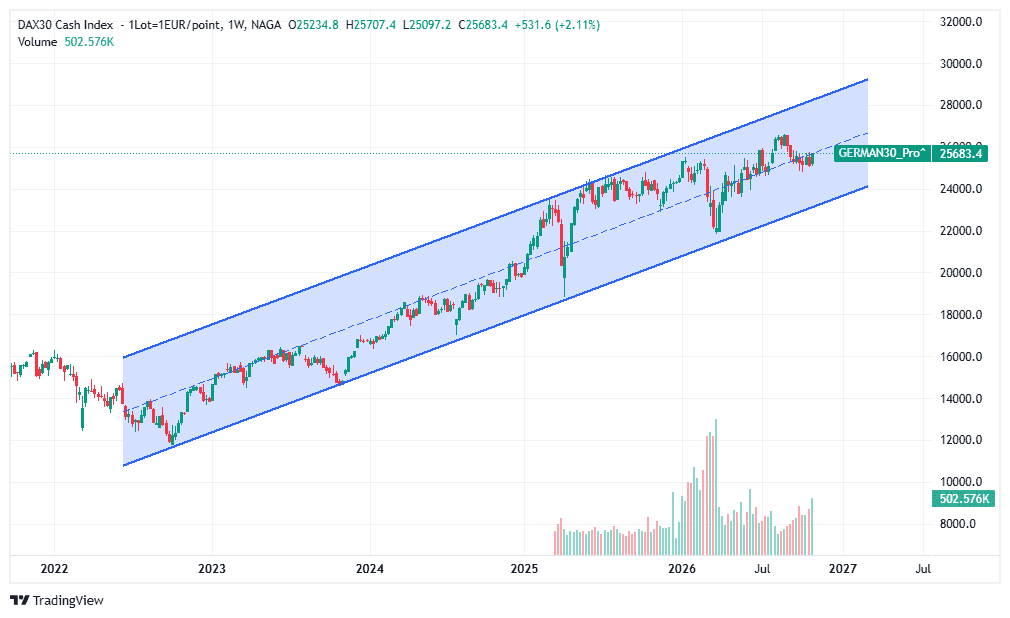
On the weekly chart, the DAX's whole post-2022 advance fits inside a well-defined rising channel that started at the energy-crisis low of 11,862.84 (intraday) in September 2022. The lower rail connects that low with the higher lows of 2023, 2024 and March 2026, while the upper rail runs along the sequence of highs. The midline has acted as a pivot: the index broke above it on the way to the August record and has traded around it since September. The rail values below are approximate readings from the weekly chart for late October 2026; because the channel rises, they move higher every week.
Past performance is not a reliable indicator of future results. All historical data, including but not limited to returns, volatility, and other performance metrics, should not be construed as a guarantee of future performance.
Channel Reference Zones for Year-End 2026
The upper rail now sits around 28,300, well above the August record of 26,570 (close) and 26,619 (intraday); it marks where the channel would be tested, not a price target. The midline, around 25,700, is the level the index has been oscillating around since September, and the lower rail, around 23,150 and rising, is the line that held at the March low.
Read against the scenarios outlined above, the channel offers three reference zones:
- a move from the midline (~25,700) back towards the record area of 26,570–26,619, inside the range of most year-end bank targets
- a deeper pullback toward the 8 October low of 24,807 and then the lower rail (~23,150 and rising)
- a break above the record that extends toward 27,500–28,000, still inside the channel and below the upper rail (~28,300)
None of these zones is a forecast. A weekly close below the lower rail would be the first break of the post-2022 structure and would invalidate this reading, while a sustained move above the record would shift attention from the midline to the upper half of the channel.
Key Technical Levels
LEVEL POINTS SIGNIFICANCE Channel upper rail ~28,300 (rising) Upper boundary of the channel from the 2022 low, late October 2026; a reference point, not a price target All-time high 26,570 close / 26,619 intraday (28 Aug 2026) Record set on 28 August 2026; the first resistance above the current level ⬤ Current level / channel midline 25,591 (27 Oct 2026 close) / ~25,700 The index has oscillated around the channel midline since September October low 24,807 (8 Oct 2026 close) Lowest level since July; first support below 25,000 Channel lower rail ~23,150 (rising) Rising trendline that held at the March 2026 low; a weekly close below it would break the channel 2026 low 21,864 (23 Mar 2026, intraday) Iran-war low; the lowest level of 2026 so far (closing low 22,301 on 27 March) Channel origin / structural floor 11,863 (Sep 2022, intraday) Energy-crisis low where the post-2022 uptrend started Past performance is not a reliable indicator of future results. Technical levels are analytical reference points, read from the weekly chart, not price forecasts.
To learn more about technical analysis as a forecasting tool, visit NAGA Academy.
DAX 40 Forecast 2026–2027 — Bank Predictions
Here is where German banks stand on the DAX, based on their most recently published or reaffirmed targets. Every revision published since July has been an upgrade: Helaba lifted its year-end target from 25,000 to 27,000, M.M. Warburg from 26,000 to 27,500, and DekaBank raised all of its forecast horizons.
INSTITUTION END-2026 TARGET LATER TARGET KEY DRIVERS DZ Bank 27,500 — Raised from 25,000 on 11 Jun 2026, reaffirmed 2 Oct; semiconductor boom and double-digit earnings growth, assuming no renewed escalation in the Middle East M.M. Warburg 27,500 — Raised from 26,000 on 28 Aug 2026; assumes an unchanged DAX P/E at year-end and earnings growth of about 15% in 2026 and 2027 Helaba 27,000 27,500 (mid-2027) Raised from 25,000 on 20 Aug 2026, reaffirmed 18 Sep; an improving economic backdrop should support equities DekaBank 27,000 (3-month view) 28,000 (6 and 12 months) All horizons raised on 3 Sep 2026, reaffirmed 5 Oct; improving earnings momentum at German companies Berenberg 26,000 27,000 (mid-2027) Published 1 Sep 2026; sees little upside for European equities for now and a comparatively subdued medium-term outlook Deutsche Bank (Private Bank CIO) — (12-month view only) 28,600 (Sep 2027) Raised from 26,300 for June 2027 on 9 Sep 2026; European equities have held up despite renewed energy concerns Börse Online strategist poll 25,500–27,500 — Anonymous snapshot of strategists published 30 Sep 2026; the most recent German poll Targets are the latest each bank has published or reaffirmed, as of 28 October 2026. DekaBank publishes rolling three-, six- and twelve-month forecasts rather than calendar-year targets. Most banks publish their 2027 outlooks in November. Forecasts are not reliable indicators of future results.
DZ Bank and M.M. Warburg: 27,500 by Year-End
DZ Bank and M.M. Warburg share the highest year-end target among German banks at 27,500, about 7.5% above the 27 October close. DZ Bank raised its target from 25,000 on 11 June, pointing to the boom in semiconductors, and has reaffirmed it several times since, most recently on 2 October; when it raised the target in June, it expected DAX company earnings to grow by around 15% this year. Its call assumes that the conflict in the Middle East does not escalate again and that earnings estimates hold. M.M. Warburg chief economist Carsten Klude lifted his target from 26,000 on 28 August, on the assumption that the DAX's price-to-earnings ratio at year-end stays where it was then, with earnings rising about 15% this year and next.
DAX Forecast 2027: What Banks Expect Next Year
The first 2027 targets point higher still. Helaba sees 27,500 by mid-2027, DekaBank 28,000 on a six- and twelve-month view, Berenberg 27,000 by mid-2027, and Deutsche Bank's Private Bank CIO office 28,600 for September 2027, up from 26,300 for June 2027 in its previous outlook. That range of 27,000–28,600 would be roughly 5–12% above the 27 October close. For context, the last broad survey of German institutions, published by the Frankfurter Allgemeine Zeitung in January, averaged just under 26,000 for the end of 2026; the DAX first closed above that level on 3 August.
Berenberg: 26,000, the Cautious End of the Range
Berenberg's wealth and asset management team has the lowest year-end target among the banks in the table, at 26,000, about 1.6% above the 27 October close, and 27,000 for mid-2027. In its September handout, it said that despite a solid August it saw little upside for European equities at present and described the medium-term outlook for the asset class as comparatively subdued. The anonymous strategists polled by Börse Online at the end of September spanned a similar range, from 25,500 to 27,500.
Model-Based DAX Forecasts: What the Algorithms Say
Algorithmic forecasting sites publish DAX predictions that update automatically with the price. As of 28 October 2026, they sit at or below the current level for the end of 2026, well below the bank targets, and show much larger numbers further out:
MODEL MOST RECENT UPDATE END-2026 TARGET LATER PROJECTION LongForecast 28 Oct 2026 24,619 (Dec 2026) 31,315 (Dec 2027); 44,381 (Nov 2030) CoinPriceForecast 27 Oct 2026 25,652 (end-2026) 28,846 (end-2027); 34,489 (end-2030) WalletInvestor 28 Oct 2026 25,113 (Dec 2026) 28,172 (Dec 2027); 35,573 (Oct 2031) Trading Economics 28 Oct 2026 24,681 (end of Q4 2026) 22,636 (12 months)
The spread shows how mechanical these models are. LongForecast's end-2027 projection of 31,315 would mean a gain of more than 20% in a little over a year, while Trading Economics' twelve-month projection of 22,636 implies a fall of more than 10%.
Model outputs like these extrapolate past prices and change with every update. They are best read as a sentiment gauge alongside bank research, not as forecasts in their own right.
DAX Price History — Key Moments
The DAX's modern history is a story of accelerating milestones: the journey from 5,000 to 10,000 points took more than 16 years, while recent round-number thresholds have fallen in a fraction of that time — a reflection of both genuine earnings growth and the index's increasingly global revenue base.
September 2022: The Energy Crisis Low
Russia's invasion of Ukraine and the resulting European energy crisis drove the DAX to a multi-year low near 11,862 in September 2022, as soaring gas prices and recession fears weighed heavily on Germany's energy-intensive industrial base. This low marks the starting point of the multi-year uptrend that has driven the index to its subsequent record highs.
May 20, 2025: 24,000 for the First Time
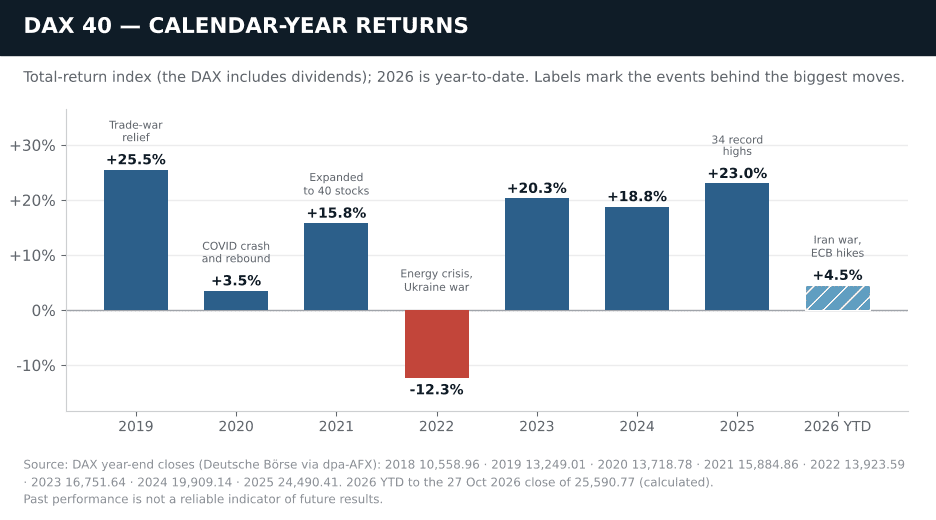
The DAX crossed 24,000 points for the first time on May 20, 2025, helped by easing US–China trade tensions, hopes for diplomacy over Ukraine and expectations of further ECB rate cuts. It went on to set 34 record highs in 2025, 31 of them in the first half, and finished the year up 23%, its best year since 2019.
January 7, 2026: The Historic 25,000 Breakout
The DAX surpassed 25,000 points for the first time in its history on January 7, 2026, trading at 25,003.73 shortly after the open and closing at a record 25,122.26 the same day. The milestone was driven by expectations of a 2026 German economic upturn fuelled by multi-billion-euro government investments in infrastructure and defence, alongside expectations of lower global oil prices easing inflationary pressure. The January rally peaked on 13 January at a record close of 25,420.66, a high that stood until July.
March 2026: The Iran-War Sell-Off
The year's sharpest reversal had nothing to do with tariffs. After US and Israeli strikes on Iran began on 28 February, traffic through the Strait of Hormuz came to a near standstill and Brent crude climbed to around $120 a barrel. The DAX lost 10.3% in March. On 23 March, after a 48-hour US ultimatum over Hormuz, it fell below 22,000 for the first time since the April 2025 tariff shock, to an intraday low of 21,863.81, before rebounding more than 1,000 points the same day when Washington postponed strikes on Iranian energy sites. Its lowest close of the year, 22,301, came on 27 March.
April 2026: Ceasefire Relief and the Best Day Since 2022
On 8 April a two-week, Pakistan-mediated ceasefire between the US and Iran sent the DAX up 5.06% to 24,080.63, its best day since 2022, as Brent briefly dropped below $91. The recovery was not smooth: talks in Islamabad failed, a US naval blockade followed, and the index slipped back to a closing low of 23,951 on 15 May before a new uptrend began.
July–August 2026: New Records Above 26,000
A framework deal between the US and Iran in mid-June lifted the STOXX 600 to a record on 15 June, and the DAX followed on 2 July with its first record since January, after weak US jobs data. The truce collapsed on 8 July and the index went through a three-week slump, but hopes of new talks drove it above 26,000 for the first time on 3 August, when it also closed at a record 26,001.31. The current all-time high came on 28 August, led by a rally in car makers: a record close of 26,569.99 and an intraday high of about 26,619.
September–October 2026: Oil, Rate Hikes and a Pullback
The DAX has not set a new record since. Brent moved back above $100 on 9 September, the ECB raised rates to 2.50% the next day and the Fed hiked to 3.75–4.00% on 16 September, while euro area bond yields climbed to 15-year highs. The index fell to a close of 24,806.97 on 8 October, 6.6% below its record, before recovering to 25,590.77 on 27 October as the third-quarter earnings season got under way.
When looking for DAX price predictions, it is important to remember that analysts' forecasts can be wrong, sometimes substantially, as the gap between bank targets and algorithmic models in 2026 shows. Projections are based on fundamental and technical analysis of historical price movements; past performance and forecasts are not reliable indicators of future results. It is essential to conduct your own research. Your decision to trade depends on your attitude to risk, your expertise in the market, the spread of your investment portfolio, and how comfortable you feel about losing money. Never invest money you cannot afford to lose.
Sources:
- Trading Economics — Germany Stock Market Index (DE40)
- Frankfurter Allgemeine Zeitung — Institutional Survey
- Deutsche Börse — DAX Index Data & Surveys
- European Central Bank — Monetary policy decisions, 10 September 2026
- Destatis — German exports in the first half of 2026
- DZ Bank via dpa-AFX — DAX uptrend intact, 3 August 2026
- M.M. Warburg — DAX target raised, 28 August 2026
- Helaba — Märkte und Trends, August 2026
- DekaBank — Economic forecasts, 3 September 2026
- Berenberg — Horizonte Handout, September 2026
- Deutsche Bank — PERSPEKTIVEN macro and asset class outlook, September 2026
- STOXX — DAX holds ground in third quarter, 5 October 2026
Other Resources
- Dow Jones forecast & price predictions 2026
- NASDAQ 100 forecast & price predictions 2026
- EUR/USD forecast & price predictions 2026
- Oil forecast & price predictions 2026
- Natural Gas forecast & price predictions 2026
- Gold forecast & price predictions 2026
- Silver forecast & price predictions 2026
- IBEX 35 forecast & price predictions 2026
- German Stock Market Academy Guide
- How to trade stocks and indices