


An investment in an IPO has the potential to deliver attractive returns, but sometimes investors lose a lot of money. This guide explains what an IPO is, how the IPO process works from filing to first trade, and how to evaluate, trade and invest in IPO stocks. For confirmed dates of upcoming listings, see NAGA’s IPO calendar.
How to Trade and Invest in IPO Stocks – Quick Guide
- Follow the IPO calendar. NAGA’s IPO calendar tracks upcoming and recent listings, such as Anthropic and SpaceX.
- Decide how to take a position on an IPO: With us, you can trade or invest in the shares once the company has completed the IPO and the shares are available on the platform.
- Build your IPO trading plan and strategy. Make sure you know about trade planning and risk management, including when you plan to take profits and cut losses.
- Copy lead traders. Copy the moves of top performing traders in real-time with NAGA Autocopy.
What is an IPO?
There are thousands of companies that trade on the New York Stock Exchange (NYSE), Nasdaq, or Tadawul. These companies range from the leviathan Apple or Saudi Aramco to the smaller companies, with market capitalizations of less than the price of a car.
Every one of those companies had to start somewhere. They each sprang to trading life with initial public offerings (IPOs), turning from private companies to public ones, attracting investors, and raising capital.
An initial public offering (IPO) is when a private company becomes public by selling its shares on a stock exchange for the first time. In simple terms, the IPO meaning is “going public”: ownership of the company’s shares opens up from a small group of private investors to anyone who buys them on the stock market.
Private companies work with investment banks to bring their shares to the public, which requires tremendous amounts of due diligence, marketing, and regulatory requirements.
Purchasing shares in an IPO is difficult as the first offering is usually reserved for large investors, such as hedge funds and banks.
Retail investors can usually buy the shares, or trade them, as soon as they start trading on the exchange.
When an IPO has happened, you can go long or short on share prices through CFD trading or buy shares with ownership. Remember, if you’re trading, you can aim to profit from upward or downward share price movements.
IPO vs direct listing vs SPAC
An IPO is the most common way to go public, but not the only one. In a direct listing, a company lists its existing shares without raising new money or using underwriters to price an offering. In a SPAC merger, a private company merges with a listed shell company and becomes public that way. An IPO usually brings the most scrutiny and price discovery before trading starts, which is why it remains the standard route for large companies.
How Does an IPO Work?
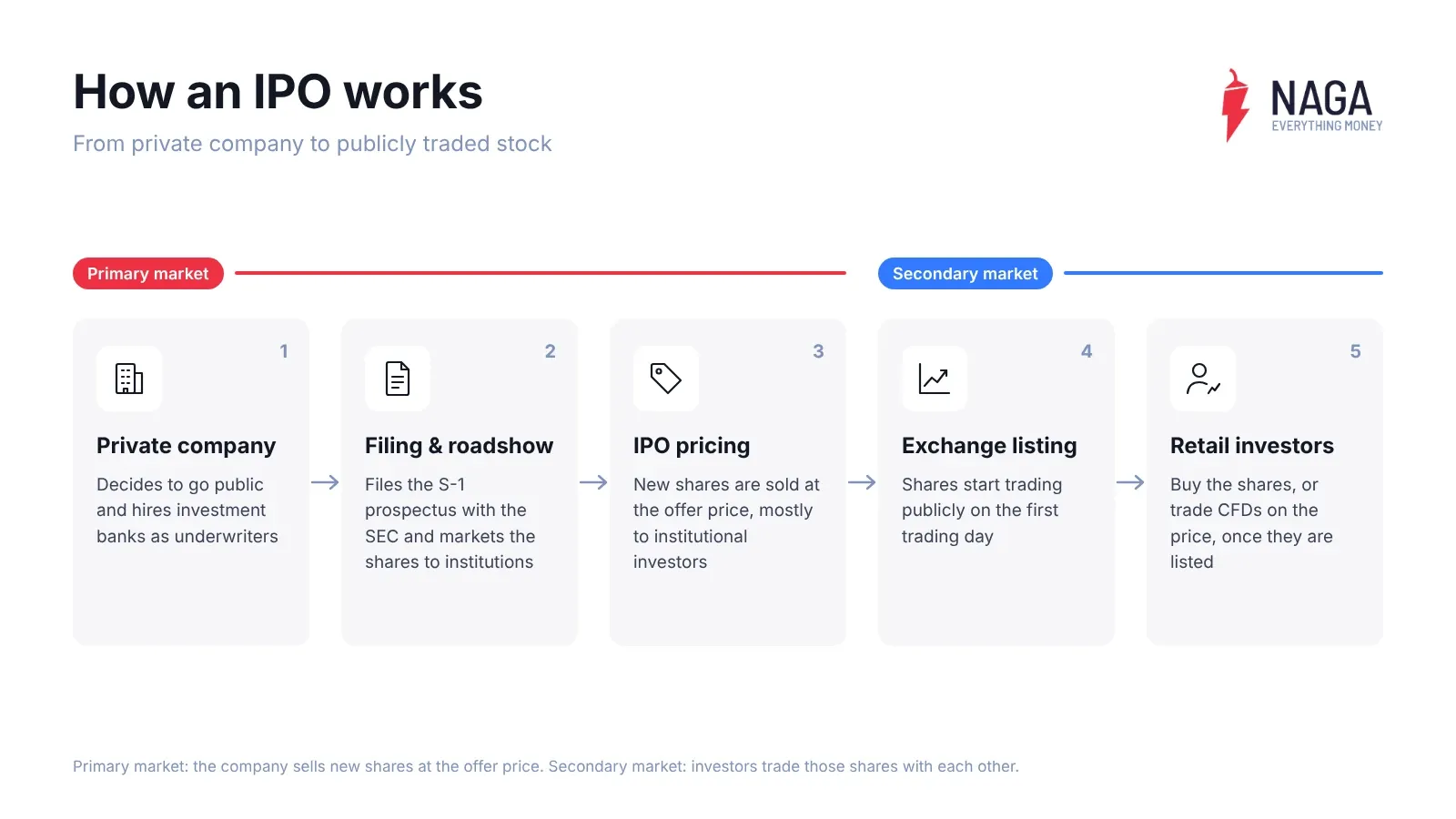
Going public is a challenging, time-consuming process that’s difficult for most companies to navigate alone. A private company planning an IPO needs not only to prepare itself for an exponential increase in public scrutiny but also must file a ton of paperwork and financial disclosures to meet the requirements of the Securities and Exchange Commission (SEC), which oversees public companies.
That’s why a private company that plans to go public hires an underwriter, usually an investment bank, to consult on the IPO and help it set an initial price for the offering. Underwriters help management prepare for an IPO, creating key documents for investors and scheduling meetings with potential investors, called roadshows.
The underwriter puts together a syndicate of investment banking firms to ensure widespread distribution of the new IPO shares. Each investment banking firm in the syndicate will be responsible for distributing a portion of the shares. For example, Goldman Sachs and Morgan Stanley lead a 22-bank syndicate on Anthropic’s planned 2026 IPO.
Once the company and its advisors have set an initial price for the IPO, the underwriter issues shares to investors, and the company’s stock begins trading on a public stock exchange, like the New York Stock Exchange (NYSE) or the Nasdaq.
IPO timeline: from filing to first trade
Most US IPOs follow the same sequence. The time between steps varies, and companies can pause at any point if market conditions turn.
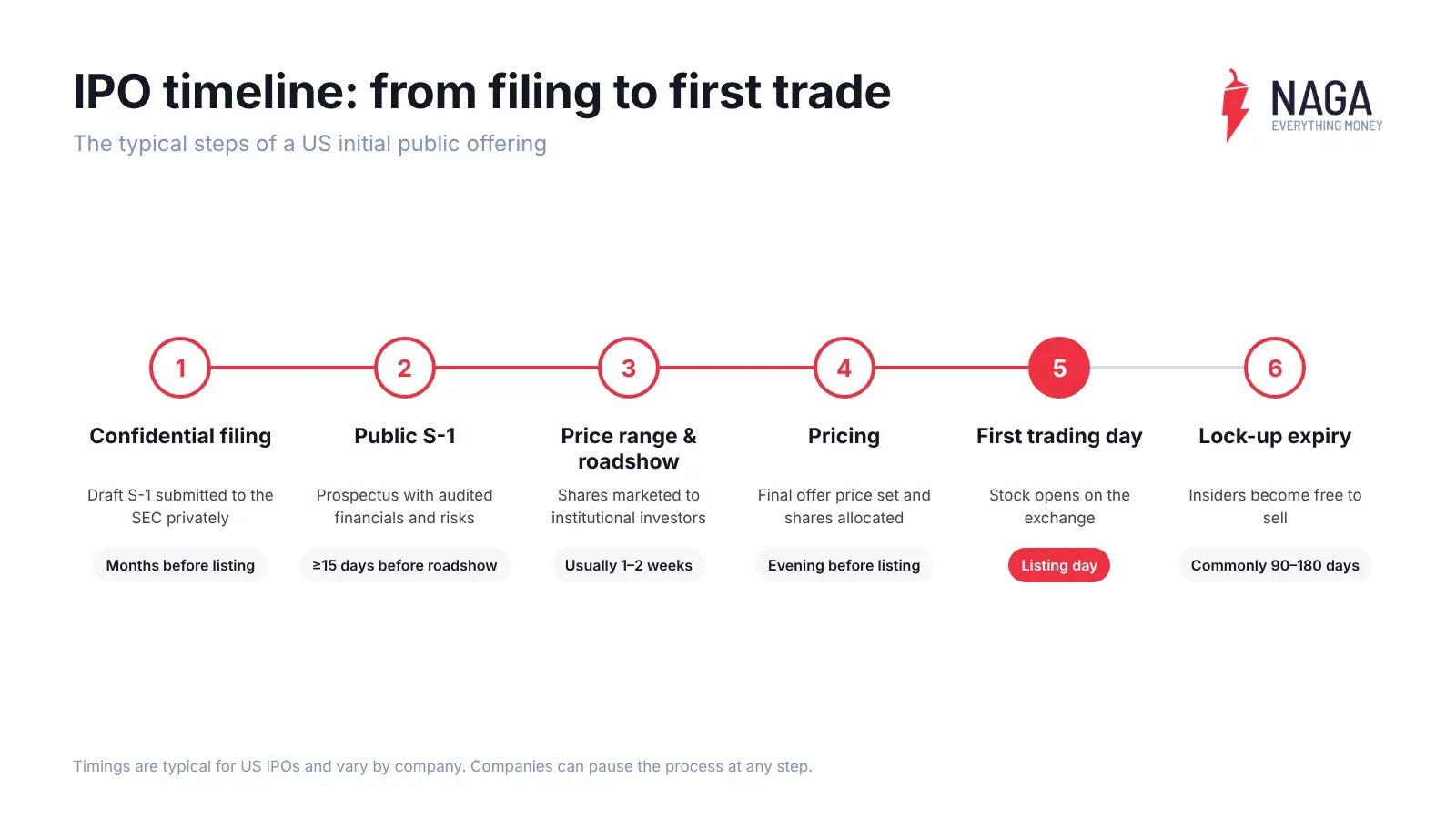
Step What happens Typical timing 1. Confidential filing The company submits a draft registration statement (Form S-1) to the SEC privately. Months before listing; some companies never proceed 2. Public S-1 The prospectus becomes public, with audited financials and risk factors. At least 15 days before the roadshow 3. Price range and roadshow An amended filing sets the price range, and management markets the shares to institutional investors. Usually one to two weeks 4. Pricing The final offer price is set based on demand, and shares are allocated. The evening before the first trade 5. First trading day The stock opens on the exchange, often well away from the offer price. Listing day 6. Lock-up expiry Insiders and pre-IPO investors become free to sell, which can add supply. Commonly 90–180 days
How are IPO prices set?
The company and its underwriters set an initial price range based on the company’s financials, the valuations of listed peers and early feedback from investors. During the roadshow, institutions place orders at different prices, a process called book-building. If demand is strong, the final offer price can be set at the top of the range or above it; if demand is weak, it can be cut. The opening price on the first day is then set by the market and can differ sharply from the offer price.
Why do companies go public?
An IPO may be the first time the public can buy shares in a company, but it’s important to understand that one of the purposes of an initial public offering is to let early investors in the company cash out their investments.
Think of an IPO as the end of one stage in a company’s life cycle and the beginning of another—many of the original investors want to sell their stakes in a new venture or a start-up. Alternatively, investors in more established private companies that are going public also may want the opportunity to sell some or all their shares.
There are other reasons for a company to pursue an IPO, such as raising capital or boosting a company’s public profile:
- Companies can raise additional capital by selling shares to the public. The proceeds may be used to expand the business, fund research and development, or pay off debt.
- Other avenues for raising capital, via venture capitalists, private investors, or bank loans, may be too expensive.
- Going public in an IPO can provide companies with a huge amount of publicity.
- Companies may want the standing and gravitas that often come with being a public company, which may also help them secure better terms from lenders.
While going public might make it easier or cheaper for a company to raise capital, it complicates plenty of other matters. There are disclosure requirements, such as filing quarterly and annual financial reports. They must answer to shareholders, and there are reporting requirements for things like stock trading by senior executives or other moves, like selling assets or considering acquisitions. This is also why many large companies now stay private for longer: Stripe, for example, uses regular tender offers to give employees liquidity without listing.
Pros of IPOs
A successful IPO can raise massive amounts of capital, as becoming listed on a stock exchange can help to increase the exposure and public image of a company. In turn, the firm’s sales and profit can increase. IPOs are also beneficial to traders because it’s easier to buy publicly traded shares than those that only trade privately.
Cons of IPOs
Public companies are subjected to the rules and regulations of a governing body. One of the rules is that it is required to publicly disclose financials, such as accounting information, tax, and profits. IPOs also carry significant costs and could require the company to raise additional funding if its shares perform poorly.
Notable Upcoming IPOs to Watch
2026 has been the biggest year for IPOs in a generation by money raised. According to Renaissance Capital, US issuers priced 114 IPOs raising $147.6 billion through mid-October, more than three times the $44 billion raised in all of 2025. The table below shows some of the most-watched companies preparing to go public. Valuations are private-market marks or reported targets, not IPO prices, and timelines change often. For confirmed dates, price ranges and listing-day updates, use NAGA’s IPO calendar.
Company Sector Latest valuation Expected timing Status Anthropic AI $965bn (May 2026); IPO talk of $1.5–2tn November 2026 (reported) Public S-1 filed; ticker ANT OpenAI AI $852bn (Mar 2026) 2027 Confidential S-1 Databricks Data and AI software $190bn (Aug 2026) 2027 at the earliest No filing Stripe Payments $159bn (Feb 2026 tender offer); no public stock price No date No filing Revolut Digital banking $115bn (Jul 2026 secondary sale) 2028 or later No filing Canva Design software $42bn (2025 share sale) 2027 target No filing Kraken Crypto exchange $20bn (late 2025) Q2 2027 at the earliest Confidential S-1 Visma Business software €19bn 2027 (London) Delayed from 2026 SumUp Payments $10bn+ (reported target) Early 2027 (London) Banks appointed Cohesity Data security $7bn+ (after Veritas merger) No date No IPO price or date yet
Anthropic: the next mega-IPO
Anthropic, the AI company behind the Claude models, filed its S-1 publicly on 26 October 2026 to list on Nasdaq under the ticker ANT, with a debut reported for November. The offering is reported at $75–100 billion, which could make it the largest IPO in history, ahead of SpaceX. Until the first trade, there is no public Anthropic share price.
What 2026’s IPOs teach investors
Several of the year’s biggest listings show how differently new stocks can behave:
- SpaceX (June 2026): the largest IPO ever priced at $135 and closed its first day 19% higher, then fell to about $108 before recovering above its offer price. A strong first day doesn’t rule out sharp swings later.
- Shein (September 2026): listed in Hong Kong at about $26.5 billion, roughly a quarter of its 2022 private valuation, and fell 9% on its debut. A high private valuation doesn’t guarantee a high public one.
- PayPay (March 2026): priced at $16, below its marketed range, but opened at $19. Pricing below the range doesn’t always mean a weak debut.
- Jio Platforms (October 2026): India’s largest IPO was subscribed more than 22 times and listed 21% above its issue price. Strong demand often signals a strong first day, but not necessarily lasting gains.
Key IPO Terms
Like everything in the world of investing and financial markets, initial public offerings have their own special jargon. You’ll want to understand these key IPO terms:
- Common stock. Units of ownership in a public company typically entitle holders to vote on company matters and receive company dividends. When going public, a company offers shares of common stock for sale. Some companies issue several share classes with different voting rights.
- Issue price. The price at which shares of common stock will be sold to investors before an IPO company begins trading on public exchanges. Commonly referred to as the offering price.
- Lot size. The smallest number of shares you can bid for in an IPO. If you want to bid for more shares, you must bid in multiples of the lot size.
- Preliminary prospectus. A document created by the IPO company that discloses information about its business, strategy, historical financial statements, recent financial results, and management. It has red lettering down the left side of the front cover and is sometimes called the “red herring.” In the US, it is part of the registration statement filed with the SEC on Form S-1.
- Price band. The price range in which investors can bid for IPO shares, set by the company and the underwriter. It’s different for each category of investor. For example, qualified institutional buyers might have a different price band than retail investors like you.
- Underwriter. The investment bank manages the offering for the issuing company. The underwriter determines the issue price, publicizes the IPO, and assigns shares to investors.
- Roadshow. Presentations by management and underwriters to institutional investors to build demand before the shares are priced.
- Lock-up period. A period after the IPO, commonly 90 to 180 days, during which insiders and early investors agree not to sell their shares. Its expiry can add selling pressure.
- Greenshoe option. An option that lets underwriters sell up to 15% more shares than planned if demand is strong, which helps stabilise the price after listing.
How to Evaluate Buying an IPO Stock
If you've decided on buying IPO stock, be sure to consider the strengths of the business itself. Ask yourself a few key questions:
- If this business does not grow at a high enough rate to justify its price, what is the reason? What are the probabilities of those failures occurring?
- What are the competitive moats that protect the business? Are there patents, trademarks, key executives, or some other unique factor protecting it?
- What is stopping some other firm from coming in and destroying the attractive economics?
Also, consider your personal level of comfort with the business and how it is run:
- Would you be comfortable owning this business if the stock market were to close for the next five, 10, or 25 years? In other words, is this business model and the company's financial foundation sustainable? Or is obsolescence because of technological advancement or lack of sufficient capital a possibility?
- If the stock falls by 50% due to short-term problems in the business, will you be able to continue holding your shares without any emotional response?
Do your due diligence on the company and its prospects before committing capital. It may be difficult to do, as the company hasn't made a good deal of financial information public to that point, but it's crucial to your success. Start with the prospectus, especially the risk factors, and note the lock-up schedule and the first earnings date, which often bring volatility.
Metrics for judging a successful IPO
The following metrics are used for judging the performance of an IPO:
- Pricing. Whether the IPO priced within, above or below its range, and how many times the offering was oversubscribed.
- Performance against the offer price. How the stock trades relative to the offer price on day one, after 30 days and after the lock-up expires.
- Valuation against peers. Whether the market capitalisation holds up next to comparable listed companies.
Market Capitalization = Stock Price x Total Number of Company’s Outstanding Shares
How to buy or trade IPO stock
- Research the market. Follow the IPO calendar, read the prospectus and watch for the price range and pricing news.
- Open and verify your account in advance. That way, you can act from the first day the stock is available instead of waiting for verification.
- Choose how to take a position once the company is public. Buy the shares for ownership without leverage, or trade CFDs to go long or short with leverage.
- Pick a strategy. Choose whether you want to go long (buy) or go short (sell). Please note that some trading restrictions may apply on initial trading.
- Keep up to date with news and analysis. This can include daily reports and predictions from professional market analysts and external news providers.
To trade CFDs on the price movements of an upcoming IPO after it has passed the process, it's a simple process to register for a live account with us and get started now.
The IPO itself happens in the primary market, where the company sells new shares at the offer price, mostly to institutional investors. Once trading starts, shares change hands in the secondary market, which is where most retail investors buy or trade IPO stocks. Before listing, shares in companies such as Anthropic, OpenAI or Stripe trade only privately, generally among accredited or professional investors.
With us, you can invest in the company’s shares with an Invest account on the secondary market. You can also trade on the company’s share price on the secondary market with derivatives like CFDs.
Buying shares
You can create an Invest account to invest in shares once they’re listed on the stock exchange and available on the platform.
When you’re investing, you’ll pay the full value of the position up front which will give you direct ownership of the company’s stock. This’ll make you a shareholder, and you’ll be eligible to receive any dividends that the company pays and get shareholder voting rights if the company grants them.
Trading derivatives
You can create a Trading account to speculate on a share’s price movements with derivatives like contracts for difference. After the IPO, you can use them to speculate on a stock’s price rising (by going long) and falling (by going short).
You might choose derivatives because they enable you to open a position with leverage, which requires a small deposit (margin) rather than committing the full value of the shares upfront. This can magnify profits and losses, as both will be calculated from the full exposure of the trade, not just the margin you put up as a deposit.
Should You Trade or Invest in the Upcoming IPOs?
As with any type of investing, putting your money into an IPO carries risks—and there are more risks with IPOs than buying shares of established public companies. That’s because there are less data available for private companies, so investors are making decisions with more unknown variables.
Despite all the stories you’ve read about people making bundles of money on IPOs, there are many more that go the other way. In fact, more than 60% of IPOs between 1975 and 2011 saw negative absolute returns after five years. Recent listings show both sides: Shein fell 9% on its first day of trading in 2026, while SpaceX dropped below its offer price within weeks of a record debut before recovering.
Just because a company goes public, doesn’t necessarily mean it’s a good long-term investment.
Conversely, a company might be a worthwhile investment but not at an inflated IPO price. You could buy the best business in the world, but if you overpay for it by 10 times, it’s going to be hard to get your capital back out of it.
Buying IPOs, for most buyers, isn’t investing—it’s pure stock speculation, as many of the shares allocated in the IPO are flipped on the first day. If you really like the stock and plan to hold it as a long-term investment, consider waiting a few weeks or months until the frenzy has disappeared, for example until after the first earnings report and the lock-up expiry.
The Benefits of Buying IPO Stock
The Downsides of IPO Investing
Buying IPO stock can be appealing. A block of common stock bought during an initial public offering has the potential to deliver huge capital gains decades down the line. Even just the annual dividend income of an extraordinarily successful company can exceed the original investment amount, given a few decades' time. Your investment provides capital to the economy, enabling companies that provide real goods and services to grow and expand. Learning how to buy IPO stock can lead to extremely attractive results when conditions are right. The biggest downside for IPO investors is dealing with volatile price fluctuations. It can be hard to stay invested when the value of your shares plummets. Many stockholders don't stay calm when prices tumble. Rather than valuing the business and buying accordingly, they look to the market to inform them. However, in doing so, they fail to understand the difference between intrinsic value and price. Instead, consider whether look-through earnings and dividend growth are growing and poised to stay that way.
The Bottom Line
The late and legendary Benjamin Graham, who was Warren Buffett's investing mentor, decried IPOs as being for neither the faint of heart nor the inexperienced. They're for seasoned investors; the kind who invest for the long haul, aren't swayed by fawning news stories and care more about a stock's fundamentals than its public image.
For the common stock investor, purchasing directly into an IPO is a complicated process, but soon after an IPO, a company's shares are released for the public to buy and sell. If you believe in a company after your research, it may be beneficial to get in on a growing company when the shares are new. To see which companies are about to list, check NAGA’s IPO calendar.
Free resources
Before you start trading and investing in IPO stocks, you should consider using the educational resources we offer like NAGA Academy or a demo trading account. NAGA Academy has lots of free trading and investing courses for you to choose from, and they all tackle a different financial concept or process – like the basics of analysis – to help you to become a better trader or make more-informed investment decisions.
Our demo account is a suitable place for you to learn more about leveraged trading, and you’ll be able to get an intimate understanding of how CFDs work – as well as what it’s like to trade with leverage – before risking real capital. For this reason, a demo account with us is a great tool for investors who are looking to make a transition to leveraged trading.
Sources:
- https://www.cnbc.com/2026/06/12/spacex-ipo-spcx-live-updates.html
- https://www.cnbc.com/2026/08/10/spacex-spcx-stock-ipo-price.html
- https://www.cnbc.com/2026/09/01/shein-ipo-market-debut-hong-kong.html
- https://www.investing.com/news/stock-market-news/paypay-ipo-surges-19-in-nasdaq-debut-valuing-softbankbacked-fintech-at-147b-4557914
- https://www.ifre.com/equities/2505731/anthropic-takes-to-stormy-waters-with-us100bn-sink-or-swim-ipo