



Until the first trade, Anthropic remains a private company: there is no public Anthropic share price yet, and retail investors cannot buy the stock on an exchange. Once trading begins, investors in the European Economic Area will typically have four routes to exposure — buying the shares, trading their price movements via CFDs, holding ETFs that own Anthropic or its backers, or investing in listed companies connected to its growth.
This guide explains how each route works, what it costs and what can go wrong, from shareholder rights and EU leverage limits to which ETFs European investors can actually access.
Investing in Anthropic Stock – Summary
Anthropic filed its S-1 publicly on 26 October 2026, proposing ticker ANT on Nasdaq. No price range or listing date yet — press reports point to a roadshow from the week of 9 November. The last private round valued the company at $965 billion (May 2026), with reported investor expectations ranging from about $1.5 trillion to $2 trillion; nothing is set until pricing.
- Buy shares: full ownership, no leverage, suited to long-term investors. Class A shares carry limited voting influence.
- Trade CFDs: go long or short with leverage capped at 1:5 for retail clients on share CFDs under EU rules.
- ETFs: AI and tech ETFs could add ANT in the first days or weeks after listing; UCITS Nasdaq-100 trackers could add ANT if it qualifies the index’s fast-entry rule.
- Proxies: Amazon and Alphabet are Anthropic’s largest backers; Microsoft, Nvidia and SpaceX are computing partners.
Once ANT starts trading, you can act on it with NAGA — a €250 minimum first deposit, shares and CFDs from the same account, up to 2.4% APY on idle EUR cash with NAGA Earn while you wait, and Autocopy to mirror lead traders automatically.
Can you buy Anthropic stock before the IPO?
Not through a regular brokerage account. Before listing, Anthropic shares change hands only in private transactions — employee share sales and secondary-market platforms such as Forge Global and Nasdaq Private Market, which are generally limited to accredited or professional investors and come with high minimums, transfer restrictions and prices that can differ widely from the eventual IPO. At the IPO itself, the underwriting banks led by Goldman Sachs and Morgan Stanley allocate shares at the offer price, mostly to institutional investors.
Some platforms also market “tokenized” or synthetic pre-IPO exposure. These products usually give a claim on a special-purpose vehicle or a derivative contract rather than Anthropic stock itself, and their prices can diverge sharply from the listing price. For most retail investors, the realistic starting point is the first day of public trading; the Anthropic IPO report tracks the latest status of that date.
4 ways to invest in Anthropic: shares, CFDs, ETFs and proxies
Each route gives a different kind of exposure to the same company. Owning Anthropic shares makes you a part-owner; a CFD tracks the price without ownership; an ETF spreads the bet across many holdings; and a proxy stock gives indirect exposure through a company that owns part of Anthropic or sells its computing capacity. The table below compares the four ways to invest in Anthropic stock:
Buy shares Trade CFDs ETFs Proxy stocks What you own Anthropic Class A shares A contract on the price Fund units Shares of another company Leverage None Up to 1:5 (EU retail, shares) None (ETF CFDs: leveraged) None Profit from falls? No Yes (go short) No No Anthropic exposure Direct, 100% Direct, price only Partial; depends on weighting Indirect, diluted Typical horizon Long term Short to medium term Medium to long term Long term Main costs Commission/FX where applicable Spread, overnight financing Fund fees, spread Commission/FX where applicable Key risk IPO volatility, concentration Leverage magnifies losses Diluted exposure, tracking Anthropic is a small part of value
The right choice depends on your time horizon, risk tolerance and whether you want ownership or price exposure. The sections below explain each route in turn, starting with owning the shares outright.
Option 1: Buy Anthropic shares and own the stock
Buying Anthropic shares is the most direct way to participate in the company’s growth: once ANT lists on Nasdaq, each share is a slice of ownership in Anthropic, PBC, with no leverage and no expiry. Gains and losses follow the share price one-for-one, and the most you can lose is the amount invested.
How Anthropic share ownership works on NAGA
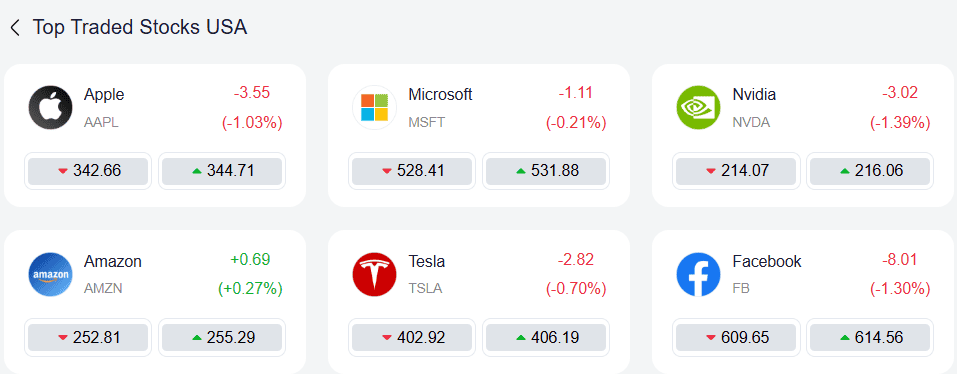
If Anthropic becomes available on the NAGA platform after public trading begins, clients may be able to buy it as a real stock, alongside more than 3,000 real stocks offered. ANT will be quoted in US dollars, so EUR accounts incur a currency conversion. The minimum order size will appear in the order ticket once the instrument is listed.
What Class A shareholders do and don’t control
Anthropic is a public benefit corporation, which legally requires its board to balance shareholder returns with its stated mission. According to the S-1, a Long-Term Benefit Trust elects a majority of the board and a founders’ entity holds 50.1% of voting power, so Class A shareholders buying on the market will have limited influence over key decisions. Growth-stage companies of this kind typically reinvest earnings rather than pay dividends; the dividend-policy section of the S-1 is the place to confirm Anthropic’s stance.
Ownership suits investors who want long-term exposure and can tolerate large swings in the early months of trading, when price discovery, index-fund buying and insider lock-up expiries can all move the stock. Traders who want to act on those swings in either direction usually look at Contracts for Difference (CFDs) instead.
Option 2: Trade Anthropic stock with CFDs
A contract for difference (CFD) on Anthropic would let you speculate on ANT’s price without owning the shares. You can open a long (buy) position if you expect the price to rise or a short (sell) position if you expect it to fall, and the CFD settles in cash on the difference between the opening and closing price.
Anthropic CFD leverage, margin and minimums
Under the EU product-intervention rules applied by CySEC, retail clients can trade single-stock CFDs with leverage of up to 1:5, which means a margin of 20% of the position value. A position worth €1,000 would require €200 of margin; a 10% move in ANT would then change the position’s value by €100 — half of the margin committed. Newly listed stocks can carry higher margin requirements in their first sessions due to volatility.
Condition Anthropic CFD on NAGA (retail, EEA) Maximum leverage Up to 1:5 (20% margin), per EU rules for share CFDs Minimum first deposit €250 Minimum trade size Per ANT contract specification, shown in the order ticket Direction Long or short Costs Spread; overnight financing on positions held past the daily cut-off; zero commission per trade Protections Negative balance protection; margin close-out at 50% of required margin
These conditions apply once Anthropic CFDs are made available on NAGA; final specifications are published with the instrument.
Costs and risks of trading a newly listed stock
The first days of a mega-IPO tend to bring wide spreads at the open, sharp intraday swings and price gaps between sessions. SpaceX, the largest IPO before Anthropic, closed its first Nasdaq session 19% above its $135 offer price in June 2026 and later traded below it. Leverage magnifies both outcomes, and overnight financing adds a cost to every day a position stays open, which makes CFDs better suited to short- and medium-term trading than to buy-and-hold.
CFDs are complex instruments and come with a high risk of losing money rapidly due to leverage. 77.41% of retail investor accounts lose money when trading CFDs with this provider. You should consider whether you understand how CFD trading works and whether you can afford to take the high risk of losing your money. Traders who prefer diversified exposure without leverage often turn to ETFs.
Option 3: Invest in ETFs with Anthropic exposure
ETF exposure to Anthropic comes in two very different forms: funds that already hold private Anthropic shares, and funds that hold Anthropic’s backers and suppliers — or would add ANT once it is listed and meets index rules. For investors in the EEA, the distinction decides what is actually accessible.
US funds holding pre-IPO Anthropic shares
A handful of US-listed funds report direct Anthropic stakes. Weightings change frequently and are drawn from fund disclosures compiled by third parties, so treat the figures below as approximate snapshots from August–October 2026.
Fund Type Reported Anthropic weight Points to note Destiny Tech100 (DXYZ) Closed-end fund, NYSE ~14–18% of NAV Can trade at large premiums or discounts to NAV; 2.5% fee Tema Photonics & Optical ETF (LAZR) ETF ~9% Anthropic held via an SPV; AI infrastructure focus KraneShares AI & Technology ETF (AGIX) Active ETF ~3% 0.99% expense ratio ARK Venture Fund (ARKVX) Interval fund ~2–4% Limited redemptions; 2.9% net fee iShares A.I. Innovation and Tech Active ETF (BAI) Active ETF ~0.75% Small satellite position
These funds are generally not available to retail investors, because US-domiciled funds typically do not publish the PRIIPs Key Information Document that EU rules require for retail distribution. They also illustrate a common trade-off of pre-IPO funds: high fees, valuation opacity and prices that can move far from the value of the underlying holdings.
How to trade and invest in ETFs
AI, tech and UCITS ETFs that most investors can access
For most investors, the practical ETF route runs through mainstream AI, technology, and index funds. These funds already hold Anthropic's listed backers and suppliers and could hold ANT itself after the listing. The most direct path is the Nasdaq-100. Under a fast-entry rule in force since 1 May 2026, a new Nasdaq listing that ranks within the index's top 40 by market value on its seventh trading day can join after 15 trading days. SpaceX joined the Nasdaq-100 this way on 7 July 2026. If Anthropic qualifies, ETFs tracking the Nasdaq-100 would buy ANT as part of their benchmark, both US-listed funds such as QQQ and their European UCITS versions.
ETF category UCITS examples US-listed examples Link to Anthropic Would it hold ANT? Nasdaq-100 trackers iShares Nasdaq 100 UCITS ETF; Invesco EQQQ Nasdaq-100 UCITS ETF Invesco QQQ Trust (QQQ); Invesco Nasdaq 100 ETF (QQQM) Hold Amazon, Alphabet, Microsoft, Nvidia Likely, if ANT qualifies for fast entry Broad market trackers S&P 500 and MSCI World UCITS ETFs SPDR S&P 500 (SPY); Vanguard S&P 500 (VOO) Hold Anthropic's backers Later: S&P 500 requires 12 months of trading history Technology sector Xtrackers MSCI World Information Technology UCITS ETF; iShares S&P 500 Information Technology Sector UCITS ETF Technology Select Sector SPDR (XLK); Vanguard Information Technology (VGT) Hold Microsoft, Nvidia and other suppliers Later, once ANT joins the underlying S&P or MSCI index AI thematic Xtrackers Artificial Intelligence & Big Data UCITS ETF; WisdomTree Artificial Intelligence UCITS ETF; L&G Artificial Intelligence UCITS ETF Global X Artificial Intelligence & Technology (AIQ); Global X Robotics & AI (BOTZ); Roundhill Generative AI & Technology (CHAT) AI software and infrastructure Possibly, depending on each fund's index or mandate Semiconductors and cloud VanEck Semiconductor UCITS ETF; WisdomTree Cloud Computing UCITS ETF VanEck Semiconductor (SMH); First Trust Cloud Computing (SKYY) Chips and cloud capacity Anthropic buys Unlikely (sector mismatch)
How you can access these funds depends on where you live. NAGA offers ETFs both as real ETFs and as ETF CFDs. Investors who want exposure that doesn't depend on index rules at all can look at the listed companies standing behind Anthropic.
Option 4: Anthropic stock alternatives and proxy stocks
Several listed companies are tied to Anthropic as shareholders, cloud providers or suppliers, which means their shares already carry some Anthropic exposure. The trade-off is dilution: Anthropic is a small part of each company’s overall value, so these stocks move mainly on their own businesses.
Who owns Anthropic: Amazon, Alphabet and other backers
Amazon is Anthropic’s largest strategic backer and primary cloud partner. It added $5 billion in April 2026, with up to $20 billion more tied to milestones, and press reports value its total stake at around $190 billion; Anthropic, in turn, has reportedly committed more than $100 billion to Amazon Web Services over ten years. Alphabet is also a major investor, and Anthropic has reportedly committed about $200 billion to Google Cloud and Google’s chips over five years — UBS estimates Anthropic alone could pay Google around $76 billion in 2027.
Microsoft and Nvidia joined in November 2025 with commitments of up to $5 billion and up to $10 billion respectively, alongside a $30 billion Anthropic commitment to Microsoft Azure. SpaceX, listed on Nasdaq since June 2026, is a compute supplier: its own S-1 disclosed that Anthropic pays $1.25 billion a month for access to the Colossus 1 data centre. Each of these companies gives indirect exposure to Anthropic’s growth — and to its spending.
NAGA Group (N4G0): a broker tied to IPO trading activity
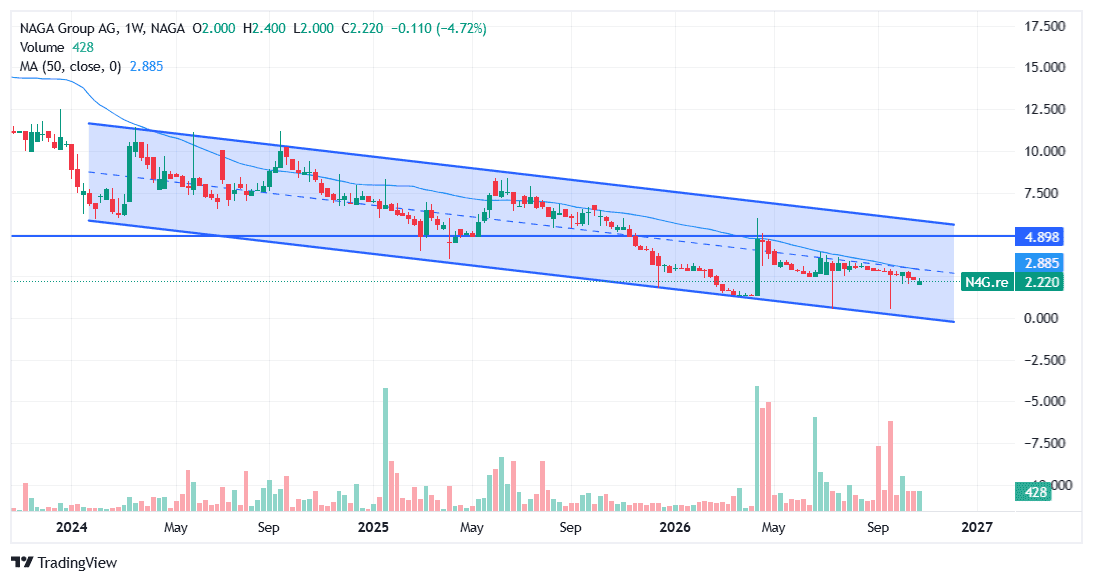
A less obvious angle is the brokers that serve the trading activity mega-IPOs generate. The NAGA Group AG (Xetra: N4G0, ISIN DE000A41YCM0), the listed company behind the NAGA platform, offers both real shares and CFDs, and its revenue has historically been sensitive to client trading activity. Major listings such as SpaceX and Anthropic can lift engagement across retail platforms, although there is no guarantee they translate into revenue.
The group describes an AI-first strategy: in Q1 2026, AI-supported customer service resolved about 66% of chat interactions without human involvement. In the first half of 2026, NAGA reported its first profitable half-year, with revenue of €27.7 million (down 14% year on year), EBITDA of €4.5 million and net profit of €1.1 million in final figures, and it maintained FY 2026 guidance of €68–75 million revenue and €10–15 million EBITDA. N4G0 is a small-cap stock with limited trading liquidity and has been highly volatile, and the full-year guidance requires a significantly stronger second half.
Past performance is not indicative of future results.
Disclosure
KEY WAY MARKETS LTD, the publisher of this article, is a subsidiary of The NAGA Group AG. This section is provided for information only and does not constitute an investment recommendation regarding N4G0 shares.
For more listings beyond Anthropic, NAGA’s IPO calendar tracks upcoming IPOs and recently listed AI companies such as Cerebras Systems. Whichever route you choose, valuation is the variable that matters most — and the one that is still being set.
Anthropic IPO price prediction and valuation outlook
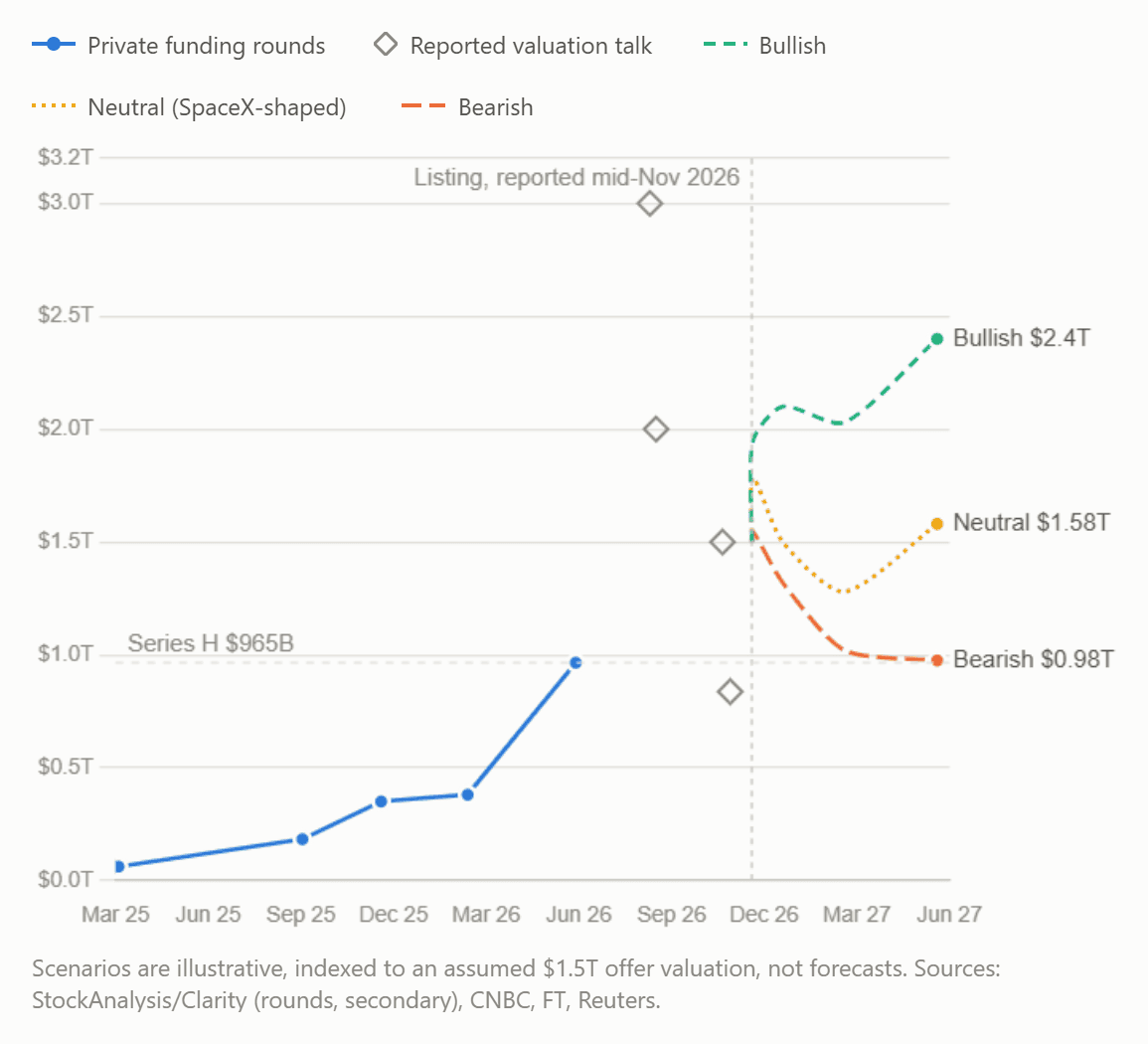
Anthropic has not published a price range, so any Anthropic IPO price prediction starts from valuation. The company’s private valuation rose about 16-fold in 15 months, from $61.5 billion in March 2025 to $965 billion in May 2026. Since then, reported IPO valuation talk has ranged from about $0.84 trillion to $3 trillion. The chart below maps that path and three illustrative scenarios for the first six months of trading.
The scenarios are illustrative and are not NAGA forecasts. They show how the same listing could play out under different conditions, using reference points investors can check for themselves.
How Anthropic valuation expectations shifted in 2026
Each funding round repriced the company sharply. Series F valued it at $183 billion in September 2025, Series G at $380 billion in February 2026, and Series H at $965 billion in May 2026. In August, the Financial Times reported that backers expected about $2 trillion at listing, and one investor argued that 30 times revenue implied $3 trillion. In October, Reuters reported that some investors were discussing about $1.5 trillion, citing slower recent revenue growth.
Secondary-market pricing tells a more cautious story. Trading data compiled by Clarity implied a valuation of about $0.84 trillion on 27 October 2026, below the last private round. Implied values differ widely across platforms and share classes, but the gap between that figure and the $2–3 trillion headlines shows how much price discovery is still ahead.
Anthropic stock after listing: bullish, neutral and bearish
All three scenarios start from an assumed offer valuation of $1.5 trillion, the most recent reported figure. Each is measured at the same three checkpoints:
- the first trading day;
- the Nasdaq-100 fast-entry window, about 15 trading days after listing;
- the first earnings report and any staged lock-up release, about three months in.
Scenario Day 1 +1 month +3 months +6 months What has to happen Bullish +30% +40% +35% +60% (~$2.4T) Oversubscribed book, buying from index funds at fast entry, Q4 results confirming the $100–120B annualised revenue backers expect, lock-up supply absorbed Neutral +19% 0% −15% +5% (~$1.58T) The SpaceX pattern: first-day pop, back to the offer price within weeks, a dip around earnings and lock-up, then a recovery Bearish +3% −12% −32% −35% (~$0.98T) AI sentiment cools, concerns over compute costs and customer concentration dominate, and lock-up selling pushes the valuation back to the Series H level
The neutral case follows the most recent precedent. SpaceX priced at $135 in June 2026, closed its first day 19% higher, and joined the Nasdaq-100 on 7 July. It fell below its offer price within about five weeks. It hit a low near $108 on 5 August, around its first earnings and the unlock of more than 900 million shares, and was back above $135 by early September. If Anthropic prices at $2 trillion instead of $1.5 trillion, multiply each six-month outcome by 1.33: about $3.2T bullish, $2.1T neutral and $1.3T bearish.
— Frank Walbaum, market analyst at NAGA
These figures are third-party estimates and illustrative scenarios. They will change once the price range, final offer price and first trading data are published. Past performance of other IPOs, including SpaceX, is not a reliable indicator of how ANT will trade.
Market forecasts and price predictions
Risks to weigh before investing in Anthropic stock
The route you choose adds its own risks on top of the company’s. CFDs add leverage and financing costs. Pre-IPO funds add fees and can trade at premiums to their net asset value. Proxy stocks dilute exposure. Every route priced in dollars adds currency risk for euro-based investors. Concentrating a large share of an investment portfolio in a single newly listed stock magnifies all of these risks.
At company level, the S-1 highlights several risks:
- a valuation that sets very high expectations;
- enormous and largely long-term compute commitments;
- revenue concentrated in a small number of customers;
- intense competition from OpenAI, Google and others;
- a governance structure that limits Class A shareholders’ influence.
None of these rules the stock out, but it does make risk management part of the plan from the start. Investors typically limit any single new listing to a small share of their portfolio, add to a position in stages rather than all on day one, and set stop-loss orders before volatility arrives. CFDs also allow short positions, which serve two purposes:
- Hedging: an investor who holds Anthropic shares, or proxy stocks such as Amazon and Alphabet, can open a short CFD to offset part of the downside during volatile periods such as the first earnings report or a lock-up expiry. Nothing has to be sold.
- Speculation: a short-term trader can short ANT on the view that the listing price has run ahead of fundamentals.
A demo account lets you practice both long and short strategies with virtual funds before committing real capital.
How to invest in Anthropic with NAGA, step by step
Setting up an account before the listing means you can act once ANT is available on the platform, rather than waiting for verification on the day.
- Create your NAGA account. Register on the website or the NAGA app in a few minutes.
- Verify your identity. Complete the KYC checks and the assessment required before trading CFDs.
- Make your first deposit. The minimum first deposit is €250, which also qualifies the account for the IRON VIP level.
- Choose how to invest. Decide between real shares (ownership, no leverage), CFDs (long or short, leverage up to 1:5) or ETFs.
- Find Anthropic once it is available. After public trading begins and the instrument is added, search for Anthropic or ANT, choose your order type and size, and set a stop-loss to manage risk.

