



Japan is one of the most technologically advanced nations in the world and one of the biggest economies, with the largest GDP after the United States and China in nominal terms. Japan enjoys technological advancements in some of the most complex industries in the world, and it is one of the few countries in the world that can manufacture its own semiconductors.
It has been among the top-performing markets in 2025, with its record gains towards the 5,000 points level (+25%) accompanied by increased buying by foreign investors including Warren Buffett. Institutional investors like Goldman Sachs believe the case for a bull run is solid and should continue. But which are the best Japanese stocks to buy in 2026 for institutional investors and market analysts?
How to Trade and Invest in the Best Japanese Stocks – Quick Guide
- Direct Investment: Buy shares of top Japanese companies such as Toyota, Sony, and Honda listed as American Depositary Receipts (ADRs) on the NYSE and NASDAQ.
- Trading CFDs: Speculate on price movements of the best-performing Japanese stocks or indices like NIKKEI 225 with leverage through CFDs, which allow for both long and short positions.
- ETFs and Index Funds: Diversify risk with focused ETFs tracking the best Japanese stocks and sectors, like the iShares MSCI Japan ETF or iShares MSCI Japan ESG Enhanced CTB.
- Social trading: Leverage NAGA’s social trading platform to follow expert traders specialising in Asian markets and copy their moves in real-time.
Japanese stocks have continued to reach new highs into 2026 – but why?
The Nikkei 225 surged to record levels in early 2026, extending the rally that began in 2024 and 2025, as Japanese equities continued to attract strong investor demand, outperforming US markets and European stocks. amid shifting global monetary conditions and improved domestic fundamentals.
A key factor has been the Bank of Japan’s gradual shift away from decades of ultra-loose monetary policy, keeping interest rates elevated at around 0.75% and signaling the possibility of further tightening as inflation dynamics evolve.
Another major driver is strong foreign investor interest. Notably, Warren Buffett’s Berkshire Hathaway has significantly increased and now holds large stakes in Japan’s major trading companies, helping validate global confidence in Japanese equities.
The landslide victory of Liberal Democratic Party leader Sanae Takaichi in the 2026 general election, along with her policy agenda focused on fiscal expansion and business-friendly reforms, has further boosted expectations for domestic growth and investment.
This renewed interest in Japanese equities reflects key considerations including shifting monetary policy, improved corporate governance attracting international capital, and strong political backing for economic stimulus.
Japanese stocks are under-valued
First, Japanese stocks currently offer good relative value after significantly underperforming the US market for decades. For instance, according to Barclays’ calculations of cyclically-adjusted p/e (CAPE) ratios, Japanese stocks are currently cheap in comparison to U.S. stocks, having previously been significantly more costly. Japanese companies recognize this, and the corporate sector has been the largest net buyer of Japanese stocks.
Yen weakens to historic levels
The Japanese yen has depreciated sharply against the US dollar since 2022, improving the international competitiveness of Japanese companies. Despite a brief appreciation in early 2025, the currency weakened again in late 2025 and early 2026, trading back above 150 per dollar. The yen remains relatively undervalued on a purchasing power parity basis, partly because Japan’s inflation rate has generally remained lower than that of the United States.
Tensions between the U.S and China
Japan is benefiting from heightened tensions between the U.S. and China, which have caused international investors to diversify away from it. Accordingly, some investors view Japan as a safe way to play China’s growth. Financial Times notes that seven of the world’s largest semiconductor makers have made plans to increase manufacturing and deepen tech partnerships in Japan.
So, will the best-performing stocks in Japan continue to perform in 2026?
Should investors continue to buy the best-performing Japanese stocks in 2026?
Leading banks and market experts maintain a cautiously optimistic outlook for the Japanese stock market in 2026. Many forecasts expect Japan’s real GDP growth to remain modest but positive — around 0.7% for 2026, supported by fiscal stimulus and domestic demand, even as external headwinds persist. Strategic analysts also point to continued improvements in corporate governance and attractive valuations as key drivers for long-term equity performance.
Regarding monetary policy, the Bank of Japan has kept its policy rate elevated near 0.75% and is widely expected to edge toward around 1.0% by late 2026 if inflation remains persistent, a stance seen by many as supportive of market confidence and currency stability. Earnings forecasts remain generally positive, with top Japanese corporates expected to deliver mid-to-high single-digit to low double-digit profit growth in the fiscal year 2025/2026, reflecting stronger pricing power and operational resilience.
Price-earnings ratios in Japan’s benchmark indices are viewed as reasonable relative to other major markets, and analysts projecting the Nikkei 225 trading in the range of roughly 55,000 to even 60,000 points by year-end — a reflection of rising investor confidence and expanding earnings expectations.
That said, some experts warn that further monetary tightening or geopolitical risks could introduce volatility. Overall, the consensus points to steady market gains in 2026, driven by macro stability, fiscal clarity, and expanding foreign investor participation, with risks concentrated around policy shifts and global economic conditions.
Strategists at Goldman Sachs believe the case for a bull run is solid, and they are recommending Japanese stocks to investors. However, many institutional investors, including BlackRock, the world’s biggest asset manager, are not convinced this marks a fundamental turning point.
How to Enter the Japanese Markets?
There are at least four ways a foreigner can get exposure to the Japanese markets:
Indexes of Japanese stock markets. The most widely quoted index in the international financial media is the Nikkei 225 (JAPAN225), which tracks the 225 largest companies based in Japan. Japanese stocks listed on the TSE or on the US Stock Exchanges via ADRs. An American Depository Receipt (ADR) is a negotiable certificate that represents a share or several shares in a foreign company. Exchange-traded funds (ETFs) that focus on Japanese stocks. There are many to choose from, from the largest providers like iShares, Vanguard, and State Street SPDR. Japanese YEN, a popular safe haven asset. The Yen is one of the world's most-traded currencies on the FX market, with USD/JPY the second-most traded currency pair globally.
Japanese Stock Indices
There are millions of investors interested in allocating part of their capital to Japan, so there is a big incentive for companies to create and promote stock market indexes.
The important thing when it comes to using a stock market index is not necessarily who calculates it, although this is a fact that we will mention. What is most important is knowing how it is calculated. This includes things such as how many companies are included in an index, what criteria are used to select them, and how those companies are weighed. That information will allow you to identify the index that best suits your needs.
Nikkei 225
The Nikkei Index (also referred to as the Nikkei 225) is a stock market that lists the 225 largest companies based in Japan. The featured stocks on the index are weighted based on the share price.
As the main Japanese stock market index traded on the Tokyo Stock Exchange (JPX), the Nikkei 225’s performance is representative of what’s happening in the local economy. Due to the size of the Japanese economy and its position on the continent, the Nikkei 225 index can be a useful indicator of market sentiments in the Asian markets.
The companies listed on the Nikkei 225 index include global brands such as Sony, Canon, Toyota, Nissan, and many others. The 225 companies are spread out over 35 industries, with each stock measured based on its performance.
A very curious feature of the Nikkei 225 is that, unlike most other global stock indexes, it weights companies based on their price, instead of their market capitalization or market capitalization adjusted for free float. As a result, the size of a company has no impact whatsoever on how important the stock will be within the index.
With NAGA.com, you can trade the NIKKEI 225 Index with the symbol Japan225 CFD (contracts for difference) which allows you to trade long and short.
Other top Stock Market Indexes in Japan
Nikkei publishes additional stock indexes for the Japanese stock market. Two of them are Nikkei 300 and JPX Nikkei 400.
Nikkei 300 weights its companies based on their market capitalization, that is, how big they are. This means that larger companies receive a higher weighting within the index.
The JPX Nikkei 400 is composed of 400 of the 1,000 largest and most liquid companies traded on the Tokyo Stock Exchange. These 400 companies are selected based on a few criteria, such as their market capitalization, their return on equity, as well as their accumulated operating profits.
The Tokyo Stock Exchange also calculates the Tokyo Stock Exchange REIT index. It is composed of all real estate companies listed on the Tokyo Stock Exchange that are incorporated in the form of Real Estate Investment Trusts (REITs).
Popular Japanese Stocks to Watch in 2026
With the current economic situation in Japan laid out, it is now time to look at some of the best Japanese stocks to watch in 2026 and beyond. Please be advised that the list of best Japanese stocks is subjective and may differ for each individual investor:
Today, we'll look at some top Japanese stocks to invest in, with the notable picks being Toyota Motor Corporation (TM), Sony Group Corporation SONY), and Honda Motors (TM).
Toyota (TM) – The Largest Japanese Stock by Market Cap
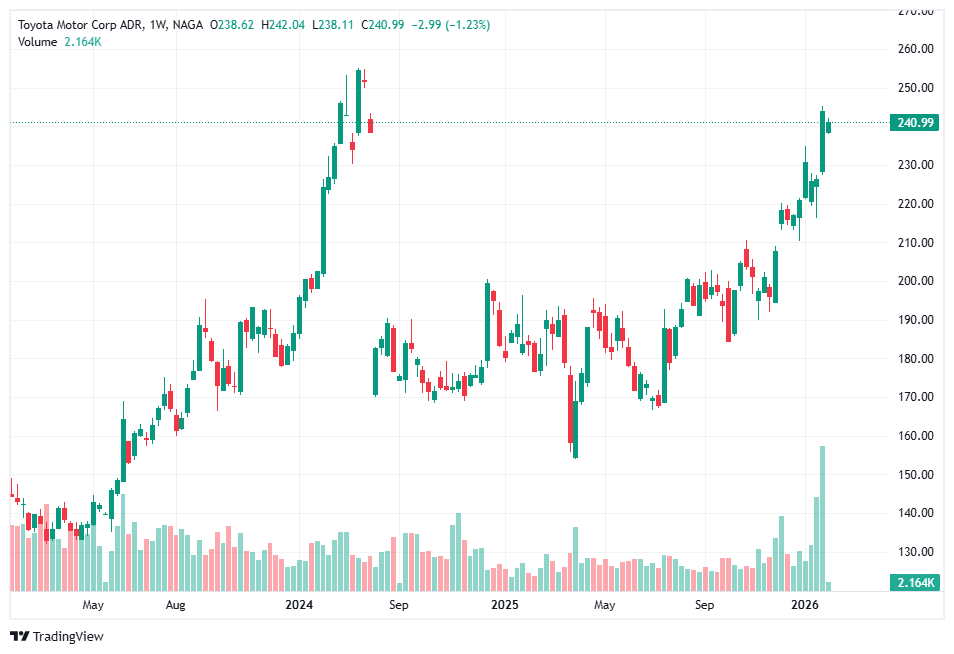
Toyota remains Japan’s flagship automaker and one of the world’s most profitable car manufacturers. The company continues to benefit from its global scale, strong hybrid vehicle leadership, and disciplined cost control. Unlike many peers, Toyota has maintained a cautious but commercially successful electrification strategy and is ranked among the top EV stocks, prioritizing hybrids while investing heavily in next-generation technologies such as solid-state batteries.
Past performance is not a reliable indicator of future results. All historical data, including but not limited to returns, volatility, and other performance metrics, should not be construed as a guarantee of future performance.
A weaker yen continues to support Toyota’s export margins, while shareholder returns have improved through higher dividends and share buybacks. Toyota’s balance sheet strength and diversified geographic exposure position it well in a more normalized global interest-rate environment.
Toyota’s 2026 outlook
Analyst price expectations: broadly range between $240–280 (ADR) during 2026, assuming stable global auto demand Dividend outlook: expected dividend yield around 2.5–3.0%, supported by strong free cash flow Key driver: earnings resilience and continued capital returns rather than aggressive EV expansion
SONY (SNE) – One of the Best Japanese Stocks to Watch in 2026
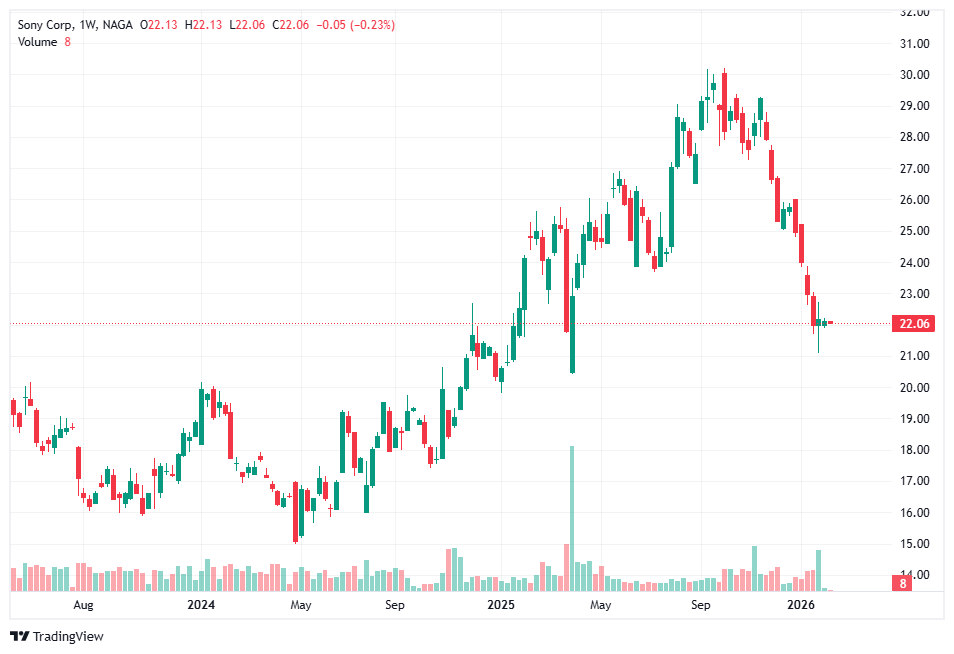
Sony continues to stand out among Japanese equities due to its highly diversified business model. While hardware sales in gaming can be cyclical, Sony benefits from recurring revenues through PlayStation Network services, a dominant image sensor business, and a growing global music and content portfolio.
Past performance is not a reliable indicator of future results. All historical data, including but not limited to returns, volatility, and other performance metrics, should not be construed as a guarantee of future performance.
Additionally, SONY is strategically expanding its market share in the thriving business of camera smartphones by acquiring additional land near its image sensor factory in Kumamoto prefecture, Japan. However, SONY’s optimism about the future seems to overlook the uncertainties and risks associated with the smartphone market. The company has also increased its focus on higher-margin segments such as imaging solutions and digital entertainment, helping stabilize earnings despite fluctuations in consumer electronics demand. Sony’s exposure to both technology and media trends provides investors with a blend of growth and defensive characteristics.
SONY’s 2026 outlook
Analyst price expectations: generally cluster in the $30–33 range (ADR) for 2026 Dividend outlook: modest but stable, with yields around 0.6–0.9%, supplemented by occasional share buybacks Key driver: growth in image sensors and digital services rather than console unit sales alone
Honda (HMC) – One of the Most Undervalued Japanese Stocks
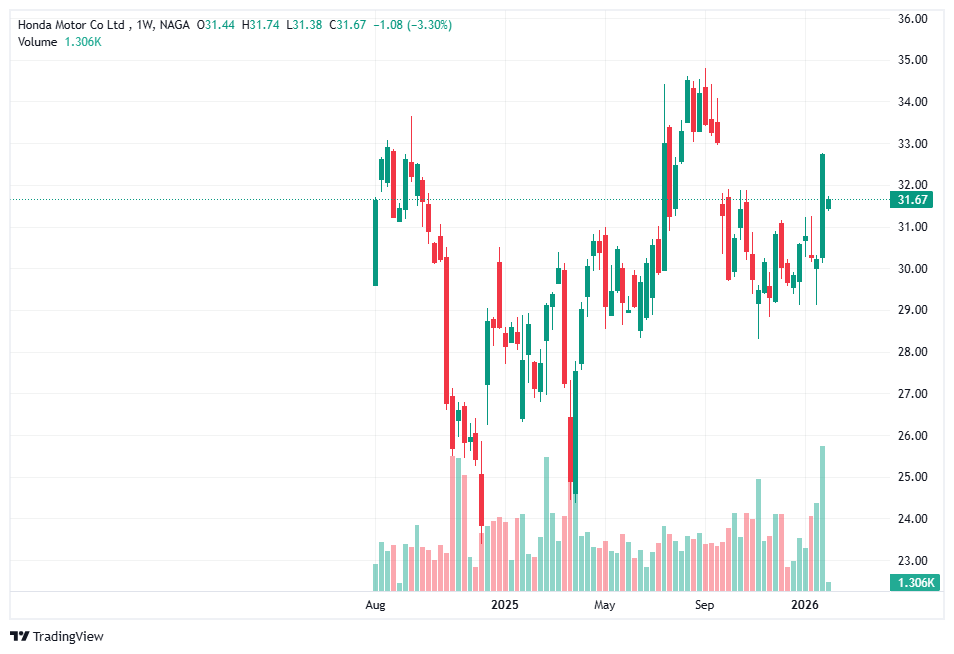
Honda has increasingly been viewed as one of the more undervalued Japanese automakers, trading at lower valuation multiples than Toyota while maintaining solid profitability. While its automotive division has faced mixed performance, Honda’s motorcycle business continues to deliver strong growth, particularly in emerging markets across Asia.
Past performance is not a reliable indicator of future results. All historical data, including but not limited to returns, volatility, and other performance metrics, should not be construed as a guarantee of future performance.
Improving supply chains, easing cost pressures, and disciplined capital spending have supported margins. Honda is also accelerating its electrification roadmap, with long-term investments aimed at expanding its EV lineup toward the end of the decade.
Honda's 2026 outlook
Analyst price expectations: typically range between $35–38 (ADR) during 2026 Dividend outlook: relatively attractive, with expected yields around 3.0–3.5% Key driver: margin recovery and steady demand rather than rapid EV penetration
With NAGA.com you can trade Toyota, Sony, or Honda stocks with a CFD account or buy shares of stocks with an Invest Account.
Other Top Japanese Stocks
Mitsubishi UFJ Financial Group, Inc. (NYSE: MUFG) is one of Japan’s largest banks by total assets and remains a key beneficiary of Japan’s gradual shift away from ultra-loose monetary policy. Higher interest rates have improved net interest margins, while the bank continues to strengthen its global presence through overseas lending and capital markets activity. MUFG is often viewed as a core play on Japan’s evolving banking environment.
Nomura Holdings, Inc. (NYSE: NMR) is a leading Japanese financial services group with a strong footprint in investment banking, asset management, and global markets. In recent years, Nomura has continued to pivot away from traditional retail operations, placing greater emphasis on wealth management and services tailored to high-net-worth and institutional clients, as part of a broader strategy to stabilize earnings and improve returns.
Sumitomo Mitsui Financial Group, Inc. (NYSE: SMFG) is another major Japanese bank with expanding international operations. The group has focused on digital banking initiatives and overseas growth, particularly in North America and Asia, positioning itself to benefit from cross-border financing demand and improving profitability as interest rate conditions normalize.
Mizuho Financial Group, Inc. (NYSE: MFG) operates across retail, corporate, and institutional banking segments and has delivered solid earnings momentum in recent periods. Improved cost controls, stronger loan growth, and higher interest income have supported profitability, making Mizuho a notable participant in Japan’s broader financial sector recovery.
Takeda Pharmaceutical Company Limited (NYSE: TAK) is Japan’s largest pharmaceutical company and one of the oldest continuously operating firms in the world. Takeda maintains a diversified portfolio across oncology, rare diseases, and immunology, with a strong international revenue base. The stock is generally viewed as a defensive option within Japanese equities, supported by stable cash flows and an ongoing focus on pipeline development and balance-sheet discipline.
Popular Japanese ETFs
Overall, the lowest-cost and simplest way to invest in a diversified basket of Japanese stocks is through a fund that tracks an index of Japanese stocks. The largest by net assets is iShares MSCI Japan ETF, while the best-performing Japan-focused fund over the past several years has been the WisdomTree Japan Hedged Equity (DXJ).
iShares MSCI Japan ETF
The iShares MSCI Japan ETF is issued by BlackRock, the largest financial asset manager in the world. The fund tracks the MSCI Japan Index, which is an index representing large and medium-sized Japanese stocks. The index covers almost 180 - 190 companies and represents 85% of Japan’s stock market.
The top ten holdings of the fund based on capital allocation typically include Toyota Motor Corporation, Mitsubishi UFJ Financial Group, Sony Group, Keyence, Tokyo Electron, Hitachi, Sumitomo Mitsui Financial Group, Shin-Etsu Chemical, SoftBank Group, and Daiichi Sankyo. Toyota accounts for approximately 4.5–5.0% of the fund’s total allocation, while Daiichi Sankyo represents around 1.4–1.7%.
The main economic sectors represented in this fund are Industrials (around 22–24%), Consumer Discretionary (approximately 18–20%), Information Technology (about 14–16%), and Financials (roughly 13–15%). The rest of the fund’s capital is spread in varying smaller amounts over several other sectors, including Health Care, Communication, and Staple Consumer Goods.
With NAGA.com, you can trade the iShares MSCI Japan ETF CFD which allows you to trade long and short. The fund trades under the ticker symbol ‘EWJ’ on the New York Stock Exchange (NYSE).
Other Japanese ETFs
The WisdomTree Japan Hedged Equity ETF manages approximately $3.5–4.0 billion in assets as of 2026 and charges an expense ratio of about 0.48%. The fund tracks a proprietary index that emphasizes dividend-paying companies and export exposure rather than pure market capitalization. As a result, small- and mid-cap stocks account for roughly 20–22% of the portfolio.
The fund is also notable for its built-in currency hedge, which aims to protect U.S. investors from adverse movements when the Japanese yen weakens against the U.S. dollar, making it particularly appealing during periods of yen volatility.
Among actively managed, Japan-focused mutual funds available to individual investors, Fidelity Japan Fund (FJPNX) has remained one of the stronger performers over multi-year periods.
Under portfolio manager Kirk Neureiter, the fund maintains a sizable allocation to technology-related stocks, representing approximately 22–25% of total assets. This positioning has benefited from global efforts to diversify technology and semiconductor supply chains away from China. Japanese technology companies continue to trade at relatively lower price-to-earnings multiples compared with U.S. peers. Semiconductor manufacturer Renesas Electronics (RNECY) remains one of the fund’s top holdings.
The Japanese Yen: A Popular Safe Haven Asset
Just seven currencies account for 83% of the forex market, and the Japanese yen is one of the largest currencies, in terms of international trade and forex trading. In modern times, the Japanese yen is typically seen as a 'safe-haven' asset.
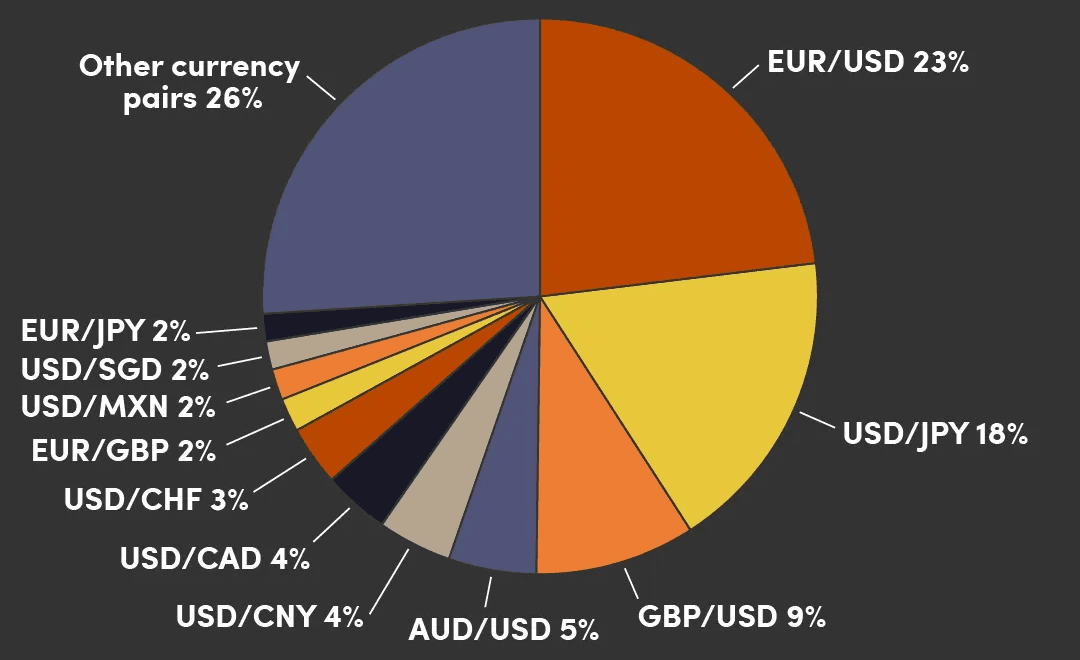
Consistently maintaining both a current account surplus and a low inflation rate, the Japanese financial system is said to be relatively stable compared to other global economies, which helps the yen maintain its 'safe-haven' status.
In periods of economic uncertainty, the yen is likely to increase in value; those looking to avoid risk will buy the yen and sell other 'riskier' currencies. By contrast, when the market is stable and risk tolerance increases, safe haven currencies, including the yen, are likely to be sold as the market looks to buy and hold currencies with a higher interest rate.
Regarding monetary policy, the choices of the Bank of Japan (BoJ) significantly influence both the market outlook and the performance of the Japanese yen.
Generally, any decision deemed to be 'tightening' of monetary policy is likely to increase the value of the Japanese yen; when monetary policy is tightened, stock markets are expected to endure some selling pressure, contributing to higher demand for the yen as a means of risk aversion.
USD/JPY is the second-most traded currency pair in the FX Market
One of the seven major currency pairs, USD/JPY has many interesting attributes. Not only is USD/JPY the second-most traded currency pair globally, at 18% of FX market volume according to BIS, USD/JPY is renowned for its high level of market liquidity, meaning that movements in price can be more consistent and stable when compared to other currency pairs.
As an example, currency pairs like EUR/JPY and GBP/JPY have a lower level of market liquidity, so price action is likely to be more erratic, which may be less suitable for currency trading beginners.
With NAGA.com you can trade USD/JPY, EUR/JPY, GBP/JPY, CHF/JPY, AUD/JPY, NZD/JPY, and CAD/JPY through CFDs with tight spreads and a negative balance protection policy.
Trade and Invest in the Japanese Markets with NAGA.com
Investing and trading are both ways to get exposure to the Japanese stock markets. Even though both offer the potential to profit or lose from the financial markets, they differ fundamentally.
Invest
Investing means that you will own the physical shares of stocks and funds until you decide to sell them. When investing, you need to commit to the full value of the investment upfront. If your shares are worth more when you sell them than when you bought them, you’ll make a profit. But, if the price has declined, you’ll incur a loss. While the potential for profit is technically unlimited, your losses are capped at your full initial outlay.
You might want to invest in Japanese stocks if:
- You’re interested in buying and selling assets (stocks and ETFs)
- You’re focused on longer-term holding
- You want to build a diversified portfolio
- You want to take ownership of the underlying asset
- You want to receive dividends (if paid)
NAGA.com offers +3.000 stocks and ETFs with ownership.
Trade
Trading, on the other hand, enables you to predict share price movements without owning the underlying asset – and you can go long or short. This means that you can speculate on rising as well as falling prices. You also don’t need all the capital upfront, as you’ll trade using leverage. All you need to open a position is a small deposit called a margin. Keep in mind that leverage magnifies both potential profits and possible losses. This makes it vital that you manage your risk properly.
Do you want to practice trading? Open a NAGA.com demo account to trade in a risk-free environment.
You might want to trade the Japanese markets if:
- You are interested in speculating on the underlying price of the assets (stocks, indexes, ETFs, commodities, bonds, currencies, cryptocurrencies)
- You want to trade rising and falling markets – going long and short
- You want to leverage your exposure
- You want to take shorter-term positions
- You want to hedge your portfolio
- You want to trade without owning the underlying asset
NAGA.com offers a wide range of CFDs on stocks, indexes, commodities, ETFs, bonds, forex, and cryptocurrencies.
Free resources
Before you start investing and trading in the Japanese markets, you should consider using the educational resources we offer like NAGA Academy or a demo trading account. NAGA Academy has lots of free trading and investing courses for you to choose from, and they all tackle a different financial concept or process – like the basics of analysis – to help you become a better trader or make more informed investment decisions.
Our demo account is a suitable place for you to learn more about leveraged trading, and you’ll be able to get an intimate understanding of how CFDs work – as well as what it’s like to trade with leverage – before risking real capital. For this reason, a demo account with us is a great tool for stock investors who are looking to make a transition to leveraged trading.