





Insider trading means trading a company's securities while in possession of material non-public information — the version that ends in handcuffs, headlines, and hedge-fund wiretaps. But the same phrase is also used for something entirely lawful: the routine, fully disclosed buying and selling that company executives and directors do in their own stock, filed with regulators and published for anyone to read.
That second kind is not a scandal. It is a data set — one of the few places in public markets where you can watch the people with the best possible information about a company put their own money in or take it out. Learning to separate the crime from the signal, and the signal from the noise, is what this lesson is about.
Insider Trading – Key Takeaways
- Insider trading is only illegal when it involves material non-public information. Executives and directors buy and sell their own company's shares legally all the time — they just have to disclose it.
- Those disclosures are public. In the US they arrive as SEC Form 4 filings within two business days; in Europe, as directors' dealings notifications under the Market Abuse Regulation.
- Insider buying is the signal that matters most. Insiders sell for many reasons — they buy for one. Cluster purchases by multiple insiders carry the most weight.
- NAGA is itself a listed company, so this lesson includes the view from inside: closed periods, notification duties, and what investors can read in the filings.
- Insider data confirms a thesis; it never replaces one. The strategy section covers how to combine it with structure and fundamentals.
What Is Insider Trading? Meaning and Definition
Before anything else, the term needs precision, because "insider trading" describes both a felony and a Tuesday-afternoon compliance routine — and the difference between them is the single most important idea in this trading course.
Insider Trading Definition
Insider trading is trading in a company's securities while in possession of material non-public information (MNPI) about the issuer: information that has not been released to the market and that a reasonable investor would consider important — an unannounced acquisition, results that haven't been published, a regulatory decision still under wraps. It becomes unlawful when someone trades, or tips or recommends trades to others, on the basis of that information in breach of a duty or of market-abuse rules.
The SEC's investor education portal defines the illegal form as trading a security "in breach of a fiduciary duty or other relationship of trust and confidence" while in possession of such information. In the European Union, the same conduct is called insider dealing and is prohibited under the Market Abuse Regulation (MAR), which applies to every company listed on an EU venue — including, as we'll see later, NAGA Group itself.
Legal vs Illegal Insider Trading
Here is the distinction that most headlines flatten. Illegal insider trading means trading (or tipping someone who trades) on the basis of MNPI. Legal insider trading means corporate insiders — officers, directors, large shareholders — trading their own company's shares without such an information advantage, and disclosing every transaction to the regulator on a public timeline. The first undermines the market; the second is a normal, supervised part of it — and note the order of the conditions: disclosure doesn't launder a trade made on inside information, it is the transparency layer on top of lawful ones.
The consequences of crossing the line are severe on both continents. In the United States, certain securities-fraud and insider-trading offences can carry prison sentences of up to 20 years, alongside substantial fines and civil penalties. Under MAR, EU member states impose criminal sanctions and administrative fines that scale with the offence, and regulators can bar individuals from managing listed companies. Yes — you can go to jail for it, and people regularly do. That enforcement is precisely what makes the disclosed data trustworthy: the system is designed so that what insiders are allowed to do is visible, and what they're not allowed to do is punished.
Illegal vs Legal Insider Trading at a Glance
At a glance Illegal insider trading Legal insider trading (disclosed) What it is Trading or tipping on material non-public information Insiders trading their own company's shares without an MNPI advantage Status A crime plus civil liability in the US and the EU Lawful, regulated, and time-restricted Visibility Hidden — until enforcement Public filings: SEC Form 4 (US), directors' dealings (EU) For investors Never usable — see the warning later in this lesson A research data set anyone can read
Keep that table in mind throughout: everything in the rest of this lesson concerns the right-hand column.
Illegal Insider Trading: Famous Cases and What They Teach
The case law is where the abstract definition becomes concrete — and where most articles get the details wrong. Two cases dominate public memory, and each teaches a different lesson about where the legal line actually sits.
The Martha Stewart Case
The most famous "insider trading" conviction in history is, strictly speaking, not one. In December 2001, Martha Stewart sold her shares in biotech firm ImClone the day before a negative regulatory decision was announced, after her broker relayed that ImClone's CEO was dumping his own stock. Stewart was ultimately convicted in 2004 — but of obstruction of justice and making false statements to investigators about the sale, not of insider trading itself; the securities-fraud charge was dismissed, and the insider-trading question was resolved in a civil settlement. She served five months in prison.
The lesson traders should take is double. First, tips travel: liability doesn't require being the insider — receiving and acting on a tip ("tippee" liability) is enough to trigger an investigation. Second, the cover-up carried heavier consequences than the trade — the investigation itself became the crime. Where the information came from matters as much as what you did with it.
The Galleon Case — and What Qualifies as Insider Trading
If Stewart's case shows the edges, Raj Rajaratnam's shows the core. The Galleon Group founder was convicted in 2011 on fourteen counts of securities fraud and conspiracy after prosecutors — using wiretaps for the first time at that scale in an insider-trading case — showed he had traded systematically on confidential tips from a network of corporate insiders. He received an 11-year sentence, among the longest ever imposed for the offence, and the case redefined how aggressively the crime is investigated.
Together the cases answer the PAA-favorite question "what qualifies as insider trading?" in practical terms: trading while in possession of material non-public information, tipping others who trade on it, or trading on a tip you knew (or should have known) came from inside. The source can be a boardroom, a broker, a printer's proof, or a friend at dinner — the law follows the information, not the job title.
Legal Insider Trading: How the Disclosure System Works
Now for the half of the topic that never makes headlines but generates the data traders actually use. Corporate insiders are allowed to trade their own stock — within strict rules — and both major regulatory systems force those trades into the open on a short clock.
In the US: SEC Form 4
In the United States, Section 16 insiders — generally directors, officers, and beneficial owners of more than 10% of a registered class of equity — report their transactions in the company's securities on SEC Form 4, typically filed within two business days of the trade, with certain exempt transactions permitted to be reported later on Form 5. The filing states who traded, their role, the transaction type (open-market purchase, sale, option exercise, gift), the number of shares, and the price — and it lands in the SEC's public EDGAR database the moment it's filed.
Two business days is fast. It means the public record of insider conviction — or insider exit — is nearly real-time, which is exactly why an entire category of screeners and dashboards exists to parse Form 4 flow. Related filings complete the picture — Form 3 registers a new insider's initial holdings — but Form 4 is where the signal lives.
In Europe: Directors' Dealings Under MAR
The European equivalent is the directors' dealings regime under Article 19 of the Market Abuse Regulation. Persons discharging managerial responsibilities — PDMRs, in the jargon — and people closely associated with them generally notify the issuer and the competent authority of transactions in the company's shares or debt within three business days; the issuer must then make the notification public promptly, under the timetable MAR prescribes.
MAR adds a feature US rules don't have: the closed period. For the 30 calendar days before the publication of an interim or year-end financial report, PDMRs are barred from trading at all, subject to narrow exceptions. The result is a rhythm European investors can learn to read — insider activity clusters in the open windows after results, and a notification filed shortly after earnings carries information precisely because the insider was legally required to wait for the same public data you have. For German-listed companies, these notifications flow through the same channels as other regulated news, which is where you'll find them for NAGA Group too.
Insider Buying and Insider Selling: Reading the Signal
Disclosure creates data; interpretation creates edge. The two halves of the insider tape — buying and selling — are not symmetrical signals and treating them as equals is the most common mistake newcomers make with this data set.
Insider Buying: The Strongest Signal in the Set
As Peter Lynch famously observed, insiders may sell their shares for any number of reasons, but they buy for only one — they think the price is going up. An open-market purchase means an executive looked at everything they know about the company, compared it with the public price, and chose to add personal capital at that price. Decades of academic work on insider transactions — from H. Nejat Seyhun's studies onward — support the intuition: some forms of insider purchasing have contained information about subsequent returns, with the effect strongest in smaller, less-covered companies. The honest footnote researchers attach applies here too: the strength of the effect varies by market, company size, transaction type, and period — and by the time a filing is public, part of the move may already be priced, so the signal is not a fee-free trading system.
Not all buys are equal, though. The signal strengthens with clusters (several insiders buying in the same window), with size relative to the buyer's salary and existing stake, with open-market purchases rather than option exercises or scheduled plan buys, and with context — a cluster buy after a sharp decline says more than one into strength. A CEO adding a token amount for optics and a CFO deploying a year's salary after a sell-off are different events wearing the same filing.
"One insider buying is a data point. Three insiders buying in the same week, with their own money, on the open market — that's a sentence. They are telling you what they think the business is worth relative to the price, and unlike analysts, they're saying it with their net worth. The pattern I weight most is cluster buying after a decline: nobody spends their own salary on a stock they expect to keep falling."
— Frank Walbaum, Market Analyst
The honest counterweight belongs next to the enthusiasm: insiders are early, often by quarters rather than weeks, and they are not infallible — executives famously bought their own collapsing banks all the way down in 2008. The signal is real; it is not a timing device.
Insider Selling: The Noisy Signal
Selling is where Lynch's asymmetry bites. Insiders sell to diversify concentrated wealth, to pay taxes triggered by vesting stock, to buy houses, to fund divorces — and, in the US, a large share of sales execute automatically under pre-arranged 10b5-1 plans set up months in advance precisely so the insider isn't choosing the timing. A routine sale, on its own, tells you close to nothing.
Selling starts to matter at the extremes: several senior insiders selling unusually large stakes in a tight window, first-ever sales by long-term holders, disposals that dwarf the seller's usual pattern, or heavy selling into a price run-up that the company's own communications are fueling. Even then, treat it as a question to investigate — check the filing type, check for a trading plan, check the economic calendar — rather than a verdict. The asymmetry is the discipline: buying is a statement, selling is a maybe.
How to Track Insider Trading
Everything above is public — the practical question is where to read it, and how much work you want the reading to take. There are two routes: the raw regulatory sources, and stock trading platforms that aggregate them into something usable at a glance.
The Public Sources
In the US, every Form 4 is free on the SEC's EDGAR full-text search the day it's filed — searchable by company or by insider, with the full transaction detail. In the EU, directors' dealings notifications are published by the issuer and collected by national regulators; for German-listed companies they arrive through the regulated news channels alongside ad-hoc announcements, and most issuers mirror them in the investor relations section of their own site.
The raw sources are authoritative and free, and every serious user of insider data should know how to read an actual filing. Their weakness is workflow: filings arrive company by company, in regulatory formatting, with no context — no history of the insider's past trades, no comparison across companies, no way to see at a glance whether this week's purchase is a cluster or a one-off. Raw data answers "what happened?"; it takes aggregation to answer "does it matter?"
Insider Activity in NAGA Insights
That aggregation layer is built into the platform. NAGA Insights brings insider transactions into the same view as the rest of a stock's research picture: open the Insights tab on any covered stock — Trade section, pick the stock, Insights — and corporate insider activity appears alongside analyst consensus, hedge-fund positioning, and news and investor sentiment, instead of in a separate regulatory database.
Insider transactions are also one of the eight factors in the Insights stock score, a 1–10 rating of a stock's potential that weighs insider activity together with analyst ratings, fundamentals, technicals, hedge-fund moves, and sentiment — which operationalizes exactly the discipline this lesson teaches: insider data as one input among several, never a verdict on its own.
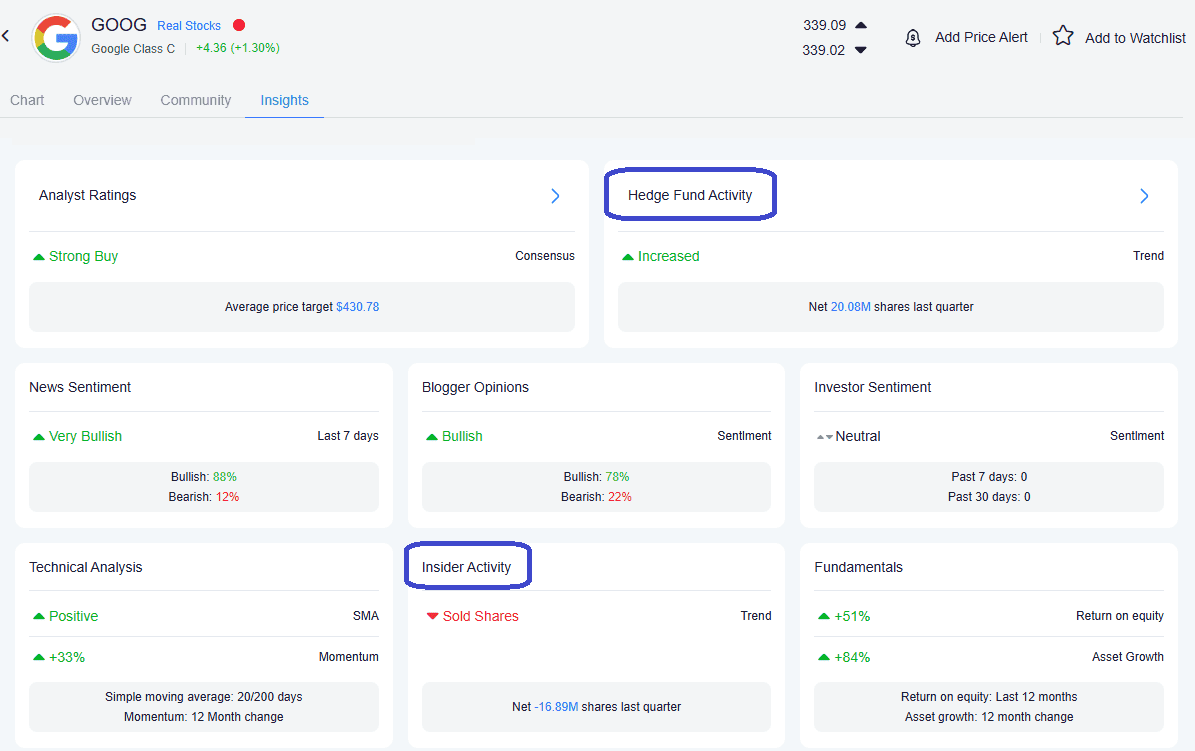
Insights are included for all NAGA users at no extra cost. To see it in practice, open the Insights tab on any covered stock and set this week's insider activity against the analyst and sentiment reads.
Inside a Listed Company: How NAGA Handles Insider Rules
Most articles about insider trading are written from the outside looking in. NAGA can offer the reverse angle: The NAGA Group AG is itself listed on the Frankfurt Stock Exchange (ISIN: DE000A41YCM0), which means every rule described in this lesson — MAR, insider lists, closed periods, directors' dealings — is not theory here but operating procedure.
Closed Periods and Clean Processes
As an EU-listed issuer, NAGA maintains insider lists of everyone with access to inside information, enforces the 30-day closed periods before financial reports during which managers cannot trade the stock at all, and processes PDMR notifications on the MAR timeline. For employees of a listed fintech, "insider trading" is not an abstract compliance module — it is a calendar, a set of walls between teams, and a discipline about what is said before it is published.
"As a listed company, we live on both sides of this topic. Our managers are subject to closed periods and notification duties under the Market Abuse Regulation, and every notification becomes public information the moment it's made. That is the point of the system: the same rules that restrict insiders are what turn their disclosed trades into data the market can trust."
— Compliance Department, NAGA
The dual perspective is worth pausing on: the platform that shows you insider data is governed by the same regime that generates it — a vantage point a standalone data aggregator cannot offer.
What Investors Can See
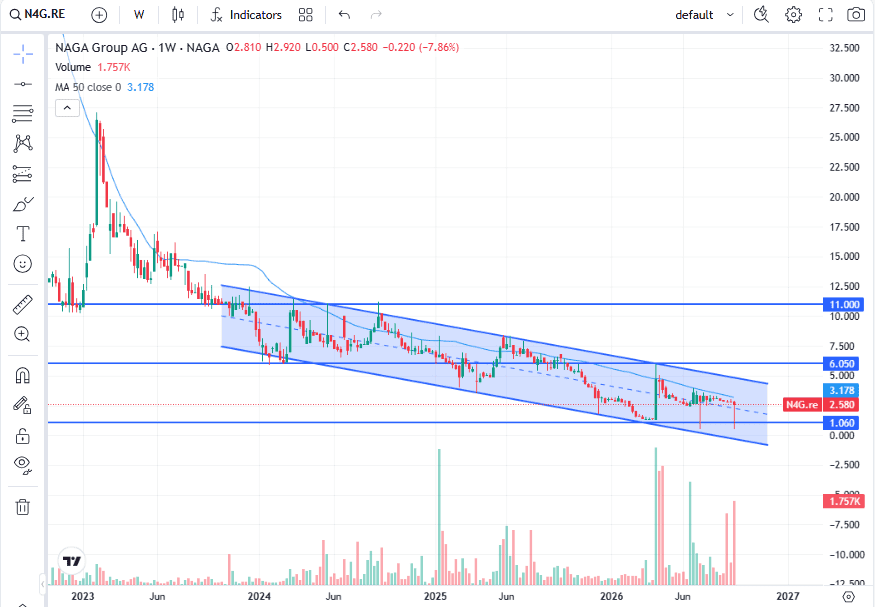
For NAGA Group's own stock (XETRA: N4G0), the disclosure trail is the standard German one: directors' dealings notifications published through regulated news channels and the company's investor relations newsroom, each stating who traded, in what capacity, the instrument, the volume, the price, and the date. Investors researching N4G0 read those notifications exactly the way this lesson describes reading any insider data — role, direction, size, and timing relative to the open windows.
That record sits alongside the rest of the public file — results, guidance, research coverage — which is covered in depth in the NAGA Group stock forecast and the analysis of undervalued European stocks where N4G features. Transparency, here, is not a marketing line; it is a filing obligation.
Using Insider Data in Your Trading Strategy
Data becomes strategy only with rules attached. This section sets out which insider signals deserve weight, how they combine with the analysis frameworks, and the mistakes that turn a useful data set into an expensive one.
Signals Worth Acting On
Four patterns carry most of the documented value:
- Cluster buying — multiple insiders purchasing in the same window — tops the list.
- Conviction size comes next: purchases that are large relative to the insider's salary and existing holdings.
- Buys into weakness — insiders stepping in after a significant decline — have tended to say more in the published research than buys into strength.
- First purchases by insiders who rarely trade say more than routine additions by habitual buyers.
Each is visible in the filing history; none requires guesswork.
The multiplier is confluence with your own analysis. Insider buying that appears while a chart is building a base — the accumulation stage described in our trend reversal lesson — is two independent evidence types agreeing: the people with the best information, and the price structure, pointing the same way. Insider data pairs the same way with valuation work of the kind in our trend trading guide and fundamentals-driven screens.
"Insider data is a confirmation layer, not a trade ticket. When a cluster buy lands on a chart that's already building a base, I pay attention — the best-informed money and the price structure agreeing is about as good as public signals get. But I've never taken a position on insider activity alone, and I'd advise students the same: it tells you where to look, your own analysis tells you whether to act."
— Frank Walbaum, Market Analyst
Note what both expert opinions in this lesson have in common: insider data narrows the watchlist and strengthens conviction — it does not replace entries, invalidation levels, or position sizing. The mechanics of the trade remain yours.
Mistakes to Avoid
The failure modes are consistent:
- Copying blindly — buying whatever any insider bought, without context on size, role, or history — imports their timeline and risk tolerance, not their information.
- Over-reading sales, especially scheduled plan sales, generates false alarms by the dozen.
- Trading stale data matters too: an aggregated dashboard showing a purchase from six weeks ago is history, not signal — check the filing date, not just the headline.
And in small caps, remember that the insiders' price is not your price: thin liquidity means the market may already have moved on the disclosure itself.
The line you never cross: everything in this lesson concerns public, disclosed information. If you come into possession of material non-public information — through work, a friend, an overheard call — trading on it, or passing it on, is a crime in every major jurisdiction, regardless of how you obtained it. No signal is worth a securities-fraud case. When in doubt, don't trade, and seek legal advice.
Treated with those rules, insider data earns a permanent place in a research routine — one voice in the committee, never the chairman.
Key Takeaways: Putting Insider Data to Work
The whole lesson compresses into a short discipline: know the legal line, read the filings correctly, weight buys over sells, demand clusters and conviction, and let your own analysis make the final call.
The Insider-Data Checklist
Before acting on any insider signal, confirm: the transaction is an open-market purchase (not an option exercise or plan trade); the buyer's role and size make it meaningful; there is more than one buyer or a clear conviction outlier; the timing sits in an open window and postdates the last results; and your own thesis — technical or fundamental — independently supports the trade, with an entry, an invalidation level, and a position size defined before the ticket.
Five checks, and each one is answerable from public filings plus your own chart. If any fails, the name goes on the watchlist, not in the portfolio.
Follow the Smart Money on NAGA
Every input this lesson uses is available in one place. NAGA Insights puts insider transactions, analyst consensus, hedge-fund activity, and sentiment on a single screen for every covered stock — with insider activity built into the eight-factor 1–10 stock score — at no extra cost for NAGA users, alongside 3,000+ real stocks and ETFs and 1,000+ CFD instruments for executing whatever your analysis concludes.
Research like an insider — legally
- Insider activity on the Insights tab of every covered stock — spot the clusters in seconds
- An eight-factor stock score (1–10) that weighs insider activity alongside analysts, fundamentals, and sentiment
- Analyst consensus and hedge-fund positioning in the same view — the confluence check, built in
- Act on your analysis: 3,000+ real stocks and ETFs, 1,000+ CFDs, Stop Loss & Take Profit on every trade
Explore NAGA Insights Try a free demo
Trading leveraged products involves significant risk of loss. All investments involve risk.