




The pitch is everywhere: connect an account, switch on the bot, and let artificial intelligence trade the markets on your behalf. Videos show dashboards climbing, forums trade screenshots of green months, and every second app now describes itself as "AI-powered." The appeal is obvious — markets never sleep, humans do, and software doesn't panic at three in the morning.
The reality is more sober, and the people asking the question know it. The most common searches around this topic are not "which AI trading bot should I buy" but "do AI trading bots actually work?" and "are they scams?" Both are fair questions, and this guide answers them directly: some bots work, under some conditions, for a while — and the difference between the ones that survive and the ones that empty accounts has far more to do with risk management and honest expectations than with the sophistication of the code.
What follows covers the mechanics of how a bot works and what "AI" genuinely adds, the evidence on whether bots make money, how bots differ across crypto, stocks and forex, the strategies underneath them, the risks, a checklist for evaluating any provider, and an alternative approach that automates the copying of human decisions rather than trusting an algorithm alone.
AI Trading Bots – Key Takeaways
- A trading bot is not the same as AI. Many products sold as "AI bots" run fixed rules — grids, dollar-cost averaging, indicator triggers — with an AI label attached.
- A backtest is not a track record. Strategies tuned to past data routinely fail when market conditions change; the gap between simulated and live results is the single biggest risk.
- Crypto is bot territory for structural reasons — 24/7 markets and open exchange APIs — while stock and forex bots face different constraints and traditions.
- The dangerous failures are not technical. Overfitting, leverage, unattended drawdowns and unregulated operators account for most losses.
- Automation can copy judgment instead of replacing it. Copy trading with AI-assisted research sits between DIY bots and black boxes — with its own risks, covered below.
What Is an AI Trading Bot?
The term covers a wide range of software, from a simple script that buys every time a price dips to institutional systems built by teams of quantitative researchers. Precision matters here, because much of the marketing around "AI trading" relies on the reader not knowing where the lines fall.
The Definition — and the Label Problem
An AI trading bot is software that analyses market data and can open, manage or close positions automatically. Unlike a conventional rule-based bot, an AI-enabled system may use machine learning, language models or statistical methods to classify information, rank signals or adapt its analysis over time. In practice, many retail products marketed as "AI bots" use conventional rules with an AI label — the technology should be assessed by what it actually does, not by the name used in the marketing.
That distinction is the most useful thing a beginner can learn about this space. A grid bot that places buy and sell orders at fixed intervals is automation, and can be perfectly useful automation — but it isn't intelligence, and it doesn't become intelligence because a landing page says so. The questions to ask of any "AI" claim are simple: what data does it read, what does it decide, and what can a human still override?
How Trading Bots Work
Every bot, whatever its label, runs the same four-step loop:
- Market data in. The system ingests prices, volume, order-book information and — in more sophisticated setups — news feeds or sentiment data.
- Signal logic. Rules or models decide whether the data justifies an action: a grid level hit, an indicator crossing, a model scoring a setup above its threshold.
- Execution. Orders are sent to an exchange through an API key, or to a broker platform, without a human clicking anything.
- Risk rules and feedback. Stops, position limits and a kill switch (if the bot has one) constrain the damage a bad decision can do; results feed the next cycle.
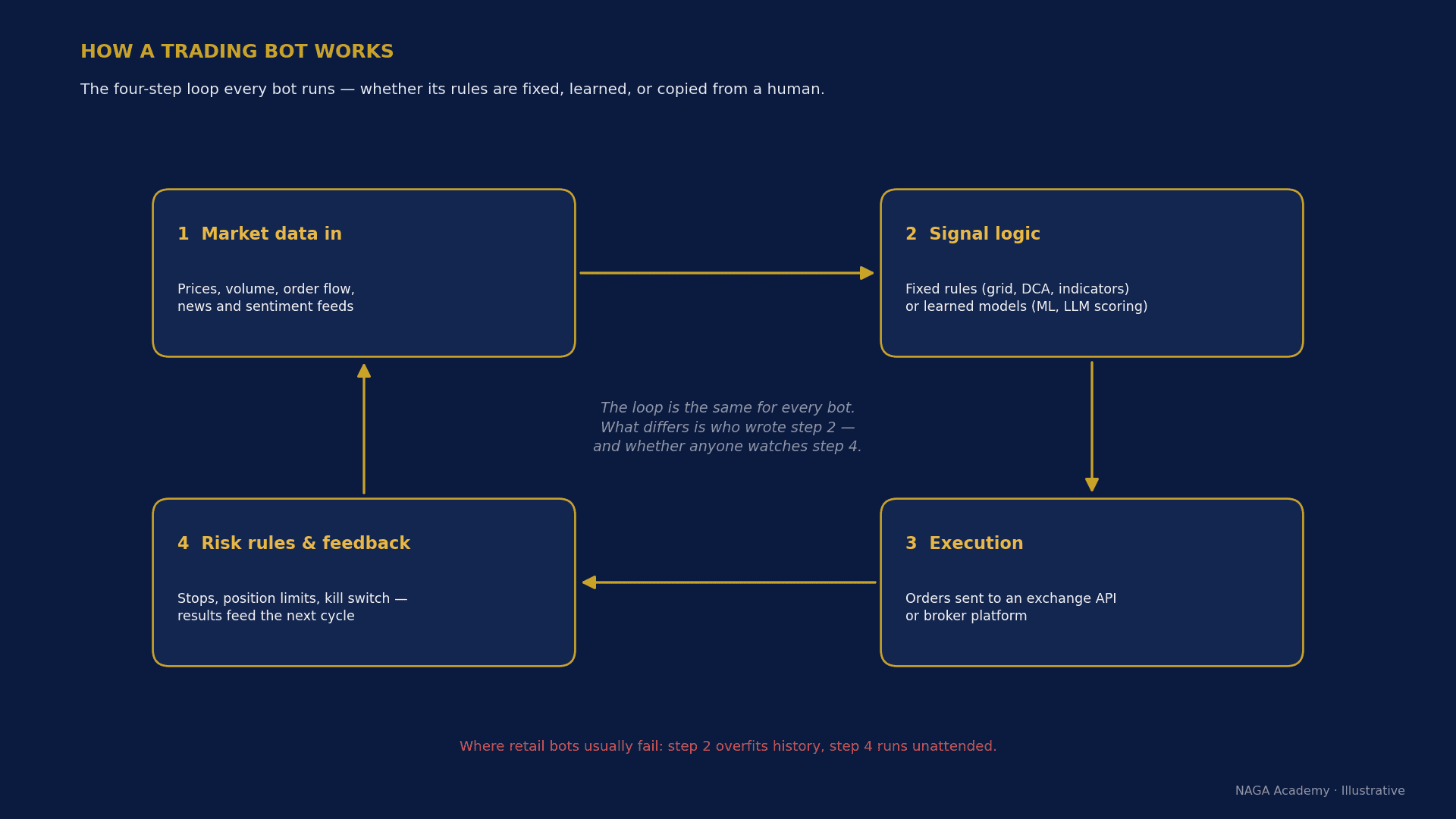
Where "AI" fits is almost entirely in step two — and occasionally in step one, where a language model might score news sentiment before the rules see it. Steps three and four are plumbing and discipline, and no amount of intelligence in step two compensates for their absence. Algorithmic trading, the institutional cousin of all this, has run the same loop for decades with fixed rules and enormous infrastructure; genuine machine-learning systems that adapt their own rules tend to live in the same institutions, because they require clean data, constant retraining and people watching them. What a retail user realistically gets from "AI" is analysis and prioritisation — help deciding what to look at — not clairvoyance.
Do AI Trading Bots Actually Work?
The direct answer is "some, under some conditions, for a while." That is not a dodge; it is the only honest summary of a space where the survivors advertise and the failures go quiet. The useful question is not whether bots can make money — a few clearly do — but why most retail attempts don't, and what separates the exceptions.
What the Evidence Shows
The central problem is the gap between backtested and live performance. A strategy tuned to five years of history has, by construction, learned that history's quirks — and markets change regime: a grid bot built for a sideways 2021 met a trending 2022 and bought all the way down. Add survivorship bias (the bots you hear about are the ones that haven't failed yet), transaction costs and slippage that erode thin edges on every trade, and latency against institutional players with faster infrastructure, and the pattern that emerges is consistent: retail automation tends to work until the conditions it was built for end, and the end usually arrives without warning.
None of this means automation is worthless. Removing emotion from execution is a real benefit, and disciplined rules beat impulsive trading for most people. But the benefit comes from the discipline, not from the bot's cleverness — a point best made by someone who has run systematic strategies with institutional resources.
"The bot does not give you an edge in trading – you should focus on the discipline around it. Professional funds constantly check and monitor data, risk and their performance. Retail bots often only sell the model, without the monitoring option or the necessary safety net behind it."
— Frank Walbaum, Market Analyst, former hedge fund manager
Why Many Retail AI Trading Bots Fail
Five failure modes account for most of the damage:
- Overfitting: the strategy memorised the past rather than learning anything transferable.
- Leverage amplification: a bot that is slightly wrong at 1x is badly wrong at 10x, and it doesn't hesitate.
- Unattended drawdowns: the "set and forget" promise is exactly the problem — nobody is watching when the losing streak begins.
- Exchange and API risk: outages, changed APIs, and compromised keys have ended more bots than bad strategies have.
- Operator risk: an unregulated vendor with your API keys, your deposit, or both.
Notice that four of the five are not about the intelligence of the system at all. They are about supervision, sizing, infrastructure and counterparty — which is why the evaluation checklist later in this guide spends more time on those than on the algorithm.
Types of AI Trading Bots by Market
Bots are not evenly distributed across markets, and the reasons are structural rather than fashionable. Crypto has open exchange APIs and never closes; stock markets have hours, regulation and broker gatekeeping; forex has a two-decade automation tradition of its own. Each market shapes what a bot can do — and what can go wrong. (The strategies mentioned here — grid, DCA, signal and trend bots — are explained in detail in the next section.)
AI Crypto Trading Bots
Crypto is where retail bots live, for three reasons: markets trade 24/7, so automation has an obvious job; exchanges expose trading APIs to anyone with an account; and volatility creates the price swings that grid and DCA logic feeds on. The common bot types are grid bots (buy low, sell high inside a range), DCA bots (accumulate on schedules or dips), arbitrage bots (exploit price gaps across venues) and signal bots (execute on indicator or third-party triggers). Platforms such as 3Commas, Bitsgap, Pionex and Cryptohopper are typical examples of configurable-bot services — mentioned here as examples of the category, not as recommendations, and this guide makes no claims about their performance.
Two structural risks are specific to this corner of the market:
- First, custody and keys: a DIY bot usually needs API access to an exchange account, and a compromised key or a failed exchange is a total-loss scenario the strategy can't protect against.
- Second, the operator: many bot vendors and the exchanges they connect to sit outside any financial regulation, which matters most on the day something goes wrong.
For readers who want crypto exposure with automation but without holding exchange keys, crypto CFDs can be traded long and short through a regulated NAGA entity.
AI Stock Trading Bots
Equities change the equation. Markets have opening hours, so a bot can't simply run around the clock; broker API access is more restricted than exchange access in crypto; and rules such as US pattern-day-trading requirements limit how often a small account can trade. The result is that fully autonomous retail stock bots are rarer than the marketing suggests — and where AI genuinely earns its keep in equities is not execution but research: screening thousands of names on fundamentals, scoring news and sentiment, modelling how a stock tends to react to earnings.
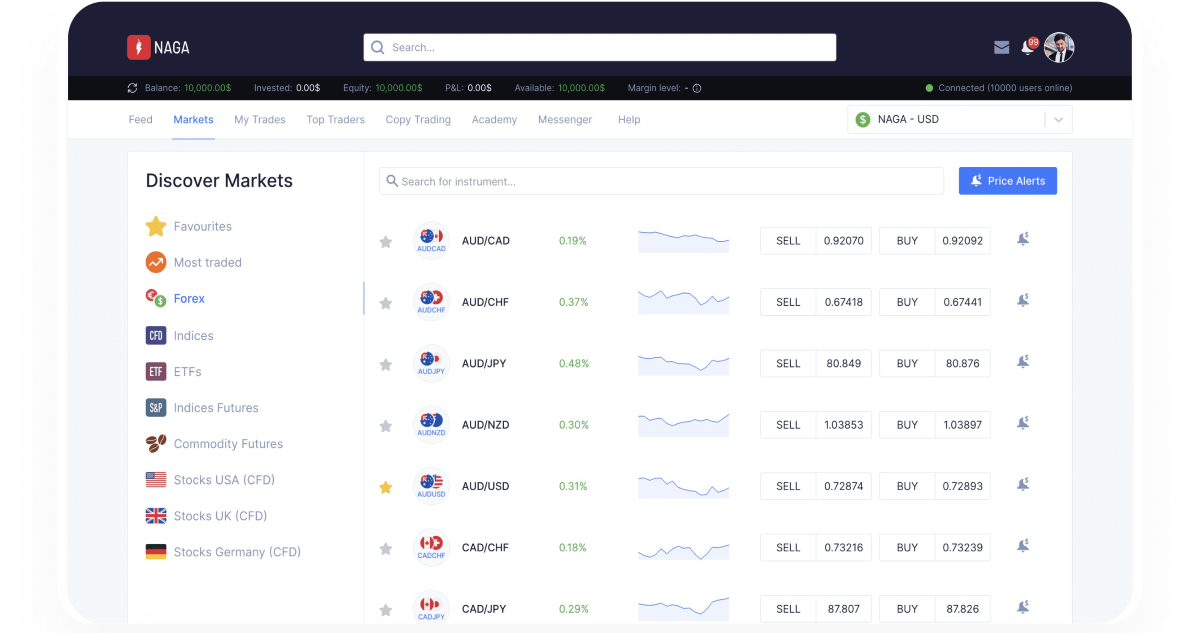
That is the realistic shape of "AI stock trading" for most people: intelligence in the analysis, a human on the trigger. The tools that help are the ones that surface and rank — AI-powered technical signals on a chart, analyst and sentiment data aggregated in one view — rather than the ones that promise to trade unattended. On NAGA, AI-powered analysis and signals are available on charts alongside research insights for real stocks and ETFs.
AI Forex Trading Bots
Forex automation predates the AI label by twenty years. The Expert Advisor (EA) — a script that runs inside MetaTrader — is the oldest retail bot ecosystem there is, and thousands of EAs are sold, shared and copied every day. Common EA strategies include scalping (many small trades on tight spreads), trend-following, and grid or martingale systems — the last of which deserve a specific warning: martingale doubles position size after losses, which produces smooth equity curves right up until a single trend wipes out the account.
Forex bots are unusually leverage-sensitive because forex is leveraged; a strategy with a small statistical edge at 1:1 can be ruinous at 1:30. The same execution and supervision rules apply as everywhere else. Traders who want to run EAs at a regulated broker can do so where MT5 is offered alongside a proprietary platform, and those who would rather not maintain a bot at all can replace the EA with copy trading — the approach covered later in this guide.
AI Trading Bot Strategies Explained
Underneath the branding, most retail bots run one of a handful of strategies. Knowing how each works — and, more importantly, which market conditions each one needs — is the fastest way to see through a sales page, because every strategy has a known failure mode that its marketing never mentions.
Grid and DCA Bots
A grid bot places a ladder of buy orders below the current price and sell orders above it, at fixed intervals. As price oscillates inside the range, it buys the dips and sells the rips mechanically, collecting small profits on each round trip. Grids do exactly what they promise in a sideways market — and exactly the opposite in a trending one: when price breaks below the grid and keeps falling, the bot has bought every level on the way down and holds a full-size losing position with no sell orders left to fill.
A DCA bot (dollar-cost averaging) buys fixed amounts on a schedule, or adds to a position as price falls, lowering the average entry. It is a sound accumulation method for assets you would hold anyway — and a slow-motion disaster for assets in structural decline, where it methodically averages down into something that never recovers. Neither strategy has a view about direction; both borrow the user's view, and both punish the user when that view is wrong.
Signal, Trend and Machine-Learning Bots
Signal bots act on triggers: an indicator crossover, a pattern recognition flag, a third-party signal service, or a message in a channel. Their quality is exactly the quality of their signal source.
- Trend-following bots ride momentum with moving averages or breakouts and accept many small losses for occasional large wins.
- Trend-reversion bots bet on prices returning to an average and win often but lose big when a trend refuses to revert.
These are the two classical systematic families, and every institutional desk runs some version of each.
Where genuine machine learning appears in retail-accessible tools, it is usually in the analysis rather than the execution: sentiment scoring of news and social feeds, classification of the market's current regime (trending, ranging, high-volatility), and ranking of setups so a human sees the most promising first. That is the distinction to hold onto: a signal a user reads and judges is a research tool; a signal a bot executes blindly is an automated strategy carrying every risk in the previous section.
Risks of AI Trading Bots
Every risk in this section has appeared in the story of some emptied account. They divide into two groups: risks from the people and platforms behind a bot, and risks from the market itself once the bot is running. The first group is where beginners lose the most, because it is the least discussed.
Scams, Clones and Unregulated Operators
The "AI trading bot" label attracts fraud because it promises effortless returns and is hard for a beginner to verify. The recurring patterns: guaranteed or fixed monthly returns (no legitimate system offers them); performance screenshots with no verifiable account history; pressure to deposit quickly or to grant API keys with withdrawal permissions enabled; anonymous teams behind polished sites; and bots that "require" you to fund an account on an exchange or broker the vendor chooses. Any one of these is a reason to walk away.
A related risk is impersonation. Fraudulent sites, apps and social-media accounts routinely borrow the branding of established platforms to harvest logins and deposits — NAGA's name has been used this way. Users should verify that they are accessing the official NAGA website and app before entering login or payment details, and be cautious of domains, accounts or platforms that use NAGA branding but are not linked from NAGA's official website.
Market and Execution Risks
Once a bot is live, the market supplies the rest:
- Leverage turns a small strategy error into a large one, and a bot executes its error without hesitation.
- Unattended drawdowns compound because nobody is there to notice the regime has changed.
- Outages — exchange downtime, API changes, a server that stops — can leave positions open with no stop management.
- Overfitting, discussed earlier, is the silent version: the bot behaves perfectly until it meets conditions it never trained on.
- Correlation catches copy-trading users specifically: following several traders who all happen to be in the same trade means diversification on paper and concentration in fact.
The common thread is that none of these are solved by a better algorithm. They are solved by position sizing, stop rules, supervision and a fast way to switch everything off — the same controls a professional applies to any system before trusting it with capital.
"Before I let any system trade — mine, a bot's, or another trader's — I want three answers: what's the worst month in its record, what happens when the market regime changes, and how do I switch it off in ten seconds. If a vendor can't answer the first two and hasn't built the third, it isn't a trading system. It's a lottery ticket with a dashboard."
— Frank Walbaum, Market Analyst, former hedge fund manager
How to Evaluate an AI Trading Bot
The questions below apply to any automation — a configurable bot, a signal service, or a trader you intend to copy. They are ordered by how much money each one has historically saved people, which is why regulation and custody come before returns.
The Due-Diligence Checklist
- Who holds your money, and who regulates them? Identify the legal entity, its licence, and the jurisdiction. If the answer is "an unregulated vendor with your API key," the rest of the checklist barely matters.
- Is the track record verifiable — and does it show drawdown? A return figure without the worst peak-to-trough loss beside it is marketing, not a record. Prefer live, audited or platform-verified history over backtests.
- What are the total costs? Subscription fees, spreads, commissions and funding charges all eat a strategy's edge; a bot that trades often pays often.
- What is the custody model? Exchange API keys, a vendor wallet, or a regulated broker account are very different exposures.
- Is there a kill switch and are risk limits enforced? Per-trade stops, maximum position size, daily loss limits, and a one-click stop-all.
- Can you test it without real money? Demo or paper mode first, for long enough to see a losing period.
- Start small, scale on evidence. Size the first live allocation so a total loss would be an irritation, not a crisis; increase only as the live record earns it.
Seven questions, and a legitimate operator answers all of them without discomfort. Evasion on any one — particularly the first two — is itself the answer.
Red Flags
Some signals end the evaluation immediately: guaranteed, fixed or "risk-free" returns; urgency to deposit; anonymous or unverifiable teams; the absence of any risk disclosure; "AI" claims with no explanation of what the AI reads, decides or can be overridden on; and, for copy trading, a lead trader whose profile shows spectacular returns with no drawdown history or with a track record measured in weeks. The more a product's marketing leans on lifestyle and less on mechanics, the more the mechanics probably deserve scrutiny.
Legitimacy, in the end, is not a feeling about a website; it is a licence you can look up, a record you can verify, and a stop button you can find. With those criteria established, the alternatives to a DIY bot can be judged on the same terms.
AI-Assisted Copy Trading: The Middle Ground Between DIY Bots and Black Boxes
The choice is usually framed as binary: configure your own bot and own every parameter, or hand your capital to an algorithm you can't inspect. There is a third path — automate the copying of human decisions, and use AI-assisted analysis for the research around them. The trade-off is stated up front: instead of choosing parameters, you are choosing traders, and instead of trusting a model, you are trusting a person's published record. That does not remove risk; it changes what you have to judge.
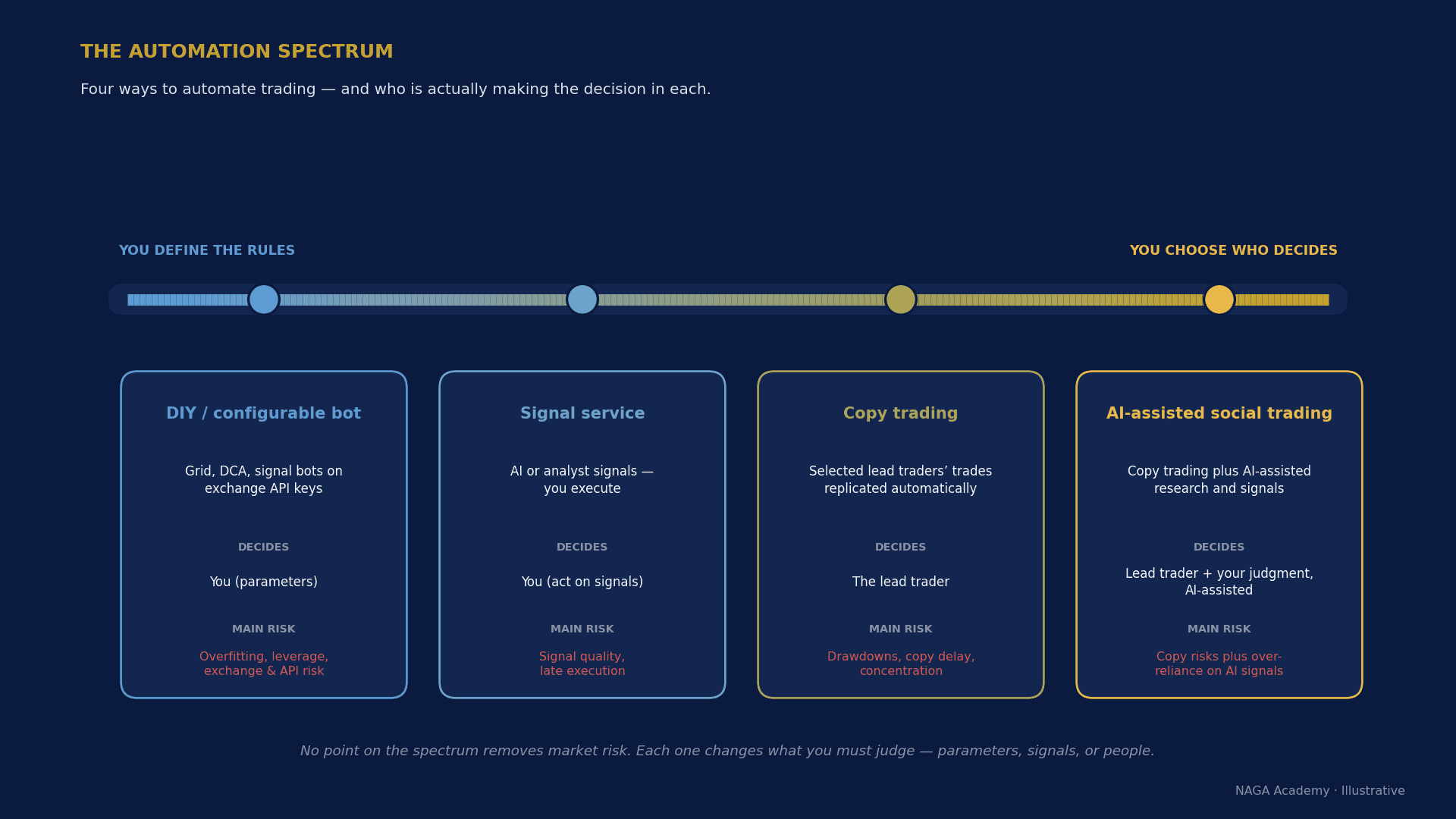
It helps to keep four functions distinct, because marketing tends to blur them:
- AI-assisted analysis summarises information and surfaces signals.
- Rule-based copying replicates a chosen trader's positions in your account.
- Human trader decisions are what actually get copied.
- Your own execution and risk controls — how much you allocate, when you stop — remain yours.
On a platform like NAGA, which combines social trading with AI-assisted research tools, all four are present; the execution of copied trades is rule-based automation, not an AI making trades.
Copy Trading: Automated Replication of Selected Lead Traders
Copy trading automates one specific thing: once you select a lead trader, the platform replicates that trader's trades in your account automatically, in proportion to your allocation, until you stop. Selection is the whole skill. Lead traders publish profile statistics — return history, maximum drawdown, risk score, trading frequency, number of followers — and the same due-diligence rules from the previous section apply: prefer long records to short ones, drawdown to headline return, consistency to a spectacular month.
On NAGA, the Autocopy feature lets users browse verified traders' published profiles, copy their trades automatically, and stop at any time; the mechanics are covered in our copy trading lesson.
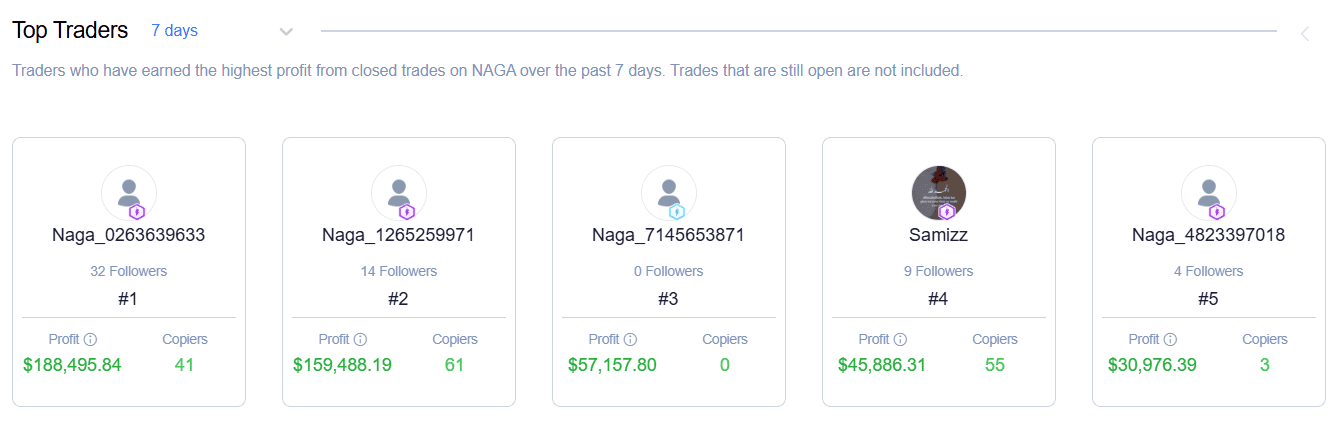
The honest limits belong beside the feature. Past performance of a copied trader does not guarantee future results. Copied traders may be inexperienced, may have objectives or a risk tolerance very different from yours, and may change their behaviour after gaining followers. You carry the leverage on every copied position, and copying several traders who share the same trades concentrates risk rather than spreading it. Copy trading replaces the problem of building a strategy with the problem of judging people — an easier problem for many, but not a smaller one.
AI-Assisted Analysis: Signals and Feed Insights
The AI-assisted layer is research support, and it should be described as exactly that. On NAGA, AI-powered analysis and trade signals are available on the charts — suggested setups and technical levels that the user evaluates and decides on. AI-assisted agents on the NAGA Feed summarise market information and surface insights alongside the community's own posts. These tools may help a user decide which lead traders or markets to look at; they do not eliminate market risk, guarantee the accuracy of any analysis, or independently ensure that a trade is suitable for an individual user.
Put side by side, the three approaches look like this:
Configurable Bots vs Copy Trading vs AI-Assisted Social Trading
Criterion Configurable bots Copy trading AI-assisted social trading Who makes the core decision User-defined rules or vendor strategy Selected lead trader Lead trader, with AI-assisted research available to the user Setup effort Medium to high Low to medium Low to medium Control High parameter control Less control over individual decisions Less control over individual decisions Main dependency Strategy, API, exchange or vendor Lead trader's decisions Lead trader, platform and AI tools Transparency Varies by provider Depends on published history Depends on trader data and platform disclosures Main risks Overfitting, leverage, outages Drawdowns, copying delay, concentrated exposure Same copying risks plus over-reliance on AI signals Best suited to Users who want to configure systems Users who prefer to follow traders Users who want research support alongside social trading
The verdict is two-sided. The middle ground suits beginners and busy traders who want exposure across several asset classes at a regulated entity without designing strategies or maintaining software — NAGA's Autocopy with AI-assisted research is one example of the category. It does not suit traders who want spot custody of their crypto, full parameter control over a strategy, or exchange-native grid bots; for them, the configurable-bot route, with all the checks above, remains the honest answer.
Key Takeaways: Automating Without Abdicating
The lesson compresses to one principle: automation should remove effort and emotion from execution, never judgment from the decision about what to trust. Whichever point on the spectrum you choose, the checks are the same.
Before Switching Anything On
Confirm the operator's regulatory status and where your money sits; demand a track record that shows drawdown, not just returns; understand the total cost per trade; know the custody model; find the kill switch and the risk limits before you need them; test in demo through at least one losing stretch; and size the first live allocation so a total loss is survivable. Treat any "AI" claim as a question — what does it read, what does it decide, what can I override — rather than a reassurance.
If a product fails any of those checks, the sophistication of its algorithm is irrelevant. If it passes all of them, the algorithm is still only one input among several that decide whether the automation earns its place.
Explore AI-Assisted Trading and Copy Trading on NAGA
NAGA combines social trading with AI-assisted research tools in one platform: Autocopy for replicating selected lead traders' trades automatically, AI-powered analysis and signals on TradingView-powered charts, and AI-assisted market insights on the Feed — across 1,000+ CFD instruments and 3,000+ real stocks and ETFs, with Stop Loss and Take Profit on every trade and negative balance protection. Products, features and availability vary by NAGA entity and jurisdiction.
Automate the copying, keep the judgment
- Autocopy: browse verified traders' published profiles, copy automatically, stop any time
- AI-powered analysis and signals on advanced charts — research you judge, not a black box
- Multi-asset: CFDs on forex, indices, commodities, shares and crypto, plus real stocks and ETFs
- Stop Loss & Take Profit on every trade, negative balance protection, demo account to test first