




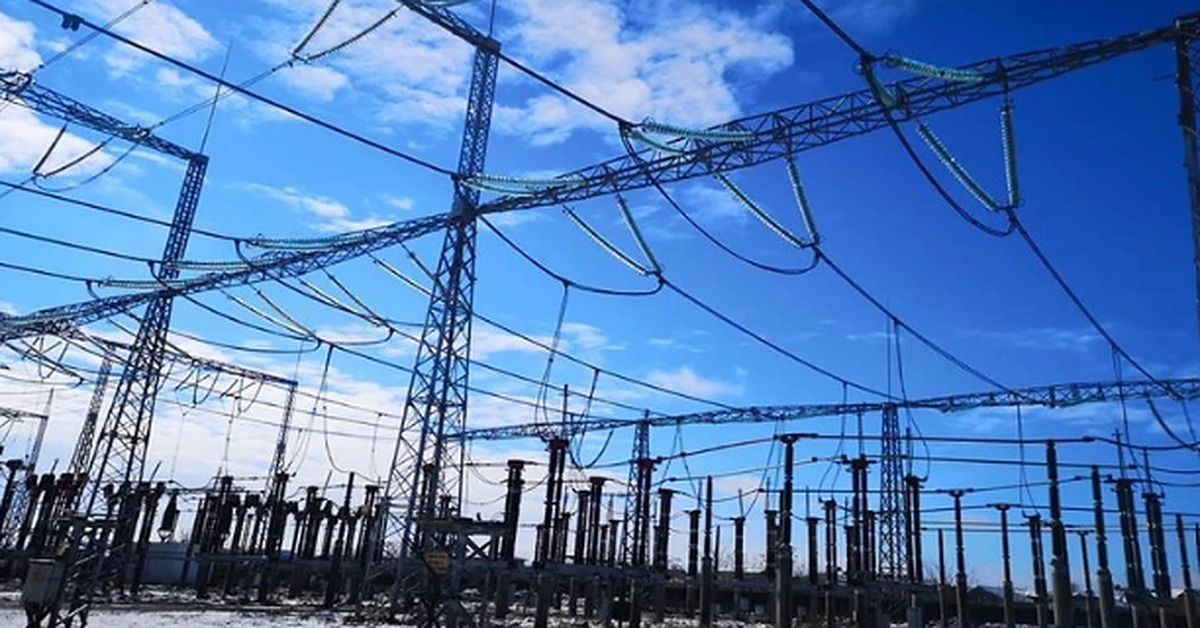
Transelectrica (BVB: TEL) is the operator of Romania’s high-voltage electricity transmission grid and of the national power system. In 2026, its net profit for the first nine months more than tripled to RON 611 million, the shares have gained about 35% since the start of the year, and the company is running its largest investment programme, with a ten-year plan of about RON 10.5 billion. The dividend paid in 2026, however, was much smaller than a year earlier.
With NAGA, you can buy Transelectrica shares (TEL) and own them directly, with full shareholder rights.
Why Invest in Transelectrica Stock (TEL) – Key Takeaways
- Profit growth: Net profit rose 235% to RON 611 million in the first nine months of 2026, driven by higher revenue from interconnection capacity allocation, a higher regulated transmission tariff and a positive result in activities that are meant to break even.
- Not all of it is recurring: Part of the increase depends on European power prices and on regulatory adjustments that can reverse in later years.
- Share price: At RON 101.40 on 13 November 2026, TEL is up about 35% since the start of the year and about 15% below its 52-week high of RON 119.60, reached in July.
- Investment programme: Shareholders approved a development plan of about RON 10.5 billion for 2026–2035 in November 2026, with more than RON 900 million planned for 2026, partly financed with EU funds.
- Dividends: In July 2026, the company paid RON 0.48 gross per share, a yield of about 0.5%, compared with RON 3.81 per share a year earlier.
- Investment empowerment: Buy TEL shares to gain exposure to Romania’s electricity infrastructure and potentially benefit from shareholder rights and capital appreciation.
Alternatively, you can copy the moves of lead traders in real-time with NAGA Autocopy.
Overview of Transelectrica Stock (BVB: TEL)
Founded in 2000, Transelectrica (Compania Națională de Transport al Energiei Electrice) is Romania’s electricity transmission and system operator. It runs the high-voltage grid that carries power from producers to distribution networks and large consumers, balances supply and demand in the national power system in real time, and manages the cross-border interconnections with neighbouring countries. Its shares have been listed on the Bucharest Stock Exchange since 29 August 2006.
Transelectrica is included in the BET index, which tracks the performance of the most liquid Romanian companies, with a weight of about 2% in November 2026.
- Ticker: TEL (Bucharest Stock Exchange); TELE in the NAGA Web App
- Ownership: The Romanian state holds 58.7%, through the General Secretariat of the Government, and PAVĂL Holding holds 6.5%
- Shares: 73.3 million
- Market capitalisation: About RON 7.4 billion on 13 November 2026
- Sector: Utilities – electricity transmission
- Employees: About 2,800
Transelectrica (TEL) Share Price and Stock Performance
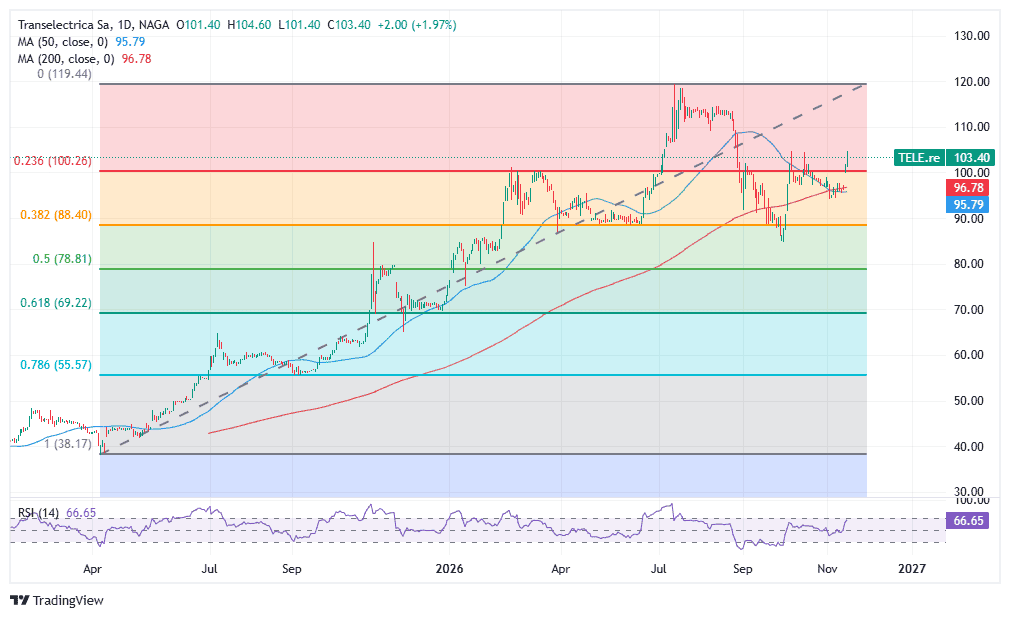
Transelectrica has been one of the strongest stocks on the Bucharest Stock Exchange over the past year and a half. The rally began in April 2025, from about RON 38, and took the price to about RON 100 in early 2026. After several months between about RON 88 and RON 100, the shares reached a 52-week high of RON 119.60 in July 2026.
A correction followed: by the end of September, the price had fallen to RON 86.10, about 28% below the July high. The shares then recovered to above RON 100 in October and closed at RON 101.40 on 13 November, after the nine-month results, up about 35% since the start of the year. The market capitalisation is about RON 7.4 billion.
Date Event Share price (RON) Apr 2025 Start of the rally (low) ~38 Early 2026 First test of RON 100 ~100 Jul 2026 52-week high 119.60 30 Sep 2026 After the autumn correction (closing price) 86.10 13 Nov 2026 After the nine-month results (closing price) 101.40
Transelectrica Dividends: 2026 Payment and Dividend History
Transelectrica’s dividend has varied widely from year to year. In 2026, shareholders received RON 0.48 gross per share from the 2025 profit, about RON 35 million in total, with the ex-date on 9 July and payment from 30 July 2026. At the 13 November share price, that is a yield of about 0.5%.
The 2026 dividend was approved only at a second meeting, on 22 May, after shareholders rejected the 2025 financial statements and the dividend proposal on 29 April. A year earlier, the company had paid RON 3.81 per share from the 2024 profit, about half of that year’s profit, while the 2026 payment was about 11% of the 2025 profit of RON 328 million.
Profit year Gross dividend per share (RON) Ex-date Payment date 2025 0.48 9 Jul 2026 30 Jul 2026 2024 3.81 10 Jul 2025 31 Jul 2025 2023 0.28 6 Jun 2024 27 Jun 2024 2022 0.71 6 Jul 2023 27 Jul 2023
Transelectrica Stock Analysis and Forecasting
Transelectrica stock (BVB: TEL) combines a regulated, strategic business and a large investment programme with profits that, in 2026, depend partly on volatile items. These are the main points:
Nine-Month 2026 Results
In the first nine months of 2026, net profit rose 235% to RON 611 million, from RON 183 million a year earlier. Total operating revenue increased 16% to RON 4.82 billion and reported EBITDA more than doubled to RON 960 million. Transelectrica reports two sets of activities: the “profit-allowed” operations, where it earns a regulated return, and the “pass-through” operations, such as the balancing market, which it is meant to run at cost.
In the profit-allowed operations, revenue rose 19% to RON 2,041 million while costs increased 9%, lifting EBITDA 37% to RON 850 million. The pass-through operations swung to an operating profit of RON 111 million from a loss of RON 156 million; the company describes the recovery of this backlog as complete.
Indicator (RON million) 9M 2026 9M 2025 Change Operating revenue, profit-allowed operations 2,041 1,716 +18.9% of which cross-border capacity rents 403 235 +71.4% of which regulated transmission fee 1,484 1,376 +7.8% Cost of grid losses 507 401 +26.5% EBITDA, profit-allowed operations 850 621 +36.8% Operating profit, pass-through operations 111 −156 From loss to profit Total operating revenue 4,816 4,150 +16.0% Reported EBITDA 960 465 +106.5% Operating profit (EBIT) 662 175 +278.0% Net profit 611 183 +234.8%
Most of the Increase Came in the Third Quarter
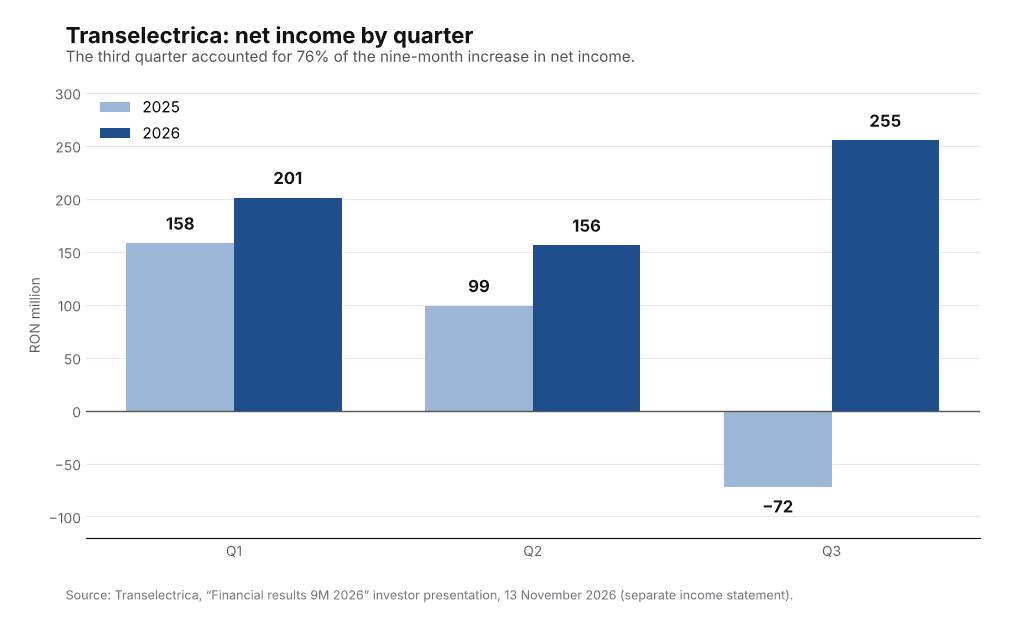
Transelectrica states that the third quarter accounted for 76% of the increase in nine-month net income. In the third quarter of 2026, net income was RON 255 million, against a loss of RON 72 million in the same quarter of 2025, when high balancing capacity prices pushed the pass-through operations to an operating loss of RON 203 million. In the third quarter of 2026, those operations earned RON 25 million. EBITDA from the core, profit-allowed operations rose 46% to RON 309 million, helped by cross-border congestion income of RON 140 million, up from RON 84 million.
Net income by quarter (RON million) 2026 2025 Change First quarter 201 158 +27% Second quarter 156 99 +57% Third quarter 255 −72 From loss to profit Nine months 611 183 +234.8%
What Drove the Profit, and What May Not Repeat
Three items explain most of the increase. Revenue from cross-border capacity rents rose by RON 168 million, the regulated transmission fee approved by the energy regulator ANRE added RON 107 million, after a tariff increase of about 11% against slightly lower volumes, and the pass-through operations swung from a loss of RON 156 million to a profit of RON 111 million.
Not all of this is likely to recur. Cross-border congestion income depends on electricity price differences between European markets and can fall as quickly as it rose, while the pass-through result is a base effect against a weak 2025 rather than new earnings power. Volumes were also lower: the energy billed fell 2.7% to 37.48 TWh. Costs are rising too: the average price Transelectrica paid for the energy it buys to cover grid losses increased 21% to RON 677 per MWh, and losses reached 2.34% of grid intake in the first nine months, above the 2026 regulatory cap of 2.26% as an annual average.
Investment Plan and Financial Position
Transelectrica is in the middle of its largest investment cycle. On 9 November 2026, shareholders approved the development plan for 2026–2035, worth about RON 10.5 billion, roughly RON 1 billion more than the previous version. It covers 117 projects: about 37% of the spending goes to modernising the existing grid, 23% to stronger links with neighbouring countries and 22% to connecting renewable and other new power plants in Dobrogea and Moldova. In the first nine months of 2026, the company signed new contracts worth RON 777 million, added RON 702 million to assets under construction and commissioned assets worth RON 431 million. Part of the funding comes from EU programmes, including the Modernisation Fund.
The balance sheet carries little financial debt, about RON 61 million. The company reported cash of RON 1.75 billion, but most of it is earmarked for specific purposes, such as investment projects and regulated activities.
Valuation
Net profit over the last 12 months was about RON 756 million, or about RON 10.30 per share. At RON 101.40, Transelectrica therefore trades at a price-to-earnings ratio of about 10, and at a price-to-book ratio of about 1.1. Part of the profit comes from zero-profit activities and interconnection revenue, so the ratio would be higher on recurring earnings alone. The price-to-earnings ratio shown on the Bucharest Stock Exchange website, about 15, does not yet include the nine-month results.
Transelectrica Technical Analysis: Key Levels to Watch
On the daily chart, the rally from the April 2025 low of RON 38.17 to the July 2026 high of RON 119.44 is the reference move. The autumn correction briefly fell below the 38.2% Fibonacci retracement, at RON 88.40, before buyers returned. In the 16 November session, the price moved above the 23.6% retracement, at RON 100.26, and above both the 50-day (RON 95.79) and the 200-day (RON 96.78) moving averages. The RSI, at about 67, is close to the overbought zone.
If the price holds above RON 100.26, the October high of about RON 105 is the first resistance, followed by the RON 110 area, where the shares traded in August, and the July high near RON 119.50. A daily close back below RON 100 would turn attention to the moving averages, between RON 95.80 and RON 96.80, and then to the 38.2% retracement at RON 88.40.
Level Price (RON) Why it matters Resistance 3 119.44 July 2026 high (52-week high area) Resistance 2 ~110 August 2026 trading range Resistance 1 ~105 October 2026 high Support 1 100.26 23.6% Fibonacci retracement Support 2 95.79–96.78 50-day and 200-day moving averages Support 3 88.40 38.2% Fibonacci retracement Support 4 ~85 September 2026 low
Past performance is not a reliable indicator of future results. All historical data, including but not limited to returns, volatility, and other performance metrics, should not be construed as a guarantee of future performance.
Technical traders using the NAGA Web App can leverage real-time charts, indicators, and automated alerts to time entries and exit.
Transelectrica Stock Forecast: Analyst Coverage and Outlook
Transelectrica has little published analyst coverage, and the main data aggregators show no consensus price target. The outlook depends mainly on three factors:
- Regulated tariffs: the transmission tariff set by ANRE determines most of the profit from the core business, and future tariff decisions will reflect the investment programme.
- Interconnection revenue: a large part of the 2026 profit growth came from cross-border capacity allocation, which depends on European power prices.
- Investment execution: the planned investments of about RON 10.5 billion by 2035 should expand the regulated asset base, but require timely execution and funding.
Key risks
- Non-recurring profit: part of the 2026 increase comes from items that can reverse, such as zero-profit activities and interconnection revenue.
- Regulation: tariffs and the allowed return are set by the energy regulator, so regulatory decisions can change profitability.
- State control: the state holds 58.7% of the shares, and the 2026 dividend was approved only at a second shareholders’ meeting.
- Low and variable dividend: the 2026 dividend yield is about 0.5%, and the payout has varied widely from year to year.
- Volumes and grid losses: the energy billed fell 2.7% in the first nine months of 2026, while grid losses of 2.34% ran above the 2026 regulatory cap of 2.26%, at prices 21% higher than a year earlier.
- Volatility: the shares fell by about 28% between July and the end of September 2026.
Important: When considering Transelectrica's fundamental analysis, financial rating and price predictions, it’s important to remember that high market volatility and a changing economic environment make long-term estimates difficult. As such, analysts and algorithm-based platforms can and do get their ratings and predictions wrong. Always do your own research before making an investment decision. And never trade or invest more than you can afford to lose.
How and Where to Buy Transelectrica (TEL) Shares
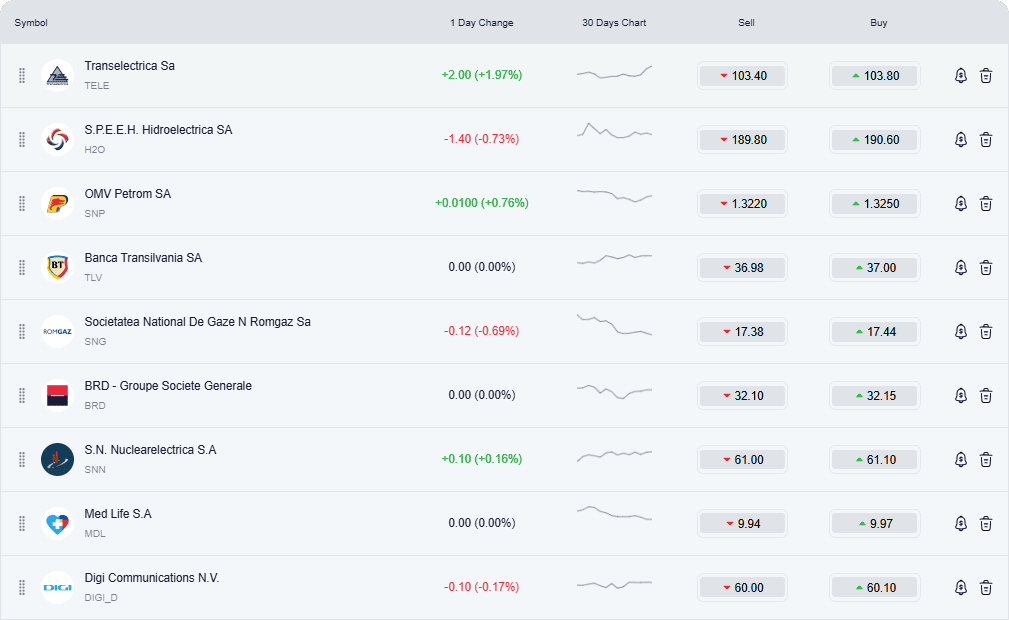
On NAGA, you can open an Invest Account to directly purchase Transelectrica shares as well as a wide range of stocks listed on the BET Index. Owning shares grants dividend rights and voting privileges, potentially suitable for long-term investors focused on compounding wealth through stock appreciation and income.
How to get started with TEL stock on NAGA
Here is how to buy Transelectrica stock (TEL) with NAGA, a trademark of The NAGA Group AG, a German-based FinTech company publicly listed on the Frankfurt Stock Exchange:
- Create an account – Open an Invest account for full stock ownership.
- Complete the verification – Complete the KYC verification for compliance.
- Deposit funds – Add RON, EUR, USD, or other supported currencies.
- Search for “Transelectrica” or the “TELE” symbol (BVB ticker: TEL) – Access Transelectrica shares on the platform.
- Take your position – Place orders to buy Transelectrica shares.
- Manage your portfolio – Use NAGA’s portfolio tracking, social trading, and risk management tools.
Should you buy Transelectrica stock (TEL) today?
Transelectrica offers exposure to Romania’s electricity transmission grid, a regulated business with a large investment programme, low financial debt and strong profit growth in 2026. At the same time, part of that profit may not repeat, the dividend is small and variable, and the state controls the company. Consider your investment time horizon and risk tolerance, as regulatory decisions, energy prices and market volatility may affect the share price.
Direct ownership of TEL shares offers distinct advantages to leverage the company’s potential within your investment strategy.
Free resources
Before you start investing in Transelectrica shares, you should consider using the educational resources we offer like NAGA Academy or a demo trading account. NAGA Academy has lots of free trading courses for you to choose from, and they all tackle a different financial concept or process – like the basics of analyses – to help you to become a more informed trader.
Our demo account is a great place for you to learn more about leveraged trading, and you’ll be able to get an intimate understanding of how CFDs work – as well as what it’s like to trade with leverage – before risking real capital. For this reason, a demo account with us is a great tool for investors who are looking to make a transition to leveraged trading.
Sources:
- https://www.transelectrica.ro/web/tel/financiar
- https://www.bvb.ro
- https://stockanalysis.com/quote/bvb/TEL/dividend/