




Cocoa is one of the world’s most important soft commodities and a major raw material for the global chocolate and confectionery industry. Because demand is steady, but supply can shift quickly due to weather, crop conditions, shipping disruptions, and political developments in producing regions, the cocoa market can offer interesting opportunities for investors looking for diversification and exposure to commodities.
The current cocoa market correction may represent an attractive entry point before the next structural supply squeeze—expected by late 2027 as aging West African plantations continue to struggle with productivity.
Cocoa Trading and Investing - Key Takeaways
- From West African production hubs to global chocolate demand, cocoa's supply chain creates predictable price drivers you can track for informed decisions.
- Weather, harvests, and economic factors shape cocoa trends – learning these helps you anticipate potential opportunities before they fully develop.
- Start with direct options like cocoa futures and CFDs, then explore indirect plays through ETFs and cocoa-related stocks based on your goals.
- Live charts, multiple instruments, and risk tools guide you from learning to live trading cocoa positions with NAGA.
Understanding the cocoa market
Cocoa has a long trading history dating back centuries and has evolved into a globally traded market forecasted to grow to $38 billion by 2032 despite ongoing supply challenges. Today, it attracts both traders and investors because its price is influenced by supply conditions, weather, crop quality, and demand from the food industry.
Before getting started, it helps to understand where cocoa comes from and why certain countries play such an important role in global supply.
Top cocoa-producing countries
Global farmers produce roughly 4.4 to 5 million metric tons of cocoa beans annually. West Africa is the heart of production, with Côte d'Ivoire (1.8 to 2.2 million metric tons annually) supplying nearly 40% of the world's cocoa, followed by Ghana (600,000 to 700,000 metric tons), Ecuador (480,000 to 650,000 metric tons), Indonesia, Nigeria, Cameroon, and Brazil. On the demand side, Europe is the largest importer and processor of cocoa beans.
The cocoa market has experienced historic supply-side constraints due to severe weather disruptions and crop illnesses in West Africa. This has led to intense price fluctuations and a structural deficit as demand pushes higher.
Cocoa’s prices in recent years
Cocoa prices have been extremely volatile in recent years, with sharp rallies driven by supply shortages and weather disruptions, followed by pullbacks as the market reacts to changing crop expectations and demand conditions. The market reached a record high of around 12,000 per ton seen during the 2024–2025 supply crisis. Prices have largely normalized, fluctuating between $3,000 and $4,500 per metric ton in the first half of 2026
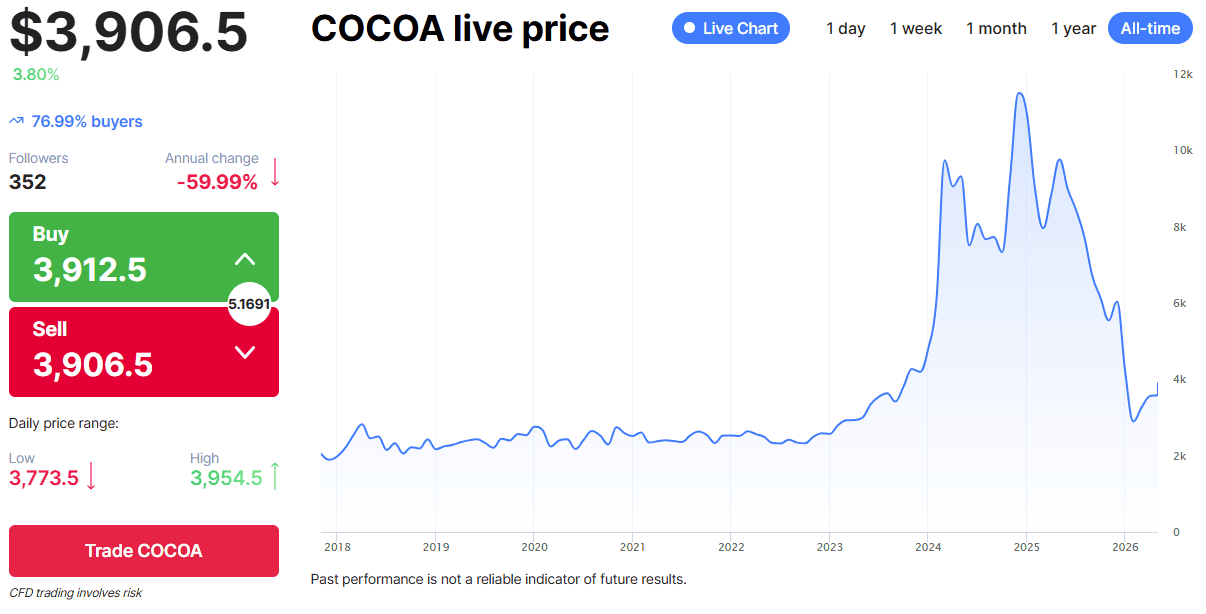
These price swings underscore cocoa's appeal to investors seeking commodity exposure with high volatility potential. On the other hand, producers and large corporate buyers need to protect against falling and rising prices.
What affects Cocoa prices?
Cocoa prices respond to global supply and demand dynamics. Production is concentrated in tropical regions where weather, logistics, and politics can quickly disrupt supply. This sensitivity creates sharp price reactions to new developments.
Weather conditions
Weather is one of the main drivers of cocoa prices, with West African droughts or heavy rainfall often reducing crop yields by 20–30% in key producing regions. These disruptions quickly trigger market reactions, as traders price in potential supply shortages.
Supply and demand
Global chocolate demand continues to grow at around 2–3% annually, while West Africa accounts for nearly 70% of supply but has recently seen output declines of about 14% due to crop diseases and structural challenges. When demand exceeds supply, prices tend to rise, while surplus conditions typically lead to market corrections.
Harvest cycles and seasonal patterns
West African main crop (Oct-Mar) sets annual pricing. Off-season (Apr-Sep) brings tight supply and volatility spikes. Traders position ahead of harvest reports for 10-20% moves.
Currency movements
USD strength makes cocoa expensive for non-US buyers. A 10% dollar rally can reduce emerging market demand by 8-15%. Weaker USD supports global chocolate makers and lifts prices.
Inflation and economic conditions
High inflation drives commodity buying as inflation hedge. Interest rate hikes slow consumer spending on chocolate products. Rate cuts boost demand while hikes pressure prices downward.
Political instability
Ivory Coast/Ghana produce 60% of world cocoa. Export bans, farmer strikes, or civil unrest cut supply 5-15% short-term. Policy shocks create 20%+ weekly price swings.
Cocoa price forecast 2026-2030
The cocoa price forecast for 2026 and beyond points to a market stabilization after the strong downward correction in the first two months of the year. Analysts and market intelligence firms outline the following outlook and targets above historical averages for the remainder of 2026, due to aging plantations, low-farm productivity, and ongoing supply constraints in West Africa:
- Just2Trade market analysis: Projects a mid-year average of $3,194/ton, easing further toward a year-end estimate of $2,703/ton.
- ING commodities research: Forecasts London cocoa futures to average slightly over £3,400 per ton (roughly $4,500–$4,600/ton), noting that while prices are down from peak crisis levels, they will remain above pre-2023 norms.
- J.P. Morgan global research: Maintains a slightly more conservative medium-term expectation of $6,000/ton. They view this as a structural floor while the multi-season availability constraints in West Africa fully heal.
- World Bank: Expects cocoa and broader beverage prices to continue moderating through 2026 as supply chains stabilize.
The severe deficits of the previous two years have given way to consecutive surpluses. Commodity tracker StoneX estimates a 247,000-tonne global surplus for the 2025/26 crop year, driven by improving weather conditions and recovering harvests in Côte d'Ivoire and Ghana.
Additionally, high raw material costs from previous seasons forced chocolate manufacturers to shrink product sizes or substitute cocoa butter with alternative fats. This led to a 7.8% drop in European cocoa grindings and a 3.8% drop in North American grindings in early 2026, severely dampening demand.
How to invest in the Cocoa market
There are several ways traders can gain exposure to cocoa markets, depending on their trading style, risk tolerance, and investment goals. Some traders prefer short-term speculative products, while others may choose indirect exposure through funds or shares of cocoa-related companies. Your choice will also depend on whether you want to own physical cocoa assets or not.
Trading Cocoa futures
When you trade cocoa, it is likely that you will be trading futures, the most popular way to gain cocoa exposure, offering high liquidity and volatility. Cocoa futures are standardized contracts that let traders agree to buy or sell cocoa at a set price on a future date.
They are traded on major commodity exchanges and are used by speculators (hedge funds, algorithmic traders, and retail investors), and commercial hedgers (farmers, exporters, and chocolate manufacturers) to manage cocoa price risk.
Traders can go long if they expect prices to rise or short if they expect them to fall, and leverage can increase both opportunity and risk. Cocoa futures on ICE also offer high liquidity and long trading hours (generally from 1:30 AM to 3:15 PM ET), which makes them accessible to global market participants.
How futures contracts work
- Margin trading: Traders do not pay the full contract value. They deposit a small fraction (initial margin) as collateral to open a position.
- Daily settlement: At the end of each trading day, the exchange adjusts accounts. Profits are credited, and losses are deducted based on closing prices.
- Resolution: Over 99% of contracts are closed out (offset) before maturity. Very few result in actual physical delivery of cocoa to exchange-approved warehouses.
Key futures trading specifications
- Primary exchanges: Intercontinental Exchange (ICE) US (trades in USD) and ICE Europe (trades in GBP).
- Contract size: One contract equals 10 metric tons of cocoa beans.
- Price quotation: Traded in dollars or pounds per metric ton (e.g., $4,200/ton).
- Delivery months: Active contracts mature in March, May, July, September, and December.
With NAGA, you can trade CFDs on Cocoa Futures. With CFD trading, you can deal on changing prices of cocoa futures without buying or selling the contract. CFD trading uses leverage, which means you only must put up a small margin to gain exposure to the full value of the trade. This can magnify your potential profit – but also your potential loss.
Learn more about CFD trading and how does it work
Traditional cocoa funds
Because cocoa is a physical agricultural commodity, investors cannot hold physical beans in a traditional fund. Instead, asset managers use Exchange-Traded Products (ETPs), which primarily fall into three structural types: Exchange-Traded Commodities (ETCs), Exchange-Traded Notes (ETNs), and Multi-Commodity ETFs.
Exchange-Traded Commodities (ETCs)
ETCs are the most common type used to trade individual soft commodities like cocoa. They trade exactly like stocks on exchanges but use synthetic financial swaps to replicate the daily movements of cocoa futures contracts.
- How they work: The fund managers buy derivative contracts linked to benchmarks like the Bloomberg Cocoa Subindex.
- Key Example: WisdomTree Cocoa (Ticker: COCO / COCOA). Listed on the London Stock Exchange (LSE) and Borsa Italiana, this is the most liquid and widely traded pure cocoa vehicle globally.
Leveraged and Inverse Cocoa ETPs
Cocoa ETPs are designed for short-term trading and tactical speculation rather than long-term buy-and-hold investing. They use aggressive financial leverage to amplify the daily price movements of cocoa futures.
- How they work: Daily leveraged products amplify the underlying index returns by a set multiplier (e.g., 2x). Inverse products provide the exact opposite return to profit from falling prices.
- Leveraged Example: WisdomTree Cocoa 2x Daily Leveraged (Ticker: LCOC). A 1% rise in cocoa futures translates to a 2% gain; conversely, a 1% drop results in a 2% loss.
- Inverse Example: WisdomTree Cocoa 1x Daily Short (Ticker: SCOC). Tailored for bearish outlooks, it gains value when cocoa prices plummet.
Multi-Commodity ETFs
These are diversified Exchange-Traded Funds (ETFs) that bundle cocoa alongside other agricultural assets, soft commodities, or broader resource indexes.
- How they work: Rather than offering 100% exposure to cocoa, these funds cushion volatility by diluting cocoa holdings with coffee, sugar, corn, soybeans, or energy contracts.
- Key Example: Teucrium Agricultural Fund (Ticker: TAGS) or the First Trust Global Tactical Commodity Strategy Fund (Ticker: FTGC). These funds actively or passively rebalance a basket of commodities to balance risk.
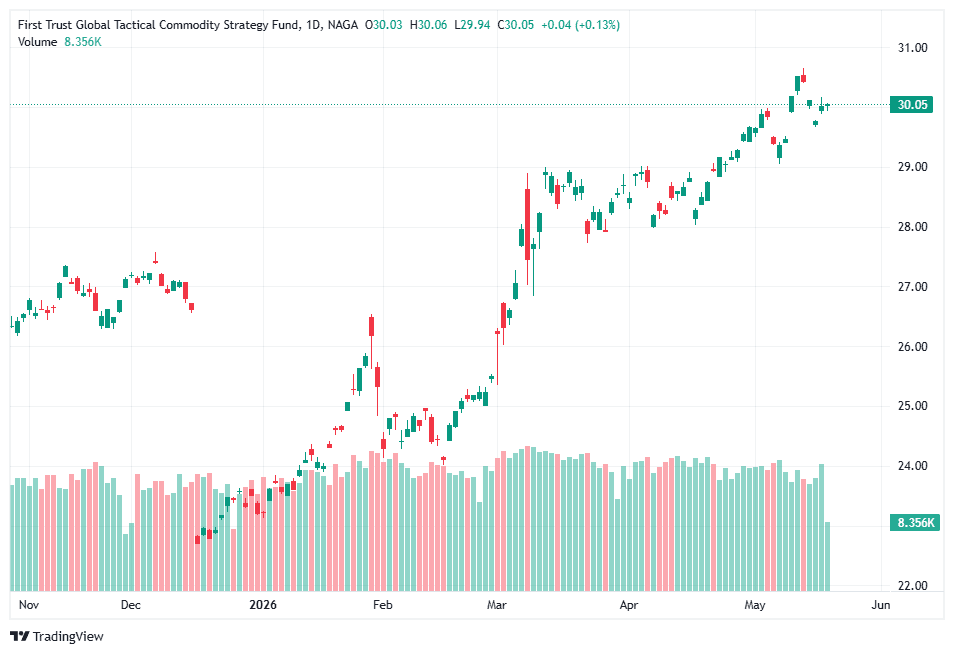
Past performance is not a reliable indicator of future results. All historical data, including but not limited to returns, volatility, and other performance metrics, should not be construed as a guarantee of future performance.
Exchange-traded funds (ETFs) are one of the most rapidly gaining popularity as an investment asset. You can take advantage of it for trading on NAGA on convenient terms.
Discover the best ETFs for 2026
Cocoa and agriculture stocks
Cocoa stocks are shares of publicly traded companies whose business models, revenues, and profit margins are directly tied to the cocoa supply chain. Because you cannot buy stock in a literal cocoa tree, investors buy shares in the businesses that touch the bean. Agriculture stocks are categorized into three main stages:
- The Processors (Midstream): Industrial giants that buy raw cocoa beans from farms, grind them down, and sell bulk cocoa butter, powder, and liquor to food brands (e.g., Barry Callebaut).
- The Pure Manufacturers (Downstream): Brands that turn processed cocoa into consumer chocolate products. Their profits are highly sensitive to cocoa prices (e.g., The Hershey Company, Lindt & Sprüngli).
- The Diversified Conglomerates: Global food giants that own massive chocolate brands but balance their cocoa risk with other products like biscuits, coffee, or pet food (e.g., Mondelez International, Nestlé).
Stock prices may be influenced not only by cocoa prices, but also by company performance and broader market conditions.
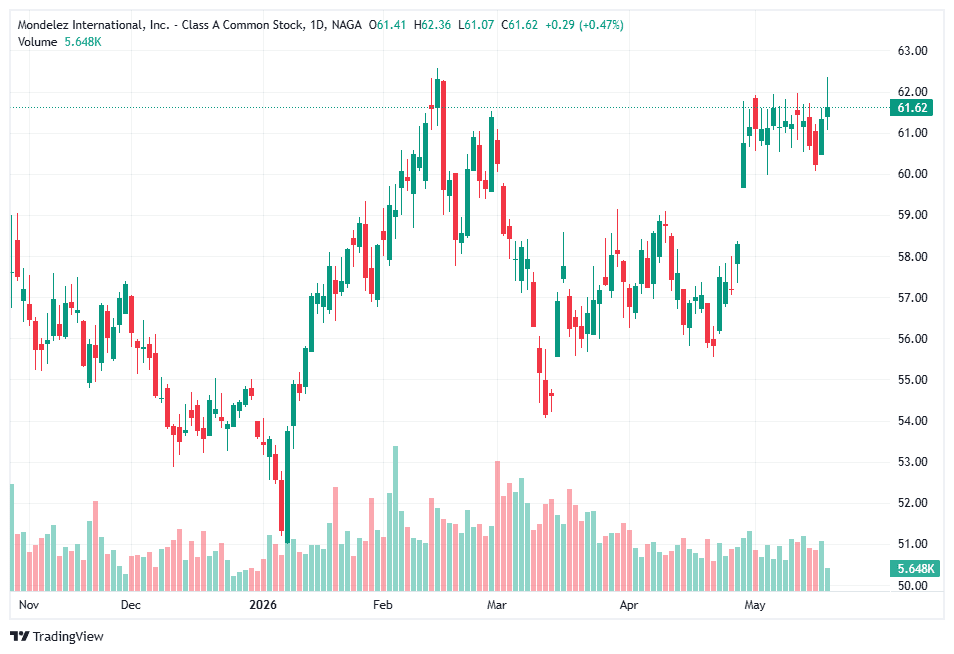
Past performance is not a reliable indicator of future results. All historical data, including but not limited to returns, volatility, and other performance metrics, should not be construed as a guarantee of future performance.
With NAGA you can invest in stocks with ownership or trade stocks via CFDs for more flexibility.
Pros and cons of investing in the cocoa market
Investing in cocoa and cocoa related assets offers a distinct balance of high-growth potential and intense structural risks. The pros and cons change completely depending on whether you choose to trade the raw commodity directly or buy corporate shares.
Pros of investing in Cocoa
Cons of Investing in Cocoa
- Massive global demand: Global consumption of chocolate and cocoa-based confectionery is steadily rising, driven by a growing middle class in Asia and Latin America.
- Effective inflation hedge: As raw commodity prices rise, cocoa futures and global chocolate stocks with strong pricing power can pass costs to consumers, preserving investor returns.
- Portfolio diversification: Soft commodities like cocoa move independently from traditional stock indices and bond markets, reducing overall portfolio volatility.
- Extreme price volatility: Sharp price swings provide active traders and speculators with frequent opportunities to capture large short-term profits.
- Cyclical macro trends: The market follows long, distinct multi-year crop cycles tied to weather and tree maturation, allowing traders to forecast major supply shifts.
- Extreme climate sensitivity: Cocoa is a fragile crop that only grows near the equator. El Niño patterns, droughts, and crop diseases in West Africa can abruptly wipe out supply and cause chaotic price spikes.
- Geopolitical & regulatory risks: Over 60% of the world's cocoa originates in developing nations like Côte d'Ivoire and Ghana. Changes in government export floors, local instability, or strict international laws—such as the EU Deforestation Regulation (EUDR)—can severely disrupt trading networks.
- Margin and leverage: Trading cocoa futures or CFDs requires margin accounts. High leverage can amplify trading losses quickly if the market moves against your position.
- Contango roll costs: Holding long-term positions in cocoa Exchange-Traded Commodities (ETCs) exposes investors to "roll yield" losses when expiring futures contracts must be replaced with higher-priced future months.
- Margin compression for stocks: Spiking raw material costs directly hit the bottom line of confectioners, squeezing the profit margins of popular chocolate stocks if they cannot raise store prices fast enough.
Are you looking to build a long-term buy-and-hold position in the cocoa market, or are you looking to execute short-term tactical trades? Open a demo account and find the most suitable strategy for you to gain exposure on the cocoa market.
Cocoa futures trading strategies and examples
Once you’ve familiarised yourself with the different ways to trade cocoa, you can choose which method best suits your trading strategy and risk appetite. Some of the most popular are:
- Trend following (macro supply cycle strategy): Traders ride long-term market directions fueled by changing agricultural fundamentals or weather disruptions.
- Spread trading (inter-market arbitrage): Traders exploit temporary, artificial price differences between different delivery months or different geographic exchanges.
- Range bound trading (consolidation strategy): Traders capitalize on periods of quiet, predictable market behavior when no major weather disruptions or supply deficits exist.
Register to NAGA webinars to learn more about different trading strategies and read the following real world trading examples.
Example A: Trader capturing a short-term cocoa price drop (short trade)
In this scenario, a retail trader using NAGA trading app notices that cocoa warehouse inventory levels are surging, indicating an upcoming oversupply. The current price of COCOA.f sits at $4,000 per metric ton.
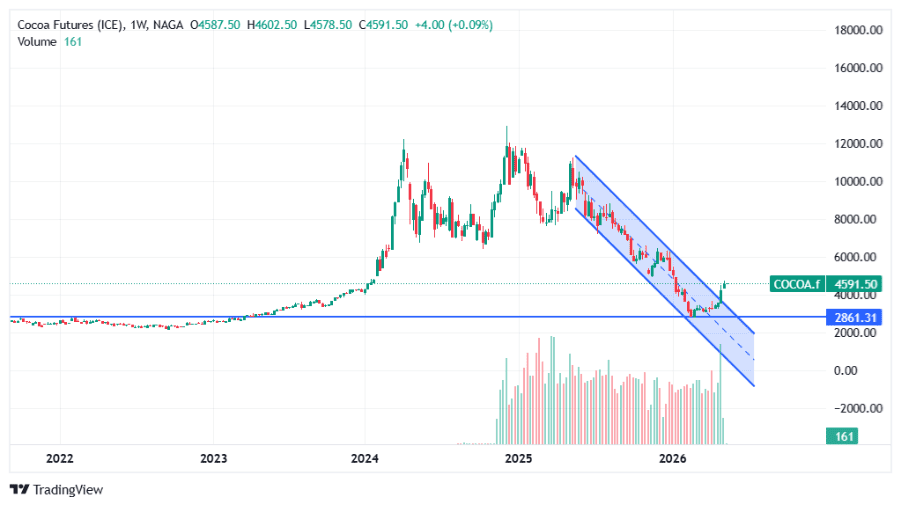
Past performance is not a reliable indicator of future results. All historical data, including but not limited to returns, volatility, and other performance metrics, should not be construed as a guarantee of future performance.
- The action: The trader opens a Short Position for 1 contract (10 metric tons).
- Total contract value: $40,000
- Margin required (e.g., 10%): $4,000 deposit
- The outcome: Two weeks later, the market drops to $3,700 per metric ton. The trader buys back the contract to close the position.
- Gross Profit Calculation: ($4,000 - $3,700) × 10 metric tons = $3,000 profit (minus trading fees).
Note that if the market goes against your short position and jumps to $4,300 per metric ton, the financial mechanics operate in exact reverse.
- The loss calculation: The price increased by $300 per ton ($4,300 - $4,000). For a 1-contract position (10 metric tons), this creates a gross loss of $3,000.
- The margin account impact: NAGA’s clearing system evaluates positions continuously in real-time. This $3,000 floating loss is immediately subtracted from your available account equity. If your margin level starts dropping, the platform will execute an automatic Margin Call or a Stop-Out, automatically closing your trade to prevent your account from going into a negative balance.
Example B: Commercial buyer locking in cocoa production costs (long hedge)
A chocolate manufacturer needs to purchase 100 metric tons of raw cocoa beans in six months for their holiday production line. The current futures price is $3,500 per metric ton. They fear bad weather will drive cocoa prices up.
- The action: The manufacturer executes a Long Hedge by buying 10 cocoa futures contracts (10 tons each × 10 = 100 tons) at $3,500.
- The outcome: Six months later, a supply shortage drives the spot market price up to $4,200 per metric ton.
- Physical market impact: The manufacturer must pay an extra $700 per ton ($70,000 total premium) to buy physical beans from their supplier.
- Futures market impact: Their 10 futures contracts gained $700 per ton in value. They sell the contracts for a $70,000 profit (gross).
- Net result: The futures profit completely cancels out the physical market price spike. Their effective cost remains locked at $3,500 per ton.
All trading involves risk, especially if you’re using leverage, which is why you need a risk management strategy to protect against unnecessary losses. There are ways in which you can minimise your risk, which includes attaching stops to your positions. Stops will close your trade at a certain point if the market moves against you, to prevent you losing more than you’re prepared to.
How to start trading cocoa on NAGA
Getting started with cocoa trading on NAGA is straightforward. The platform gives you access to multiple cocoa exposure options, live market data, and tools to help you make informed decisions.
- Learn the cocoa market drivers – Weather in West Africa, supply forecasts from Ivory Coast/Ghana, and chocolate demand create predictable price patterns you can anticipate.
- Choose your trading instrument – Trade Cocoa Futures (ICE) | COCOA.f for direct exposure, or cocoa related stocks for indirect exposure.
- Use NAGA's analysis tools – Live charts, technical indicators, economic calendar, and insights help identify optimized entry/exit points.
- Apply smart risk management – Set stop-loss/take-profit levels and position size properly to navigate cocoa's volatility (10-20% weekly swings common).
With your strategy ready, NAGA makes execution simple – whether trading manually, copying trade leaders, or using automated signals.
Conclusion
Cocoa investing offers exposure to a dynamic commodity market driven by global demand and supply challenges. Weather patterns, harvest cycles, and economic conditions create opportunities across different timeframes, whether through direct instruments like futures and CFDs or indirect exposure via ETFs and stocks.
NAGA simplifies cocoa market access with live pricing, multiple exposure options, and tools to help investors navigate volatility. Understanding the key drivers and choosing the right approach can help you position for both short-term swings and longer-term trends.
Start Trading Cocoa on NAGA Today
Sources:
- International Cocoa Organization (ICCO)
- Intercontinental Exchange (ICE) Cocoa Futures
- World Bank Commodities Data
- Food and Agriculture Organization (FAO)