



The global wheat market is one of the world's largest agricultural commodity markets, with global production projected to exceed 800 million metric tons during the 2025/26 marketing year. Wheat prices are influenced by weather conditions, harvest yields, export policies, geopolitical developments, and global food demand, making the market attractive for both active traders and long-term investors.
Following several years of supply disruptions linked to geopolitical tensions and adverse weather, the wheat market entered 2026 with improving production prospects in several exporting countries. However, ongoing uncertainty surrounding Black Sea exports, climate conditions, and global inventories continues to create price volatility, leading many analysts to expect wheat prices to remain highly responsive to both agricultural fundamentals and international trade developments.
Wheat Trading and Investing – Key Takeaways
- From global harvests to Black Sea exports, wheat markets are driven by weather, trade policies, and supply trends that traders and investors can actively monitor.
- Weather conditions, USDA reports, and geopolitical developments regularly influence wheat prices, creating both short-term volatility and longer-term investment opportunities.
- Investors can gain exposure through direct instruments like wheat futures and CFDs, or indirectly through ETFs and agriculture-related stocks, depending on their investment strategy.
- Live charts, multiple trading instruments, and integrated risk management tools help traders navigate global wheat markets with NAGA.
Understanding the wheat market
Wheat has been cultivated and traded for thousands of years and remains one of the world's most important agricultural commodities. Today, global wheat production exceeds 800 million metric tons annually, with prices influenced by weather conditions, crop yields, export restrictions, geopolitical events, and changing global food demand.
Before investing in wheat markets, it helps to understand where wheat is produced and why a relatively small number of exporting countries play a major role in determining global supply and pricing.
Top wheat-producing countries
Global wheat production exceeds 800 million metric tons each year. China is the world's largest producer, followed by India, Russia, the United States, and France. While China and India consume most of their domestic production, countries such as Russia, Canada, Australia, and the United States dominate global wheat exports.
The wheat market has experienced recurring supply disruptions due to droughts, extreme weather, export restrictions, and geopolitical tensions affecting Black Sea trade. These factors continue to create periods of tighter global supplies and elevated price volatility.
Wheat prices in recent years
Wheat prices have experienced significant volatility in recent years, driven by adverse weather conditions, geopolitical tensions, export restrictions, and changing global supply and demand. Wheat futures surged to multi-year highs during 2022 following disruptions to Black Sea grain exports before gradually easing as production recovered in several major exporting countries.
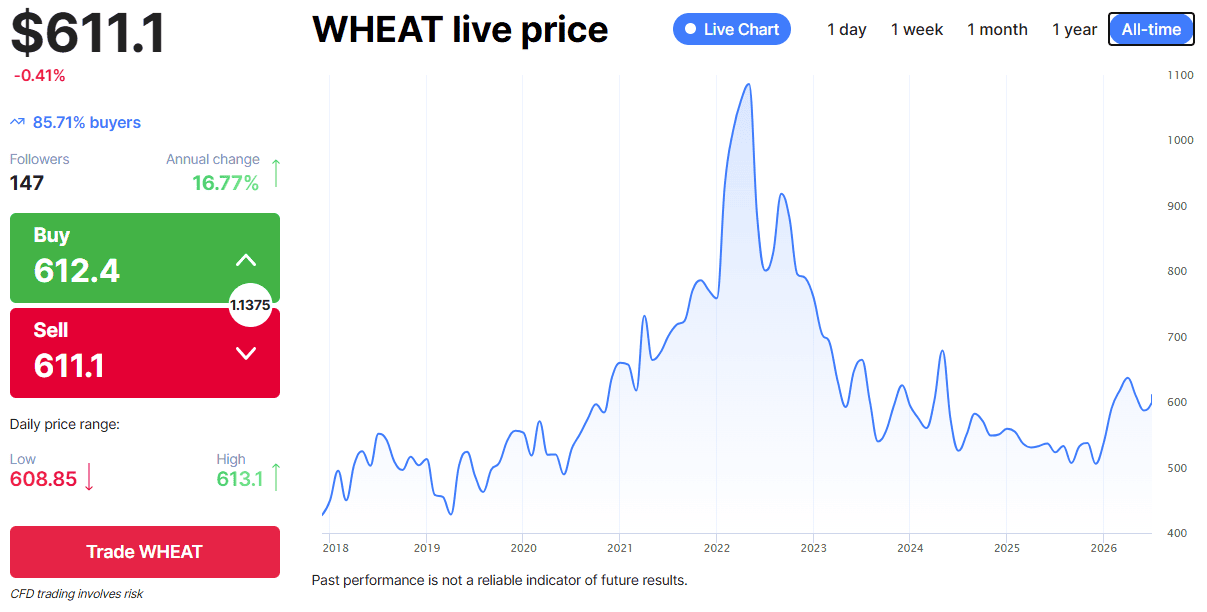
During the first half of 2026, CME Wheat Futures largely traded between 580 and 680, while WHEAT CFD (CME) on NAGA hovered around 610–615, reflecting improved harvest expectations alongside continued uncertainty surrounding global grain exports and weather conditions. Although worldwide wheat production has recovered from previous supply disruptions, climate risks, geopolitical developments, and government trade policies continue to generate periodic volatility across global wheat markets.
These price movements continue to attract active traders seeking commodity exposure, while grain merchants, food manufacturers, flour mills, and commercial buyers use wheat futures markets to hedge against fluctuations in raw material costs.
What affects wheat prices?
Wheat prices respond quickly to changes in global supply and demand dynamics. Because wheat is a staple food crop grown across multiple continents, prices are influenced by weather conditions, harvest yields, export policies, geopolitical developments, and global food demand. These factors can trigger sharp price movements across both physical wheat markets and wheat futures.
Weather conditions
Weather remains one of the biggest drivers of wheat prices, as droughts, excessive rainfall, heatwaves, and freezing temperatures can significantly reduce yields in major producers such as the United States, Russia, Canada, and Australia. Severe weather events can lower harvests by 5%–15% in affected regions, often triggering sharp price increases.
Currency movements
Because wheat is primarily traded in US dollars, exchange rate fluctuations directly influence global trade competitiveness. A stronger dollar makes wheat more expensive for importing countries, while a weaker dollar generally supports export demand and commodity prices.
Global supply and demand
Global wheat production exceeds 800 million metric tons annually, while consumption continues to rise with population growth and food demand. Lower harvests, declining inventories, or stronger import demand can tighten supplies, whereas bumper crops generally place downward pressure on prices.
Harvest cycles and seasonal patterns
Harvest seasons in major exporters such as the United States, Russia, Canada, and Australia strongly influence market sentiment. Traders closely monitor crop progress and harvest reports, as seasonal production updates can generate 5%–10% price swings during key growing periods.
Geopolitical developments
The Black Sea region accounts for a significant share of global wheat exports. Armed conflicts, export restrictions, sanctions, or disruptions to shipping routes can quickly reduce available supplies and increase volatility across international wheat markets.
Government reports and trade policies
Market participants closely follow USDA WASDE reports, export sales data, and policy decisions from major exporting countries. Revisions to production forecasts, ending stocks, or export restrictions often trigger immediate reactions in wheat futures prices.
Wheat price forecast 2026–2030
The wheat market outlook for 2026 and beyond points to a gradual stabilization following several years of weather disruptions and geopolitical uncertainty. While global production is expected to recover, analysts believe wheat prices will remain above long-term historical averages as climate risks, export policies, and global food security continue influencing market fundamentals.
- USDA wheat market projections: The USDA projects global wheat production to exceed 808 million metric tons during the 2026/27 marketing year, while global consumption is expected to remain above 810 million metric tons. Strong import demand and relatively tight ending stocks are expected to keep prices supported despite improving harvests.
- World Bank commodities outlook: The World Bank expects wheat prices to stabilize through 2026 as global supply conditions improve. However, weather risks, geopolitical developments, and rising production costs are expected to keep wheat prices above pre-2021 averages across international markets.
- International Grains Council (IGC) outlook: The International Grains Council (IGC) forecasts continued growth in global wheat trade, supported by recovering exports from major producing countries. The Council expects world wheat production and consumption to remain closely balanced, limiting the pace of inventory rebuilding.
- Rabobank commodities research: Rabobank expects wheat futures to remain highly sensitive to weather conditions in the Northern Hemisphere and developments affecting Black Sea exports. The bank notes that wheat prices are likely to fluctuate within the 560–680 range during 2026, depending on harvest conditions and global export flows.
Wheat Price Forecast 2026–2030: Analyst and Institutional Outlooks
Institution Key Forecast USDA Production: 808+ million metric tons (2026/27) World Bank Stable wheat prices through 2026 IGC Production and consumption expected to remain closely balanced Rabobank Expected range: 560–680
Climate-related risks remain one of the biggest long-term challenges for wheat markets. More frequent droughts, heatwaves, and water shortages may continue affecting crop yields across major exporting regions, contributing to elevated price volatility throughout the remainder of the decade.
At the same time, global population growth and rising food demand are expected to support wheat consumption through 2030, particularly across emerging markets where wheat remains a staple food commodity.
How to trade and invest in the wheat market
There are several ways traders and investors can gain exposure to wheat markets depending on their risk tolerance, investment horizon, and financial objectives. Some prefer direct exposure through futures and CFDs, while others choose indirect exposure through ETFs or shares of companies operating across the global agricultural supply chain.
Your choice will also depend on whether you are looking to trade short-term price movements or build longer-term exposure to the global wheat market.
Trading wheat futures
When traders invest in wheat markets, they typically gain exposure through trading future, the most liquid and actively traded wheat instruments globally. The primary benchmark is CBOT Wheat Futures, traded on the Chicago Board of Trade (CME Group) and widely used by hedge funds, commodity traders, grain merchants, food manufacturers, and commercial hedgers to manage wheat price risk.
Wheat futures are standardized contracts that allow market participants to buy or sell wheat at a predetermined price on a future date. Traders can go long if they expect prices to rise or short if they anticipate declines, while leverage can amplify both potential gains and potential losses.
Wheat futures traded on CME Group offer deep liquidity and extended trading hours, generally from 7:00 PM to 7:45 AM and 8:30 AM to 1:20 PM CT (Sunday–Friday), making them accessible to market participants worldwide.
Key wheat futures mechanics
- Margin trading: Traders deposit only a fraction of the contract value as collateral, allowing leveraged exposure to wheat price movements.
- Daily settlement: Futures positions are marked to market each trading day, with profits and losses credited or deducted automatically.
- Resolution: Most wheat futures contracts are closed before expiration, while only a small percentage result in the physical delivery of wheat.
Key wheat futures trading specifications
- Primary exchange: Chicago Board of Trade (CBOT), CME Group.
- Contract size: 5,000 bushels of wheat per contract.
- Price quotation: Quoted in US cents per bushel.
- Delivery months: Active contracts mature in March, May, July, September, and December.
With NAGA, you can trade CFDs on Wheat Futures. With CFD trading, you can speculate on changing wheat prices without owning or taking delivery of the underlying futures contract. CFD trading uses leverage, meaning you only need to deposit a small margin to gain exposure to the full value of the trade. This can magnify both potential profits and potential losses.
Learn more about CFD trading and how does it work
Traditional wheat funds
Because wheat is a physical agricultural commodity, investors cannot directly hold wheat through traditional investment funds. Instead, they gain exposure through Exchange-Traded Products (ETPs), including ETNs, ETFs, and diversified agricultural commodity funds that track wheat futures or broader agriculture indexes.
Exchange-Traded Notes (ETNs)
ETNs are among the most common products used to gain direct exposure to wheat prices. Rather than holding physical wheat, these exchange-traded notes track the performance of wheat futures indexes.
- How they work: ETNs replicate the performance of wheat futures benchmarks, allowing investors to participate in wheat price movements without trading futures contracts directly.
- Key Example: iPath Series B Bloomberg Wheat Subindex Total Return ETN (Ticker: JJG) provides exposure to wheat futures through the Bloomberg Wheat Subindex.
Broad Commodity and Agriculture ETFs
Many investors prefer diversified commodity funds that include wheat alongside other agricultural commodities such as corn, soybeans, sugar, and cotton.
- How they work: These funds spread investments across multiple agricultural commodities, helping reduce dependence on wheat prices while providing broader portfolio diversification.
- Key Examples: Invesco DB Agriculture Fund (Ticker: DBA) and Teucrium Agricultural Fund (Ticker: TAGS) offer diversified exposure to global agricultural commodity markets, including wheat-related futures.
Actively Managed Commodity Funds
Some actively managed commodity funds adjust their allocations based on agricultural cycles, inflation expectations, and macroeconomic conditions.
- How they work: Portfolio managers actively rebalance investments across agriculture, energy, and metals to capture market opportunities while managing portfolio risk.
- Key Example: First Trust Global Tactical Commodity Strategy Fund (Ticker: FTGC) actively allocates capital across a diversified basket of commodity futures, including agricultural commodities.
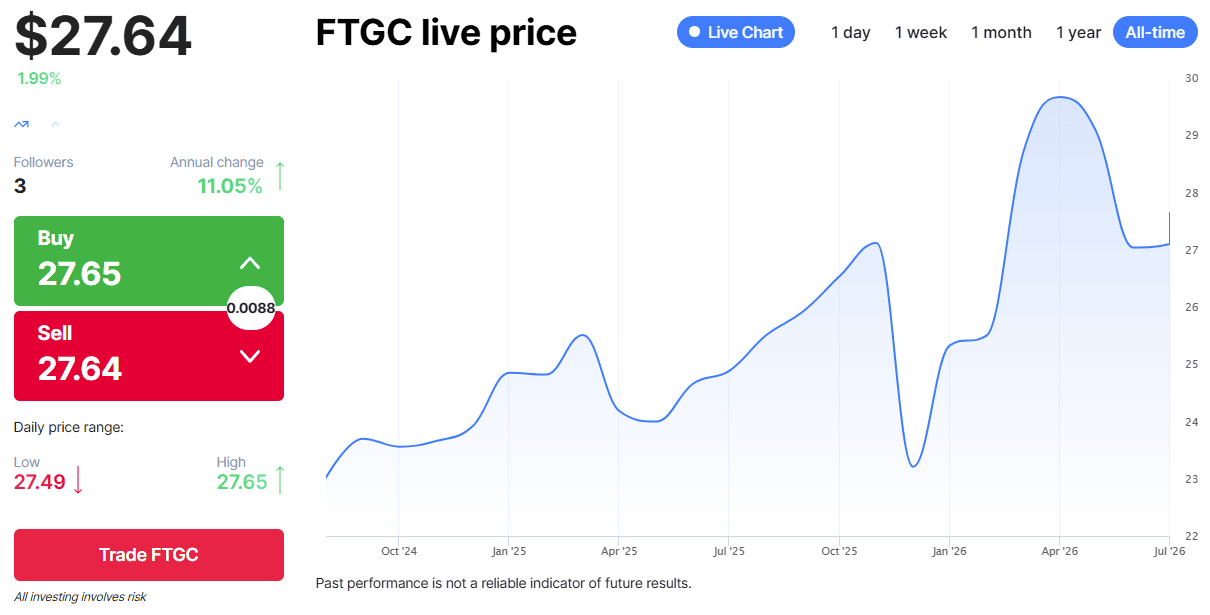
Exchange-traded funds (ETFs) continue to gain popularity among investors seeking diversified commodity exposure. Through NAGA, traders can access a wide range of ETFs and commodity-related instruments under one platform.
Discover the best ETFs for 2026
Wheat and agriculture stocks
Wheat stocks are shares of publicly traded companies whose revenues and profitability are directly or indirectly linked to wheat production, grain processing, agricultural inputs, or food manufacturing. Because investors cannot buy stock in wheat farms directly through public stock markets, many choose companies operating across different stages of the global wheat supply chain.
- The Grain Merchants & Processors (Midstream): These companies purchase wheat from farmers, process it into flour and other grain products, and supply food manufacturers worldwide (e.g., Archer Daniels Midland (ADM), Bunge Global, and The Andersons, Inc.).
- The Agricultural Input Companies (Upstream): These businesses supply seeds, fertilizers, crop protection products, and farming technology that support wheat production across global markets (e.g., Corteva, Nutrien, and CF Industries).
- The Food Manufacturers (Downstream): Global food companies use wheat as a primary ingredient in products such as bread, pasta, cereals, and baked goods, making their profitability sensitive to wheat prices (e.g., General Mills, Mondelez International, and Nestlé).
Stock prices may be influenced not only by wheat prices, but also by company earnings, weather conditions, input costs, consumer demand, currency movements, and broader market trends.
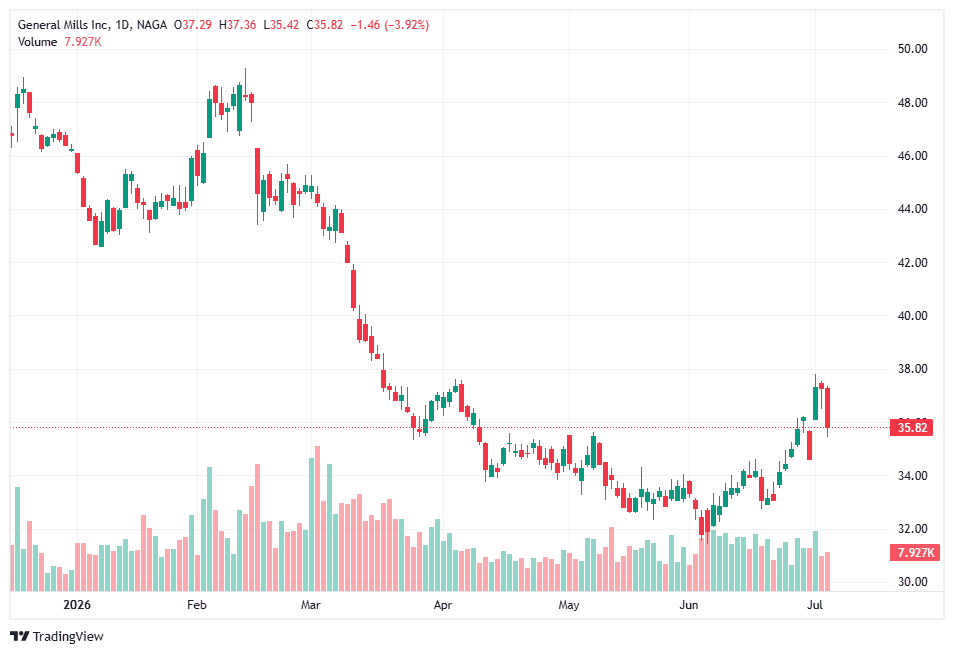
Past performance is not a reliable indicator of future results. All historical data, including but not limited to returns, volatility, and other performance metrics, should not be construed as a guarantee of future performance.
With NAGA you can invest in stocks with ownership or trade stocks via CFDs for more flexibility.
Pros and cons of investing in the wheat market
Investing in wheat and wheat-related assets provides exposure to one of the world's most important agricultural commodity markets. However, returns can be significantly influenced by weather conditions, geopolitical developments, government policies, and changing global food demand.
Pros of Investing in Wheat
Cons of Investing in Wheat
- Essential global commodity: Wheat is a staple food for billions of people, supporting consistent long-term demand worldwide.
- Portfolio diversification: Wheat often behaves differently from traditional stocks and bonds, helping diversify investment portfolios.
- High market liquidity: Wheat futures traded on CBOT (CME Group) offer deep liquidity and efficient price discovery.
- Multiple investment options: Investors can access wheat through futures, CFDs, ETFs, and agriculture-related stocks.
- Growing food demand: Population growth and rising global grain consumption continue supporting long-term wheat demand.
- Weather sensitivity: Droughts, floods, and extreme temperatures can significantly reduce harvests and increase price volatility.
- Geopolitical risk: Export disruptions and conflicts affecting major producers can trigger sudden price swings.
- Government intervention: Export bans, tariffs, and agricultural policies can rapidly change global supply dynamics.
- Leverage risk: Trading wheat futures or CFDs with leverage can amplify both profits and losses.
- Seasonal volatility: Harvest cycles and USDA crop reports can lead to significant short-term price fluctuations.
Are you looking to build a long-term position in the wheat market, or are you seeking short-term trading opportunities? Open a demo account and explore different strategies to gain exposure to global wheat markets.
Wheat futures trading strategies and examples
Once you've familiarized yourself with the different ways to trade wheat, you can choose the approach that best fits your trading style and risk tolerance. Some of the most commonly used wheat trading strategies include:
- Trend following (weather-driven strategy): Traders follow longer-term price movements driven by weather conditions, crop yields, export demand, and changes in global wheat inventories.
- Spread trading (inter-market arbitrage): Traders capitalize on temporary price differences between wheat futures contracts with different delivery months or between related grain markets.
- Range-bound trading (consolidation strategy): Traders take advantage of periods when wheat prices fluctuate within well-defined support and resistance levels during relatively stable market conditions.
Register to NAGA webinars to learn more about different trading strategies and explore the following real-world wheat trading examples.
Example A: Trader capturing a short-term wheat price decline (short trade)
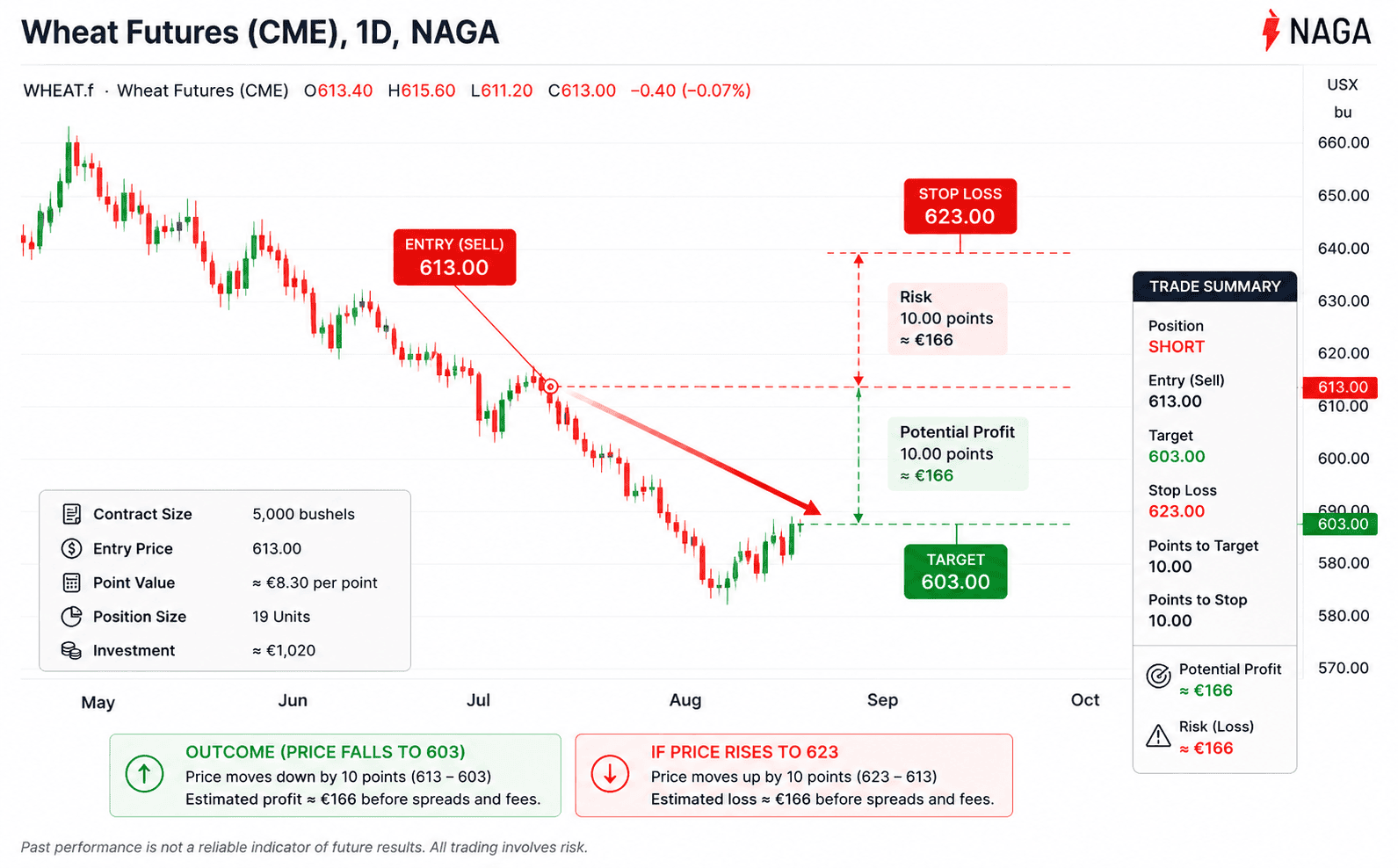
In this scenario, a retail trader using the NAGA trading platform notices improving harvest forecasts in the United States and stronger export shipments from major wheat-producing countries, signaling an increase in global supply. The current price of WHEAT.f sits near 613.
Past performance is not a reliable indicator of future results. All historical data, including but not limited to returns, volatility, and other performance metrics, should not be construed as a guarantee of future performance.
- The action: The trader opens a short position for 19 units, anticipating that wheat prices will continue declining as supply pressures ease.
- Investment: Approximately €1,020.
- The outcome: Two weeks later, wheat prices fall from 613 to 603 as harvest expectations improve and export availability increases.
- Gross profit calculation: The market declines by 10 points (613 − 603). Based on the same 19-unit position, this would generate an estimated profit of around €166 before spreads and trading fees.
If the market moves against the short position and wheat prices rise toward 623, the financial outcome reverses.
- Loss calculation: The market increases by 10 points (623 − 613). For the same 19-unit position, this would result in an estimated loss of around €166 before spreads and trading fees.
- Margin account impact: NAGA continuously monitors leveraged positions in real time. If account equity falls below maintenance margin requirements, the platform may trigger a Margin Call or automatic Stop-Out to help protect against negative balances.
Example B: Flour manufacturer hedging against rising wheat costs (long hedge)
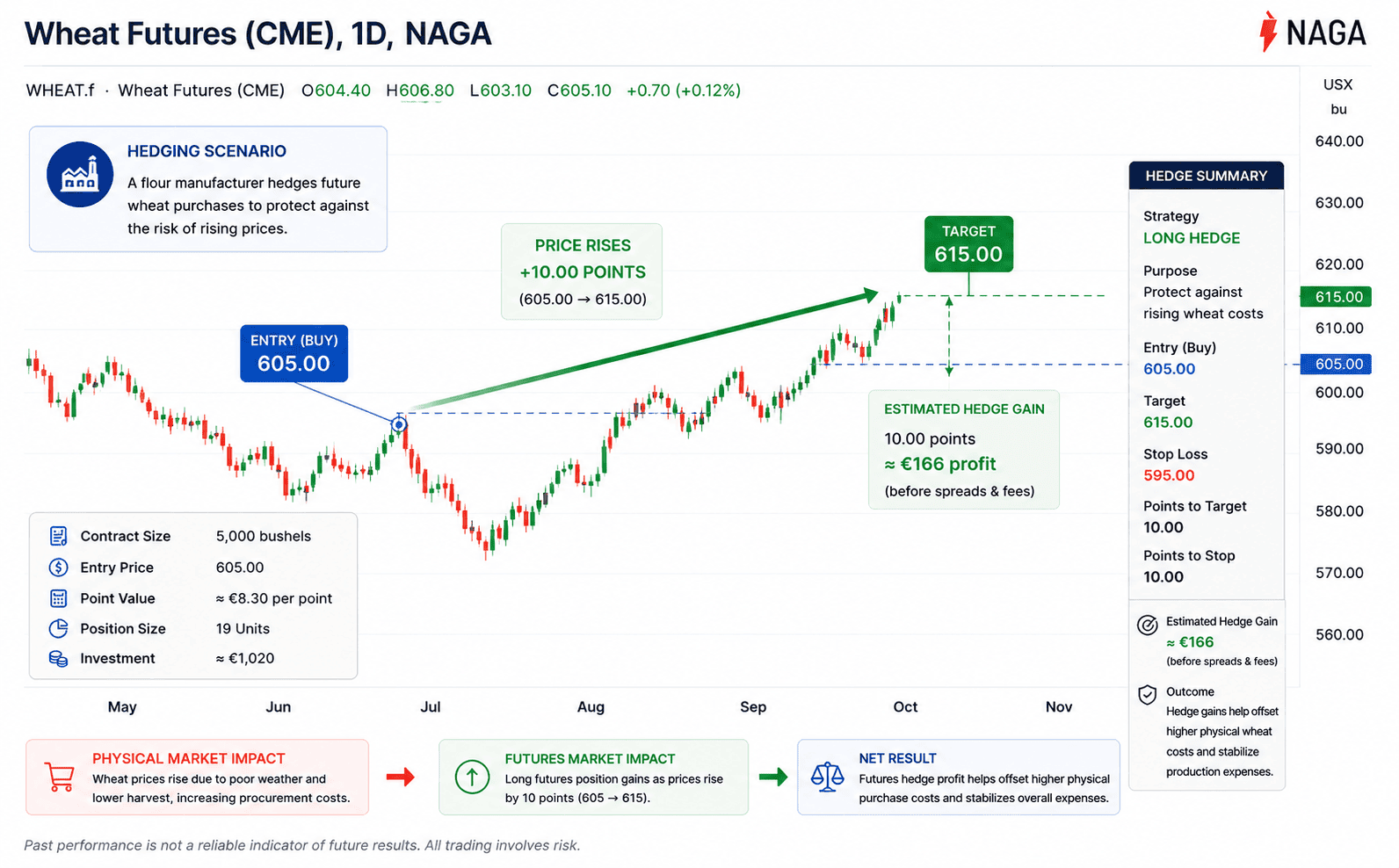
A global flour manufacturer expects to purchase large quantities of wheat over the next six months. The current wheat futures price is near 605, but management fears unfavorable weather conditions in major producing regions could reduce harvest yields and push prices higher.
Past performance is not a reliable indicator of future results. All historical data, including but not limited to returns, volatility, and other performance metrics, should not be construed as a guarantee of future performance.
- The action: The company executes a long hedge using wheat futures contracts to secure pricing exposure before its next purchasing cycle.
- The outcome: Six months later, adverse weather conditions reduce wheat production and push prices toward 615, increasing procurement costs across the physical market.
- Physical market impact: The manufacturer faces significantly higher costs when purchasing wheat from suppliers due to rising spot market prices.
- Futures market impact: The long futures hedge gains approximately 10 points in value (615 − 605), helping offset part of the increased purchasing costs.
- Estimated hedge gain: For a comparable 19-unit position, the move could generate an estimated profit of around €166 before spreads and trading fees, partially compensating for the higher procurement costs.
- Net result: The gains from the futures hedge partially offset the increase in physical wheat purchasing expenses, helping stabilize production costs despite rising market prices.
All trading involves risk, especially when using leverage, which is why risk management remains essential in wheat trading. Traders often use stop-loss orders, position sizing, and diversified exposure strategies to reduce unnecessary losses during periods of elevated market volatility.
How to start trading wheat on NAGA
Getting started with wheat trading on NAGA is straightforward. The platform provides access to wheat CFDs, live market pricing, and advanced trading tools to help investors and traders navigate global agricultural markets.
- Learn the wheat market drivers – Weather conditions, harvest forecasts, Black Sea exports, USDA reports, and global food demand regularly influence wheat price movements.
- Choose your trading instrument – Trade Wheat Futures (CME) | WHEAT.f for direct market exposure, or gain indirect exposure through agriculture-related stocks, ETFs, and commodity products.
- Use NAGA's analysis tools – Live charts, technical indicators, economic calendars, and market insights help traders identify potential entry and exit opportunities across changing market conditions.
- Apply smart risk management – Use stop-loss and take-profit orders while managing position sizes carefully, particularly during periods of elevated wheat market volatility where prices can fluctuate by 10%–20% over relatively short periods.
With your strategy in place, NAGA enables you to execute trades manually, follow more experienced investors through copy trading, or react quickly to changing market conditions using real-time trading tools.
Conclusion
Wheat investing offers exposure to one of the world's most essential agricultural commodity markets, driven by weather conditions, harvest yields, geopolitical developments, and global food demand. These factors create opportunities for both short-term traders and long-term investors through futures, CFDs, ETFs, and agriculture-related stocks.
NAGA simplifies access to global wheat markets by offering live pricing, multiple trading instruments, and integrated market analysis tools. Understanding the key drivers of wheat prices and selecting the right investment approach can help investors navigate volatility and identify potential opportunities across changing market conditions.
Start Trading cotton on NAGA Today
Sources:
- United States Department of Agriculture (USDA) Wheat Reports
- Chicago Board of Trade (CBOT) Wheat Futures – CME Group
- International Grains Council (IGC)
- Food and Agriculture Organization (FAO)
- World Bank Commodity Markets Outlook
- Rabobank Knowledge – Grains & Oilseeds Research