



Small-cap stocks can offer some of the most dynamic opportunities in the market, especially when improving earnings, sector tailwinds, and valuation recovery come together. In 2026, traders and investors are once again looking beyond mega-cap names and scanning global markets for smaller listed companies with stronger growth potential, clearer catalysts, and room for a possible re-rating.
This watchlist highlights some of the top small-cap stocks to watch in 2026, including companies from Germany, Romania, Saudi Arabia, the UAE, the US, and China. The goal is not to present a guaranteed buy list, but to identify small-cap stocks with relevant momentum, improving fundamentals, or structural themes that may be worth monitoring throughout the year.
Getting Started with Small-Cap Stocks – Quick Guide
- Research small-cap stocks – shortlist the best small-cap stocks for 2026 using clear criteria such as revenue growth, earnings momentum, liquidity, valuation, sector catalysts, and balance-sheet strength.
- Define your strategy – trading lets you speculate on short-term price movements, while dealing lets you take direct ownership of small-cap shares and invest for the longer term.
- Take your position – create an account with us to buy and trade small-cap stocks listed on global exchanges.
Alternatively, you can copy the moves of top-performing traders in real time with NAGA Autocopy.
What are Small-Cap Stocks?
Small-cap stocks are shares of publicly traded companies with a relatively modest market capitalisation — typically between $300 million and $2 billion, though the exact range varies by index and region. They sit between micro-caps (usually under $300 million) and mid-caps (roughly $2–10 billion), making them small enough to offer outsized growth potential, but large enough to have an established business, real revenue, and — in the best cases — a track record of earnings.
What makes small caps distinct isn't just their size — it's that they tend to be under-researched and under-owned by institutions, which means mispricing is more common. That's the double-edged sword of the segment: real growth potential, paired with higher volatility and lower liquidity than their large-cap counterparts.
For international stocks, the definition can be more flexible. A company listed in Germany, Saudi Arabia, or China may be considered small-cap in its local market even if its size differs from the standard US range. That is why investors often consider market cap alongside liquidity, trading volume, index classification, sector position, and growth profile when deciding whether a stock fits the small-cap category.
Small-cap vs mid-cap vs large-cap stocks
Before diving into individual picks, it helps to see where small caps sit relative to mid- and large-cap stocks:
Category Typical market cap Growth potential Risk level Liquidity Common investor use Small-cap stocks ~$300M–$2B High High Lower Growth, turnarounds, higher-risk opportunities Mid-cap stocks ~$2B–$10B Moderate to high Medium Moderate Balanced growth and stability Large-cap stocks $10B+ Lower to moderate Lower High Core holdings, stability, dividends Table comparing small-cap, mid-cap and large-cap stocks by growth potential, risk and liquidity
Small-cap stocks usually offer the highest growth and re-rating potential, but they also tend to carry higher volatility and liquidity risk. Large-cap stocks are generally more established and easier to trade, while mid-caps sit between the two, often combining growth potential with stronger financial stability.
Why Invest in Small-Cap Stocks?
Small-cap stocks can appeal to traders and investors because they often have more room to grow than larger, more mature companies. A successful product launch, earnings improvement, new market expansion, regulatory approval, or index inclusion can have a bigger impact on a smaller company’s valuation than it would on a large-cap stock. This is why some of the best small-cap stocks can deliver strong upside when business momentum improves and investor attention returns.
The case for small caps in 2026 comes down to a few key factors:
- Valuation discount — small caps are trading at a meaningful gap to large-cap peers, leaving more room for re-rating.
- Operating leverage — many small caps spent 2023–2025 cutting costs and cleaning up balance sheets; any pickup in revenue now flows disproportionately to the bottom line.
- Rate-cut tailwind — smaller, often more rate-sensitive businesses historically benefit more from easing monetary policy than large caps.
- Earnings inflection potential — this combination of leaner cost structures and improving demand is exactly what drives the kind of re-rating candidates covered in this list.
- Diversification — small caps tend to be less correlated with mega-cap tech and macro headline risk.
That upside comes with trade-offs: small caps are more volatile, less liquid, and more exposed to company-specific risk — a single bad quarter or executive departure can move the stock sharply. For traders comfortable with that risk profile, small caps offer a rare combination in today's market: real growth potential at a reasonable price.
How to Find the Best Small-Cap Stocks
Not every small cap is a good small cap — cheap doesn't automatically mean undervalued. The best candidates back up their story with evidence, not just optimism. Here's what to screen for:
- Revenue and EBITDA growth — look for consistent top-line growth paired with expanding, not just growing, EBITDA margins.
- Reliable guidance — companies that reaffirm or beat their own guidance quarter after quarter are showing real execution, not one-off luck.
- Concrete catalysts — a new license, M&A, index inclusion (like SDAX or FTSE Micro Cap), or a completed restructuring are tangible triggers for re-rating, unlike vague "growth potential."
- Margin trends — rising margins on flat or modest revenue growth (cost discipline) can be just as bullish as revenue growth itself.
- Liquidity — check average daily trading volume; a great company with a thin float can be hard to enter or exit at a fair price.
- Balance sheet health — low debt and positive or improving cash flow reduce the risk of a small cap being wiped out by one bad quarter.
The stocks featured below were selected using exactly this framework — each one backs up its story with recent numbers, not just a narrative.
Top Small-Cap Stocks to Watch in 2026
With the screening criteria above in mind, here are top 6 small-cap stocks worth watching in 2026 — spanning six markets and a wide mix of sectors, from energy infrastructure and fintech to insurtech and e-commerce logistics. Each entry includes the key numbers behind the story, the main risks to weigh, and what's driving the trade right now, so you can judge the opportunity on its fundamentals rather than the hype.
1. NAGA Group (N4G.DE) — one of the best small-cap stocks from Germany
- Sector: Fintech / social trading
- Key stats: Q1 2026 net profit €0.5 million (vs. €1.7 million loss in Q1 2025); EBITDA margin 15.8% (vs. 6.1% a year earlier); FY2026 guidance €68–75 million revenue, €10–15 million EBITDA.
- H2 2026 outlook: Base case points to €4.50–€6.00 by year-end if FY guidance is delivered; a sustained move above €4.00 on rising volume would be the first confirmation signal.
- Key risks: Trading volumes are highly sensitive to market conditions; competitive retail brokerage sector.
NAGA Group AG is emerging as one of the more compelling German small-cap turnaround stories in 2026, after posting its first-ever profitable first quarter. The improvement isn't a one-off earnings beat — CEO Octavian Patrascu has pointed to a broader shift toward "stability and steady, profitable growth," with AI now handling roughly two-thirds of customer support queries and customer acquisition costs down 16% YoY. NAGA X Ltd — the crypto-asset entity of The NAGA Group AG — secured MiCA authorisation in June 2026, giving it a regulated foothold in EU crypto services just as unlicensed competitors lose market access.
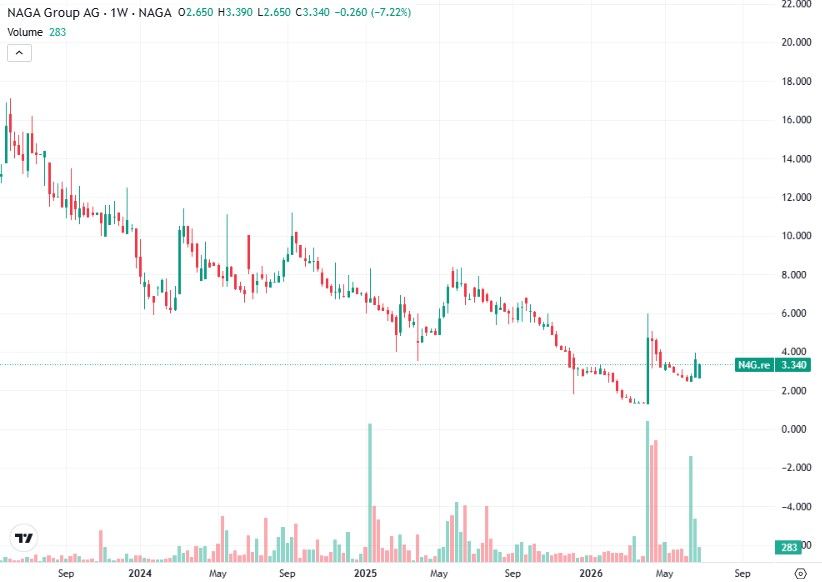
Past performance is not a reliable indicator of future results. All historical data, including but not limited to returns, volatility, and other performance metrics, should not be construed as a guarantee of future performance.
Analysts have responded with a Speculative Buy rating and a €9.50 price target from SMC Research, alongside an estimated intrinsic value of €12.44 from Alpha Spread — both well above where the stock trades today.
How to invest in the German stock market
2. AXT Inc. (AXT) — one of the best US small-cap stocks to watch in 2026
- Sector: Semiconductor materials
- Key stats: ~380% share price gain in 2025; trades around 24x forward earnings; guiding for ~30% sales growth in FY2026.
- H2 2026 outlook: Delivery against the ~30% FY2026 sales growth guidance will be the key test in H2; any commentary on AI/chip customer order visibility in upcoming earnings calls should move the stock meaningfully.
- Key risks: Customer concentration in the semiconductor supply chain, cyclicality of chip demand, competitive substrate pricing pressure.
AXT Inc. is a speciality materials producer supplying high-performance semiconductor substrates — a small but critical link in the chip-making supply chain. While mega-cap AI names dominate headlines, AXT offers a more targeted, lower-profile way to play the same underlying demand: as chipmakers scale up production, substrate suppliers like AXT see direct volume benefits without carrying the "nosebleed" valuations of the AI giants.
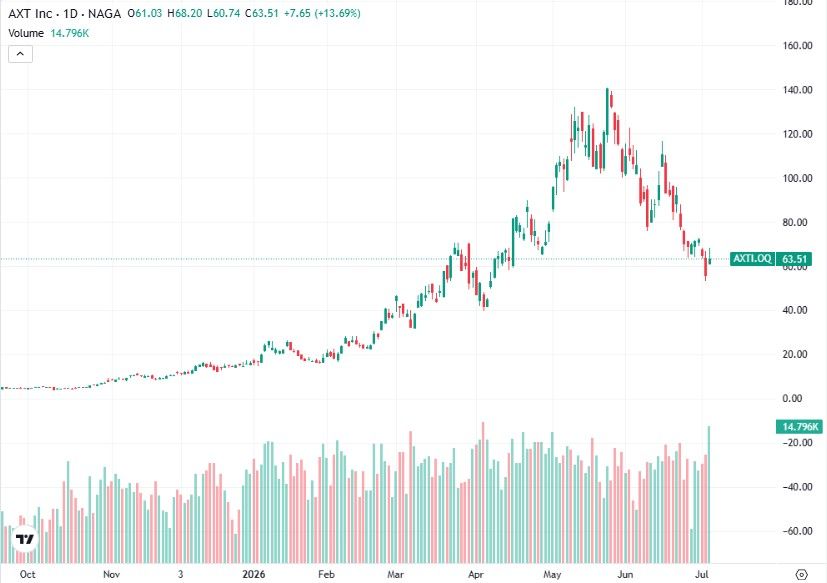
Past performance is not a reliable indicator of future results. All historical data, including but not limited to returns, volatility, and other performance metrics, should not be construed as a guarantee of future performance.
Despite a roughly 380% run in 2025, the stock still trades at a meaningful discount to large-cap semiconductor names on a forward P/E basis, largely because it remains under-followed relative to its performance. The risk is that AXT's fortunes are tied closely to a handful of large customers and to the broader semiconductor cycle, which can turn quickly — so while the AI-driven tailwind is real, so is the downside if chip demand cools faster than expected.
How to invest in the US markets
Youdao Inc. (DAO) — one of the best small-cap stocks for 2026 from China
- Sector: AI / EdTech
- Key stats: ~$360M–$1.4B market cap; Q1 2026 revenue +3.8% YoY (online marketing services +20.9%); 7th consecutive quarter of operating profitability; Citi upgraded to Buy with a $12 price target.
- H2 2026 outlook: Management has guided for improving profitability and cash flow through 2026, with H2 typically stronger than H1 due to seasonality; the key signal to watch is whether new AI agent launches (LobsterAI, Youdao Baoku) convert into monetizable growth in learning services and advertising, as management has targeted.
- Key risks: Q1 2026 earnings missed estimates (operating income down 44.7% YoY as AI investment ramps), declining smart-devices segment (-42.6% YoY), heavy reliance on parent company NetEase for financing (a $300M revolving credit facility extended to 2030).
Youdao Inc. is a NetEase-backed AI solutions provider that's pivoting hard from its legacy smart-devices business (translation pens, dictionaries) toward AI-native products across education, productivity, and advertising. The strategy is showing up in the numbers unevenly: online marketing services — powered by AI ad-targeting tools like MagicBox — grew nearly 21% year-over-year, while the declining smart-devices segment is being deliberately deprioritized in favor of higher-margin AI applications. The company's Confucius large language model now underpins a growing suite of AI agents, including Confucius4 (a multimodal K-12 tutoring model), EmotiVoice 2 (text-to-speech), and LobsterAI — giving Youdao a genuine AI-native product story rather than just an "AI-labeled" one.
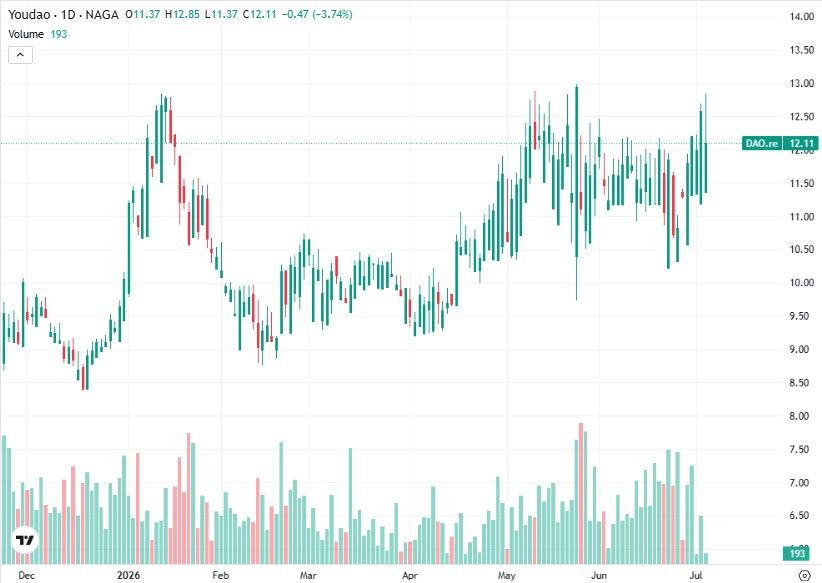
Past performance is not a reliable indicator of future results. All historical data, including but not limited to returns, volatility, and other performance metrics, should not be construed as a guarantee of future performance.
The trade-off for traders: Q1 2026 profitability took a real hit as the company invested heavily in this transition, and Youdao still leans on parent company NetEase for balance-sheet support. For traders looking for AI exposure through a small-cap, NYSE-listed, NAGA-tradeable name, Youdao offers a genuine growth narrative with real near-term earnings volatility attached.
How to invest in the Chinese stock market
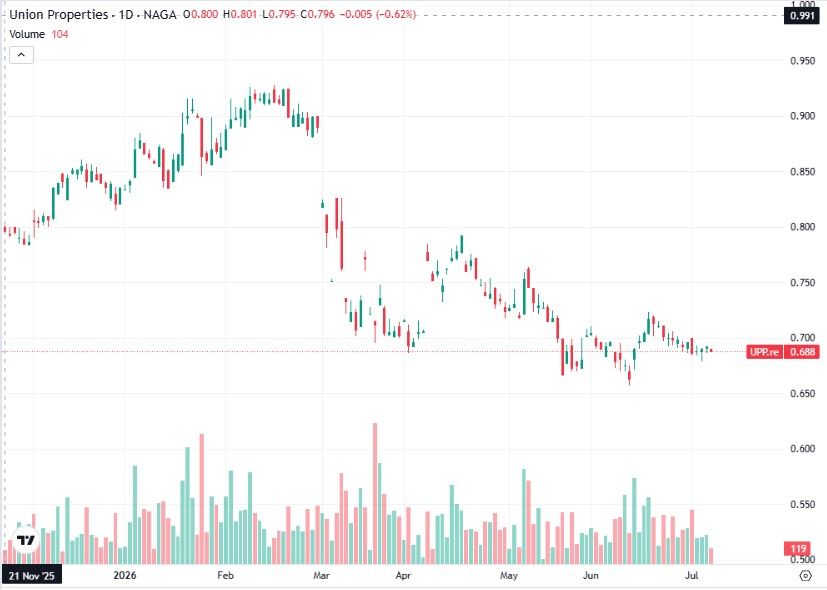
Union Properties (UPP) — one of the best UAE small-cap stocks for 2026
- Sector: Real estate
- Key stats: ~AED 3.2 billion market cap; 2025 revenue +39% YoY; 2025 net income +68% YoY; new AED 2 billion "Mirdad" residential project in Motor City.
- H2 2026 outlook: Progress updates on the Mirdad project (pre-sales, construction milestones) through H2 will likely be the main share-price driver, alongside broader Dubai property-market data.
- Key risks: Dubai real estate cyclicality, execution risk on new developments, sensitivity to regional geopolitical sentiment.
Union Properties is a genuine turnaround story riding Dubai's property cycle. After years of underperformance, the company returned to strong profitability in 2025, driven by both its core real estate development business and its ServeU facilities-management subsidiary, which recently expanded through the acquisition of House Keeping LLC. The freshly unveiled Mirdad project — a AED 2 billion, four-tower residential development — signals management's confidence in continued demand, backed by population inflows and Dubai's ongoing visa-driven growth story.
Past performance is not a reliable indicator of future results. All historical data, including but not limited to returns, volatility, and other performance metrics, should not be construed as a guarantee of future performance.
For traders, Union Properties offers direct exposure to one of the more resilient property markets globally right now, but with the caveat that real estate cycles can turn quickly, and Gulf market sentiment can be sensitive to broader regional geopolitical developments — as seen in periodic volatility across UAE-listed names in 2026.
Discover the top 10 best investments in the UAE
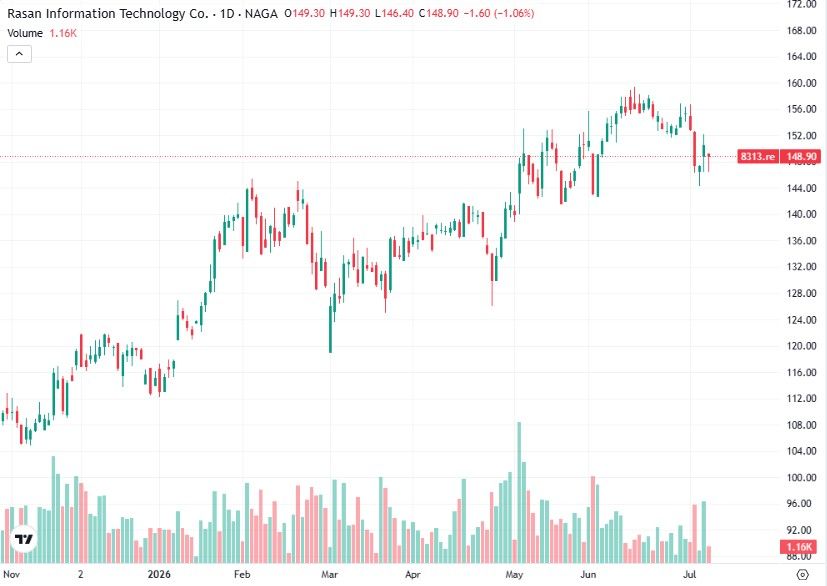
Rasan Information Technology (8313) — one of the best Saudi small-cap stocks for 2026
- Sector: Insurtech / fintech
- Key stats: Q1 2026 revenue SAR 261 million (+117% YoY); net income SAR 88 million (+193% YoY); profit margin 34% (up from 25% a year earlier).
- H2 2026 outlook: Consensus 2026 EPS estimates have already been revised up mid-year (from SAR 3.60 to SAR 4.20), suggesting analysts see the growth pace holding through H2 rather than fading — the key thing to watch is whether Tameeni's motor insurance volumes stay strong as easier comparables normalize.
- Key risks: High valuation multiple relative to growth deceleration risk, regulatory dependence on Saudi insurance/fintech policy, customer concentration in motor insurance.
Rasan is one of the fastest-growing insurtech names globally, let alone within Saudi Arabia's small-cap universe. Through its Tameeni platform — the Kingdom's leading online insurance aggregator — and its Treza digital leasing arm, Rasan has more than doubled revenue year-over-year while expanding net margins, a combination that's rare even among high-growth software names. The timing matters: Saudi Arabia removed its Qualified Foreign Investor restrictions in February 2026, opening Tadawul-listed stocks like Rasan to any international investor without the previous multi-billion-dollar AUM threshold. That regulatory shift, paired with Vision 2030's digital financial-inclusion push, gives Rasan a structural tailwind beyond its own execution.
Past performance is not a reliable indicator of future results. All historical data, including but not limited to returns, volatility, and other performance metrics, should not be construed as a guarantee of future performance.
The risk for traders is valuation: at a premium price-to-sales multiple, any slowdown in growth (rather than an outright miss) could still trigger a meaningful re-rating lower, so this is more of a momentum/growth play than a value one.
Discover top Saudi stocks for 2026
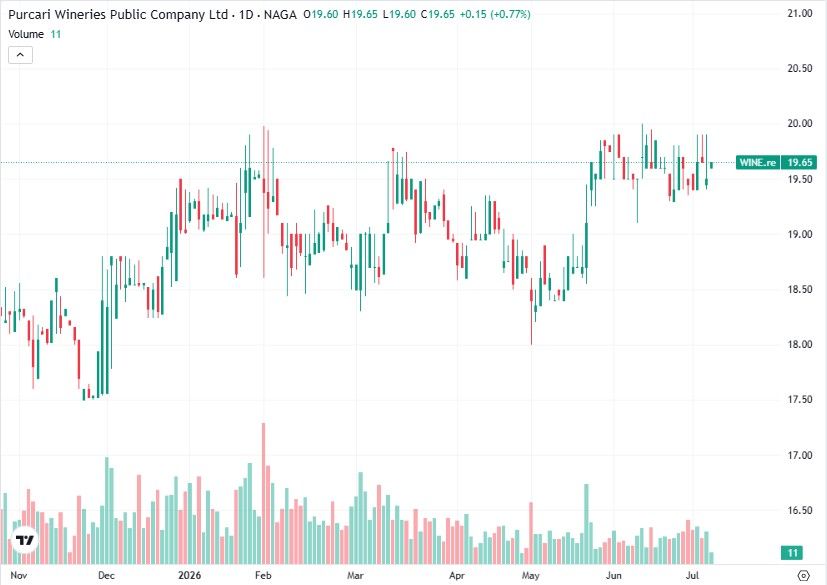
Purcari Wineries (WINE) — one of the best Romanian small-cap stocks to watch in 2026
- Sector: Consumer/beverages
- Key stats: ~$177 million market cap; ~$99 million trailing twelve-month revenue; ~24% EBITDA margin; ~3.3% dividend yield.
- H2 2026 outlook: Export order momentum into Q3/Q4 harvest season will be the key data point; absent a major surprise, expect steady rather than explosive performance, consistent with the stock's lower-volatility profile.
- Key risks: Modest trading liquidity, sensitivity to Romanian consumer sentiment and agricultural conditions, and currency exposure across export markets.
Purcari Wineries is one of the few listed consumer-brand small caps out of Central and Eastern Europe, giving traders a rare way to play the region's growing wine and premium beverage market. The company manages roughly 1,000 hectares of vineyards across Romania and Moldova and exports across more than 30 markets — including Western Europe, Asia, and North America — under brands like Purcari, Bostavan, and Domeniile Cuza.
That export diversification is the core of the investment case: it reduces reliance on any single market's consumer spending, while still giving exposure to a structurally growing premium wine segment. The trade-off is liquidity — trading volumes are modest, and the stock can be sensitive to shifts in Romanian consumer confidence or agricultural output (a poor harvest year can affect margins directly).
Past performance is not a reliable indicator of future results. All historical data, including but not limited to returns, volatility, and other performance metrics, should not be construed as a guarantee of future performance.
For traders looking for a lower-volatility, dividend-paying small cap rather than a high-beta growth story, Purcari fills a different niche than most names on this list.
Discover top 10 Romanian stocks for 2026
Ways to Trade and Invest in Small-Cap Stocks
Once you've picked a small cap worth watching, the next decision is how to get exposure. Each method suits a different trading style, timeline, and risk appetite:
- Direct stock ownership — buying and holding shares outright. Best for longer-term positions, gives you voting rights and dividend eligibility, and avoids overnight financing costs. The trade-off: you need full capital upfront, and thinly-traded small caps can be harder to enter/exit at a fair price.
- CFDs (Contracts for Difference) — trade price movement without owning the underlying share. CFDs let you go long or short, use leverage, and react quickly to short-term catalysts (earnings, guidance updates, index inclusions). The trade-off: leverage cuts both ways, and overnight positions typically incur financing charges — better suited to active, shorter-term trading than buy-and-hold.
- ETFs — gain diversified small-cap exposure through a single instrument (e.g., a Russell 2000 or MSCI Small Cap fund) instead of picking individual names. Reduces single-stock risk and is more hands-off, but you give up the upside (and the research edge) of picking specific winners like the ones covered in this article.
Small-cap stocks trading and investing: stocks vs. CFDs vs. ETFs
Direct stocks CFDs ETFs Ownership Yes No (price exposure only) Yes (fund shares) Leverage No Yes No Short Selling No (without separate tools) Yes Limited (inverse ETFs only) Suitable for Long-term holding Short-term/tactical trades Diversified, hands-off exposure Key risk Liquidity, full capital exposure Leverage risk, financing costs Diluted upside vs. single-stock picks
Which approach fits best depends on how much time you want to spend monitoring a position and how much single-stock risk you're comfortable carrying.
How to Start Trading and Investing in Small-Cap Stocks
- Step 1. Choose between share dealing and trading CFDs. Your first concern should be your risk appetite and time horizon. If you want to buy and hold small-cap stocks, open an investing account. If you want to speculate on price movements (including falling prices) with tight spreads and leverage, open a CFD trading account.
- Step 2. Open your account. Regardless of your chosen account, you must register and complete KYC to verify your identity.
- Step 3. Verify and fund your account. Before buying and trading any small-cap stock, you need to verify and fund your exchange account with U.S. dollars, Euros, or other accepted currencies.
- Step 4. Select your stocks. Build a watchlist using revenue growth, margins, cash flow, liquidity, valuation, and catalysts. You can also use NAGA copy trading to follow lead traders, though copied strategies still carry risk.
- Step 5. Place your order. Set your position size, entry level, risk limits, and time horizon before opening the trade.
Buy Small-Cap Stocks Trade Small-Cap Stocks Copy Lead Traders
Conclusion
Small-cap stocks can offer attractive growth and re-rating potential, but they also require careful research and disciplined risk management. In 2026, the strongest opportunities are likely to come from companies with improving earnings, clear catalysts, stronger cash flow, and exposure to long-term sector trends.
Whether you choose direct shares, CFDs, ETFs, or copy trading, small-cap investing should be approached selectively. Focus on quality, liquidity, valuation, and risk — not just upside potential.
Sources
- Deutsche Börse AG — Official Cash Market / Xetra Newsboard
- FINRA – Market Cap Explained
- NAGA Group AG — Official Investor Relations / Corporate News
- Saudi Capital Market Authority (CMA) — Official announcement: market opened to all foreign investors
- Youdao, Inc. — Official Investor Relations
- Purcari Wineries PLC — Official Corporate Website