



Finding the most undervalued stocks is not about buying whatever looks cheap after a selloff. It is about spotting businesses whose market price has fallen below their earnings power, asset value, or recovery potential.
In this guide, you will learn how to find undervalued stocks, how to avoid classic value traps, and how to build a practical watchlist. You will also get a current, research-based shortlist of some of the best undervalued stocks to watch now, combining educational insight with real-world examples for traders and investors.
Getting Started with Undervalued Stocks – Quick Guide
- Research your undervalued stocks – shortlist the best undervalued stocks for 2026 using strict criteria to pick the good businesses from the bad businesses.
- Define your strategy – trading lets you speculate on the price movement; dealing lets you take direct ownership of the stocks.
- Take your position – create an account with us to buy and trade undervalued stocks listed on 10 global exchanges.
Alternatively, you can copy the moves of top-performing traders in real-time with NAGA Autocopy.
What is an Undervalued Stock?
An undervalued stock is a company trading below what the market may eventually perceive as its fair value, also known as intrinsic value. That discount can show up in metrics such as earnings multiples, book value, free cash flow yield, return on equity (ROE) or simply in a share price that has not caught up with improving fundamentals.
What makes an undervalued stock different from a cheap stock?
A cheap stock only looks inexpensive by price. An undervalued stock appears inexpensive relative to business quality, balance sheet strength, normalised earnings, and future cash generation. A stock trading at 8x earnings can be a bargain if profits are stable and capital allocation is disciplined. The same 8x multiple can be dangerous if earnings are collapsing or if debt is rising too fast.
Why undervalued stocks can outperform over time
Value can unlock when sentiment improves, margins recover, debt falls, or a catalyst changes the narrative. That is why many investors searching for the best undervalued stocks to buy now are really looking for two things at once: low expectations and a credible path to better results.
Why some underperforming stocks stay cheap for years
Some underperforming stocks stay cheap due to structural decline, not just temporary slumps. A low multiple alone is insufficient; the market discounts weak governance, poor reinvestment, low returns, or disrupted business models.
Key Strategies to Identify Undervalued Stocks
One of the best ways to learn how to identify undervalued stocks is to combine valuation, fundamentals, and catalysts rather than relying on one ratio. You must combine quantitative screening with qualitative analysis.
Learn how to identify undervalued stocks by focusing on metrics that reveal their true worth, rather than being swayed by headlines, by following these steps.
Step 1: Screen for low valuation multiples
Start with basic valuation screens. The P/E ratio helps you compare the price with earnings. P/B is useful for asset-heavy sectors like banks, insurers, and autos. EV/EBITDA is often better when debt levels differ across peers. Price-to-sales can help when earnings are depressed, but revenue quality is still intact. Free cash flow yield shows what the business is producing in real cash. ROE (Return on Equity) helps you separate statistically cheap companies from those that still earn attractive returns on shareholder capital.
Step 2: Compare each stock with sector peers
A stock is "cheap" only in context. Compare revenue growth, earnings trends, margins, returns, debt, interest coverage, and cash flow quality to sector peers. True bargains offer a margin of safety to absorb bad news.
Step 3: Focus on cyclical downturns
Many of the best undervalued stocks appear during temporary industry slowdowns. Energy, autos, semiconductors, and media often look cheapest when headlines are at their worst. That can be exactly when value investors start building positions.
Step 4: Identify catalysts that could unlock value
Low valuation multiples require a catalyst to unlock value. Seek product launches, cost reductions, debt improvements, asset sales, buybacks, regulatory approvals, new management, or cyclical recovery. Without such catalysts, stocks may remain undervalued longer than expected.
Metric What it shows Best use case Typical warning sign P/E Price versus net earnings Mature profitable companies Earnings are inflated or cyclical peak earnings P/B Price versus net assets Financials, insurers, autos Assets may be overstated or low return EV/EBITDA Enterprise value versus operating profit Debt-heavy sectors, cross-peer comparison EBITDA hides weak cash conversion Price-to-sales Value versus revenue Turnarounds, low-margin businesses Sales grow but margins never recover Free cash flow yield Cash generated relative to market value Capital-light, mature cash generators FCF boosted by temporary working-capital moves ROE Profitability on shareholder equity Quality filter alongside valuation High ROE driven by leverage, not quality A table comparing key valuation metrics for identifying undervalued stocks
How to find undervalued stocks without falling into a value trap
Identifying undervalued stocks also requires knowing what to avoid. A value trap occurs when a stock appears cheap but continues to decline as its business deteriorates. To find genuine undervalued opportunities, prioritise strong fundamentals, as low multiples alone can be misleading.
Red flags that a low-priced stock may deserve its discount
A falling share price is not automatically an opportunity. Sometimes the market is correctly pricing in weaker demand, a broken strategy, or deteriorating economics.
Weak earnings quality and poor cash flow
If reported profits do not turn into cash, be careful. Weak cash conversion, large one-off adjustments, or repeated “adjusted” profit stories can turn a supposedly undervalued stock into a permanent laggard.
High debt can cancel out apparent value
Debt amplifies risk. A company can look cheap on P/E while still being expensive once you include refinancing pressure, covenant risk, and higher interest costs.
Management quality and capital allocation
Good management teams cut costs early, invest sensibly, avoid empire building, and return capital when appropriate. Bad ones chase growth for their own sake, overpay for acquisitions, and destroy value even when the stock looks cheap.
Structural decline vs temporary underperformance
This is the biggest distinction in value investing. Temporary underperformance can be recovered, while structural decline often cannot. Understand whether the company is losing share because of a cycle or because the industry has changed for good.
Key Risks in Dodging Underperforming Stocks
Trading underperforming stocks requires caution, as they tend to be volatile and unpredictable, potentially leading to significant losses if not managed carefully.
- Macro risk: rising interest rates, tariffs, recession fears, or weaker consumer demand can suppress even the best value stocks.
- Sector risk: Even solid names can stay cheap if the whole industry is under pressure, while regulatory changes can permanently damage specific industries like big tech or energy.
- Liquidity risk: Some undervalued small-caps may have low trading volume, potentially making it hard to exit your positions.
- Earnings disappointment risk: the market punishes value ideas hard when a “cheap” stock misses estimates, cuts guidance, or reveals weaker-than-expected margins. That is why position sizing matters just as much as stock selection.
With those risks in mind, the next step is to focus on stocks that look discounted but still have a solid fundamental case.
Top Undervalued Stocks Right Now
Below is a practical watchlist for investors looking for the best undervalued stocks right now. These are not blanket buy calls or personalised advice. They are current candidates worth deeper due diligence because they combine low or reasonable valuation with a visible catalyst.
1. NAGA Group AG (Frankfurt: N4G)
NAGA Group AG is a listed fintech company focused on providing seamless access to stocks, ETFs, cryptocurrencies, CFDs, payment services, and social features. NAGA demonstrates impressive improvements in key metrics despite a challenging fiscal year 2025. Revenue reached €62.4 million, EBITDA dropped to €3.3 million from €9 million, mainly due to increased investment in marketing, resulting in an impressive increase in first-time depositors, laying the foundation of future growth.
NAGA is a top undervalued stock with many growth drivers, including AI integration, user interface overhauls, and payment-trading links that aim to bridge the gap between retail and institutional investors. At the same time, the company’s evolution from a brokerage into an "intelligence hub" solidifies its premium positioning in the market.
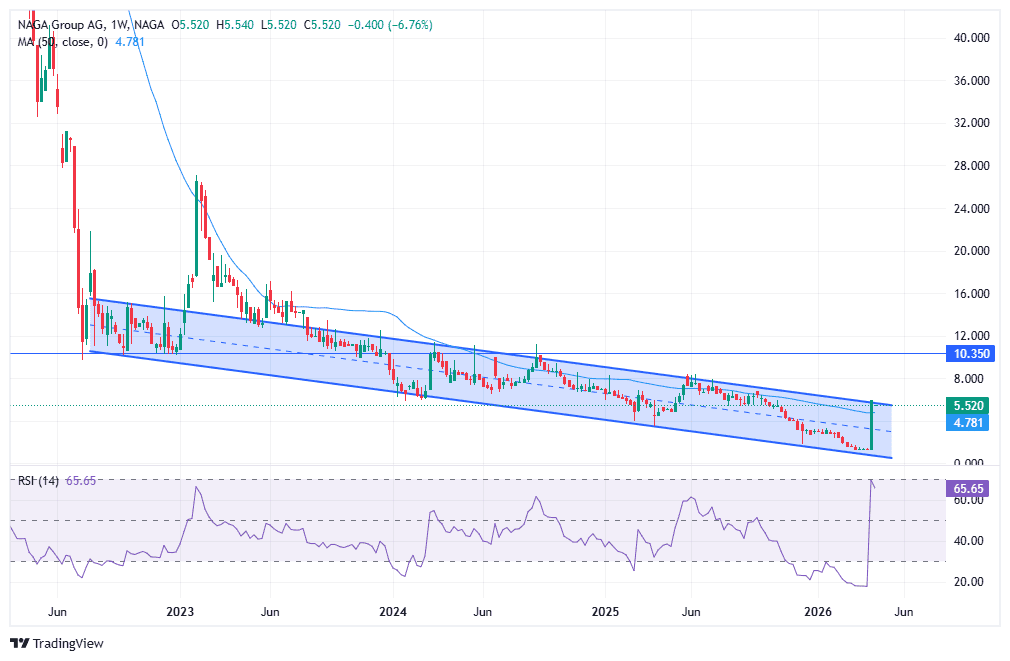
Past performance is not a reliable indicator of future results. All historical data, including but not limited to returns, volatility, and other performance metrics, should not be construed as a guarantee of future performance.
Despite a 2 million+ user base and massive growth in AI-driven trading, it trades at a significant discount to global fintech peers.
- Key angle: Low Price-to-Sales relative to user growth metrics.
- Catalyst: Client growth and platform integration.
- Main risk: Potential regulatory shifts in the EU brokerage market.
2. PayPal (NASDAQ: PYPL)
PayPal remains a global digital-payments platform, yet the stock trades at a single-digit trailing multiple. FY2025 results showed revenue, transaction margin dollars, and EPS (Earnings Per Share) growth, while 2026 catalysts include the Cymbio acquisition for agentic commerce and a growing ads business.
- Key angle: P/E of 8.54.
- Catalyst: branded checkout improvement and higher-margin commerce products.
- Main risk: competition and uneven execution.
3. CVS Health (NYSE: CVS)
CVS Health combines insurance, pharmacy, and healthcare delivery, which gives it scale that the market still discounts after a difficult period. FY2025 revenue reached a record high, and management kept 2026 adjusted EPS guidance at $7.00 to $7.20.
- Key angle: P/E of 11.63.
- Catalyst: insurance stabilisation and pharmacy strength.
- Main risk: medical-cost pressure and execution in care delivery.
4. Pfizer (NYSE: PFE)
Pfizer is still priced like a post-COVID laggard, even though full-year 2025 results were solid, 2026 guidance was reaffirmed, and the company planned about 20 key pivotal studies for 2026.
- Key angle: P/E of 8.54 and dividend yield around 6.39%.
- Catalyst: oncology and broader pipeline readouts.
- Main risk: patent cliffs and slower-than-expected new-product ramp.
5. Bristol Myers Squibb (NYSE: BMY)
Bristol Myers is another large pharma name that looks inexpensive relative to cash generation and pipeline optionality. Fourth-quarter 2025 revenue rose 1%, while growth-portfolio revenue climbed 16%, and Opdivo gained another FDA approval in March 2026.
- Key angle: P/E of 9.88 with a yield of around 4.15%.
- Catalyst: new indications and pipeline progress.
- Main risk: loss of exclusivity on older blockbusters.
6. Shell plc (NYSE: SHEL)
Shell remains one of the cleaner large-cap value cases because it continues to generate cash and return capital. In February, Shell raised the quarterly dividend 4% and launched another $3.5 billion buyback, while management also highlighted long-term LNG demand growth.
- Key angle: P/E near 14.7 with ongoing shareholder returns.
- Catalyst: buybacks and LNG expansion.
- Main risk: weaker oil and gas prices.
7. Comcast (NASDAQ: CMCSA)
Comcast looks inexpensive given its broadband, wireless, NBCUniversal, theme parks, and streaming exposure. Fourth-quarter 2025 results showed theme-park EBITDA up 24%, topping $1 billion for the first time, helped by Epic Universe, while the Versant separation also sharpened the story.
- Key angle: P/E of 7.34 and dividend yield near 4.73%.
- Catalyst: park monetisation and portfolio simplification.
- Main risk: broadband subscriber pressure.
8. Verizon Communications (NYSE: VZ)
Verizon is the classic income-and-value setup: slow growth, but real cash flow and a high dividend stock. FY2025 free cash flow reached $20.1 billion, and management guided to at least $21.5 billion for 2026.
- Key angle: P/E of 9.77 and dividend yield around 6.15%.
- Catalyst: cash-flow growth and network monetisation.
- Main risk: competitive pressure and elevated debt.
9. Stellantis (NYSE: STLA)
Stellantis is a deep-value turnaround rather than a comfort-name value stock. The company posted a large 2025 loss after huge EV-related charges, but the market now values it at just a fraction of sales and book value, while Q1 2026 shipments rose 12% year over year.
- Key angle: P/S about 0.18x and P/B about 0.37x.
- Catalyst: operational reset and new industrial plan.
- Main risk: autos are cyclical and highly tariff-sensitive.
10. Warner Bros. Discovery (NASDAQ: WBD)
Warner Bros. Discovery is an event-driven value idea. The core business remains messy, but the proposed Paramount-Skydance transaction provides a clear catalyst, with a shareholder vote scheduled for April 23 and a closing targeted for Q3 2026, subject to regulatory approval.
- Key angle: P/S around 1.85.
- Catalyst: deal completion and cash value realisation.
- Main risk: antitrust and deal-execution uncertainty.
Company Ticker Sector Why it may be undervalued Key metric Main catalyst NAGA Group AG N4G Fintech Small-cap valuation versus revenue base and platform expansion P/S about 0.5x NAGA ONE rollout, client growth PayPal PYPL Payments Single-digit earnings multiple for a global payments franchise P/E 8.5x Checkout, ads, agentic commerce CVS Health CVS Healthcare Turnaround multiple despite record revenue and stabilizing guidance P/E 11.6x Insurance normalization, 2026 EPS guide Pfizer PFE Pharma Low multiple plus high yield and active late-stage pipeline P/E 8.5x Pipeline readouts, new launches Bristol Myers Squibb BMY Pharma Low valuation with growth portfolio momentum P/E 9.9x Opdivo label expansion, pipeline Shell SHEL Energy Strong shareholder returns still support the case P/E 14.7x Buybacks, LNG demand growth Comcast CMCSA Media/Telecom Very low multiple for diversified cash-generating assets P/E 7.3x Epic Universe, Peacock, spin-off clarity Verizon VZ Telecom Single-digit multiple backed by strong free cash flow P/E 9.8x 2026 FCF growth, network monetization Stellantis STLA Autos Deep discount to sales and book after heavy writedowns P/S 0.18x Shipments rebound, new industrial plan Warner Bros. Discovery WBD Media Event-driven upside with clear transaction catalyst
P/S 1.85x Paramount-Skydance deal A table comparing the top 10 most undervalued stocks right now
Top Undervalued Stocks by Category
Not all undervalued stocks offer the same kind of opportunity. Some appeal to readers looking for faster growth, others suit income-focused investors, while some are better matched to smaller-cap risk tolerance or a long-term buy-and-hold strategy. Grouping ideas by category makes it easier to compare the best undervalued stocks based on investment goals rather than solely on valuation.
Some of the best undervalued growth stocks
For investors who want upside without paying peak-market multiples, undervalued growth stocks can be one of the most attractive areas to watch. Current growth-oriented value screens have included names such as SAP, Tyler Technologies, Experian, Equifax or CoStar Group, showing that strong businesses can still look attractively priced when sentiment weakens or earnings expectations reset.
Some of the best undervalued dividend stocks
Income investors often focus on undervalued dividend stocks because they can combine regular payouts with the potential for capital appreciation. Recent dividend-focused research has highlighted companies such as Verizon Communications, Kraft Heinz, Energy Transfer, Healthpeak Properties, and Realty Income, all of which fit the broader theme of looking for dependable yield without overpaying for it.
Learn more about growth stocks Learn more about dividend stocks Some of the best undervalued tech stocks
Technology is not always associated with value, but undervalued tech stocks can emerge when quality companies fall out of favour or growth assumptions become more conservative. Recent tech-focused value lists have included Adobe, HubSpot, Akamai Technologies, Fiserv, and Microsoft, suggesting that even established tech names can offer value when the market reassesses their near-term outlook.
Some of the best undervalued small-cap stocks
For investors willing to take on more risk, undervalued small-cap stocks can offer some of the biggest re-rating potential in the market. Examples that fit this category include NAGA Group AG Stock (N4G), Mosaic, Terex, Sensata Technologies, and Credito Emiliano. This category is often monitored by investors seeking mispriced opportunities with more upside, especially when a smaller company shows clearer earnings momentum or attracts renewed market attention.
Nasdaq-100 Forecast & Price Prediction NAGA Group Stock Forecast Some of the best undervalued stocks for long-term investors
Long-term investors usually benefit most from buying quality businesses at a discount and giving the investment thesis time to play out. In that context, current value-oriented long-term screens have featured names such as Campbell’s, SAP, CoStar Group, Broadridge Financial Solutions, and Sony Group, all of which align with a more patient approach to identifying the best undervalued stocks.
Investment Plans for Long-Term Growth
Once investors understand which type of undervalued stock best fits their strategy, the next step is turning that shortlist into action — from researching individual names more closely to choosing the best stockbroker for their needs and placing the trade.
How to Trade and Invest in Undervalued Stocks with NAGA
- Step 1. Choose between shares dealing and trading CFDs. Your first concern should be your risk appetite and time horizon. If you want to buy and hold undervalued stocks, open an investing account. If you want to speculate on price movements (including falling prices) with tight spreads and leverage, open a CFD trading account.
- Step 2. Open your account. Regardless of your chosen account, you must register and complete KYC to verify your identity.
- Step 3. Verify and fund your account. Before buying and trading any undervalued stock, you need to verify and fund your exchange account with U.S. dollars, Euros, or other accepted currencies.
- Step 4. Select your stocks. Build a watchlist around valuation, balance-sheet strength, and catalysts rather than price alone. NAGA also supports copy trading for users who want to follow lead traders, though copied strategies still carry risk.
- Step 5. Place your order. Set position size, risk limits, and time horizon before entering the trade. A low multiple does not remove downside risk.
Buy Undervalued Stocks Trade Undervalued Stocks Copy Lead Traders
Final words
Identifying the best undervalued stocks requires patience and a disciplined approach to metrics. Seasoned traders and investors will always look for low expectations, solid fundamentals, and a real reason the market could reprice the business. That is how you separate a genuine opportunity from a cheap-looking trap.
While underperforming stocks can carry risks, the potential for high-alpha returns makes value investing a cornerstone of any successful trading strategy. Start your research today and look beyond the hype.
Free resources
Before you start trading or investing in undervalued stocks, you should consider using the educational resources we offer, such as NAGA Academy or a demo trading account. NAGA Academy has lots of free trading and investing courses for you to choose from, and they all tackle a different financial concept or process – like the basics of analysis – to help you become a better trader or make more informed investment decisions.
Our demo account is a suitable place for you to learn more about leveraged trading, and you’ll be able to get an intimate understanding of how CFDs work – as well as what it’s like to trade with leverage – before risking real capital. For this reason, a demo account with us is a great tool for stock investors looking to transition to leveraged trading.
Sources: