


Automated trading has transformed the way modern traders interact with financial markets, allowing trades to be executed automatically based on predefined rules rather than manual decisions. From retail traders to institutional firms, automation has become a central part of how markets operate today.
As technology continues to evolve, more traders are exploring automated trading to improve efficiency, reduce emotional bias, and capitalize on market opportunities around the clock. But how exactly does automated trading work, what tools does it require, and is it suitable for every trader? This guide explains the essentials, benefits, risks, and practical steps to help you understand automated trading with confidence.
Automated Trading — Key Takeaways
- Rule-based execution: Automated trading works by following predefined rules that automatically trigger entries and exits, removing emotional decision-making and ensuring consistent execution across market conditions.
- System efficiency and speed: Automated trading systems operate in real time, analyzing market data and executing trades within milliseconds, which allows traders to react faster than manual methods.
- Multi-market application: Auto trading is widely used in forex, stocks, crypto, and futures markets, with each offering different levels of volatility, liquidity, and trading opportunities.
- Risk remains: Even with automated trading, financial risk cannot be eliminated, and performance depends heavily on strategy design, market conditions, and effective risk management.
- Strategy dependency: The success of automated trading systems is directly linked to the quality of the underlying strategy, including entry rules, exit logic, and continuous optimization.
- Accessibility and alternatives: Traders can either build their own systems or start with other solutions, such as copy trading, with platforms such as NAGA.com offering both approaches in one ecosystem.
What is Automated Trading?
Automated trading refers to the use of computer programs to execute trades in financial markets based on predefined rules and conditions. Instead of manually placing orders, traders rely on algorithms that automatically analyze market data and open or close positions when specific criteria are met. This approach—often called auto trading—helps traders maintain consistency and react to market changes with speed and precision.
An automated trading system typically consists of a set of programmed instructions that define when to enter a trade, how much to trade, and when to exit a position. These automated trading systems can be simple, such as executing trades based on moving-average crossovers, or highly advanced, using multiple indicators, statistical models, or artificial intelligence to optimise performance.
Today, automated trading is widely used across global markets, including forex, stocks, cryptocurrencies, and futures. As trading technology becomes more accessible, both beginner and experienced traders are exploring automated solutions to improve efficiency, reduce emotional decision-making, and streamline their overall trading process.
What is Online Trading and How Does it Work?
How Does Automated Trading Work?
Automated trading uses predefined rules to instruct software on when to enter and exit trades, without requiring constant manual input. At the heart of automated trading systems is a sequence of logical steps that analyze market data, generate signals, and execute trades automatically when specific conditions are met.
The process usually begins with defining a trading strategy. Traders select rules based on technical indicators, price movements, or statistical patterns—for example, buying when a short-term moving average crosses above a long-term moving average. Once these rules are programmed into a platform, the auto-trading system continuously monitors the market and executes orders instantly when the conditions are met.
Most automated trading systems also include risk management features such as stop-loss orders, position sizing rules, and profit targets. These components help protect capital and maintain consistency across multiple trades. Understanding how this workflow operates is essential for anyone planning how to set up automated trading, as each step—from strategy creation to execution—must function reliably to produce stable results.
In modern markets, this entire process occurs in milliseconds, enabling automated trading to capitalise on opportunities that are difficult to capture manually. This speed and precision are among the key reasons why automation has become an increasingly popular approach among traders worldwide.
Components of Automated Trading Systems
Successful automated trading systems rely on multiple interconnected components that work together to analyze markets, generate signals, execute trades, and manage risk. Understanding these core elements is essential for anyone interested in building or using automated trading, as each component plays a specific role in ensuring reliable performance and consistent execution.
Although the structure of automated trading systems may vary depending on the platform or market, most systems share several key components.
1. Trading Strategy Logic
The trading strategy is the foundation of all automated trading systems. It defines the rules for entering and exiting trades based on specific conditions. These rules may include technical indicators such as moving averages, RSI levels, or price breakouts.
A well-designed strategy must include clear entry signals, exit conditions, and risk parameters. Without a structured logic framework, automated trading cannot function effectively because the system depends entirely on the instructions provided by the trader.
2. Market Data Feed
A market data feed supplies real-time price information to the system. This component allows automated trading systems to monitor live market conditions and react to price changes instantly.
Data feeds typically include:
- Real-time price quotes
- Historical price data
- Market depth information
- Volume and volatility metrics
Accurate and fast data is critical because even minor delays can affect the performance of automated trading, especially in fast-moving markets.
3. Execution Engine
The execution engine is responsible for sending trade orders to the market once predefined conditions are met. In automated trading systems, this component ensures trades are executed at the correct time and price.
Execution engines handle:
- Order placement
- Order modification
- Order cancellation
- Trade confirmation
Efficient execution is one of the main advantages of automated trading, as it reduces delays that often occur in manual trading.
4. Risk Management Module
Risk management is one of the most critical elements within reliable automated trading systems. This module protects capital by controlling the amount of risk taken on each trade.
Typical risk management features include:
- Stop-loss orders
- Take-profit targets
- Position sizing rules
- Maximum drawdown limits
- Exposure controls
Without strong risk management, even advanced automated trading strategies can lead to significant losses during volatile market conditions.
5. Backtesting and Optimization Tools
Backtesting tools allow traders to test their strategies using historical market data before deploying them in live markets. This process helps evaluate whether the logic behind automated trading systems would have performed successfully under past conditions.
Optimization tools can further refine performance by adjusting parameters such as indicator settings, stop-loss distances, or entry conditions. These features are especially useful for traders learning how to set up automated trading effectively.
6. Monitoring and Reporting System
Even fully automated trading systems require ongoing monitoring. This component tracks performance metrics and provides reports that help traders evaluate results.
Monitoring tools typically include:
- Trade history logs
- Performance analytics
- Profit and loss summaries
- Risk statistics
- Alert notifications
Continuous monitoring ensures that automated trading remains aligned with market conditions and allows traders to make adjustments when necessary.
7. User Interface or Automated Trading App
Most modern automated trading systems are controlled through a user-friendly dashboard or automated trading app. This interface allows traders to configure strategies, review performance, and adjust settings without interacting directly with code.
A clear and user-friendly interface helps make the platform more accessible, especially for beginners interested in automated trading without extensive programming knowledge.
Pros and Cons of Automated Trading
Like any trading approach, automated trading offers several advantages but also comes with limitations that traders should carefully consider. While automated trading systems can improve speed and discipline, they are not risk-free and still require careful planning and monitoring.
The table below highlights the main benefits and drawbacks associated with auto trading.
The table below highlights the main benefits and drawbacks associated with auto trading
Pros of Automated Trading Cons of Automated Trading Speed and Efficiency – Automated trading systems can execute trades within milliseconds, reducing delays compared to manual trading. Technical Failures – System errors, connectivity issues, or platform outages can disrupt automated trading performance. Emotion-Free Trading – Auto trading removes emotional decision-making, helping traders consistently follow rules. Over-Optimization Risk – Strategies that perform well in backtesting may fail in real market conditions if overfitted to historical data. 24/7 Market Monitoring – Automated trading can continuously monitor markets, especially useful for markets like forex and crypto. Initial Setup Complexity – Learning how to set up automated trading may require technical knowledge or programming skills. Backtesting Capability – Many automated trading systems allow strategies to be tested using historical data before going live. Maintenance Requirements – Systems require ongoing updates and monitoring to remain effective in changing market conditions. Improved Trade Discipline – Rules-based execution ensures consistent risk management and position control. Market Risk Still Exists – Even advanced automated trading strategies cannot eliminate financial risk or guarantee profits.
While the advantages of automated trading systems are significant, successful implementation depends on realistic expectations and proper system management. Traders should understand that automation enhances execution efficiency but does not remove the need for strategy development, testing, and ongoing supervision.
Software for Automated Trading (MT5, NinjaTrader, TradingView)
To run automated trading, traders rely on specialized platforms that support algorithm execution, market analysis, and order management. These tools serve as the operational environment for automated trading systems, where they are built, tested, and deployed.
Different platforms offer different features, but most modern automated trading app environments provide tools for strategy development, backtesting, and real-time execution.
MetaTrader 5 (MT5)
MetaTrader 5 (MT5) is one of the most widely used platforms for automated trading, especially in forex and multi-asset markets. It supports advanced algorithmic trading through built-in scripting tools, enabling traders to create custom indicators and automated strategies.
Key features of MT5 include:
- Built-in support for automated strategies (Expert Advisors)
- Strategy backtesting using historical data
- Multi-asset trading support (forex, stocks, indices)
- Integrated technical analysis tools
- Compatibility with many brokers offering automated trading systems
Because of its flexibility and large user base, MT5 is often recommended for traders exploring automated forex trading and other rule-based strategies.
NinjaTrader
NinjaTrader is a professional-grade platform commonly used by traders focused on futures and advanced technical strategies. It offers powerful charting tools and supports sophisticated automated trading systems designed for high-performance execution.
Key features of NinjaTrader include:
- Advanced charting and market visualization
- Support for custom strategy development
- High-speed order execution
- Robust backtesting and simulation tools
- Suitable environment for building complex auto trading strategies
Due to its professional-level features, NinjaTrader is often preferred by traders who require deeper customization and detailed performance analysis.
TradingView
TradingView is widely known for its intuitive charting tools and social trading features. While it is primarily a charting platform, it also supports strategy automation through scripting tools that allow traders to create alerts and semi-automated workflows.
Key features of TradingView include:
- Cloud-based charting accessible from multiple devices
- Strategy testing using custom scripts
- Alert-based automation workflows
- Integration with various brokers and automated trading app environments
- Active community sharing strategies and indicators
TradingView is especially useful for traders who want to combine visual chart analysis with flexible automation tools in a user-friendly environment.
Choosing the Right Automated Trading Software
Selecting the right platform is an important step when building automated trading systems. The best choice depends on several factors, including the trader’s experience level, target market, risk ratio, and technical skills.
When evaluating an automated trading app, traders should consider:
- Supported asset classes (forex, stocks, crypto, futures)
- Ease of use and customization
- Backtesting capabilities
- Execution speed and reliability
- Compatibility with their broker or trading environment
Choosing the right software can significantly influence the performance and stability of automated trading, making it essential to match the platform’s capabilities with the trader’s strategy requirements.
Types of Automated Trading
Automated trading can be applied across different financial markets, each with its own characteristics, liquidity, and volatility. While the core idea remains the same—rule-based execution via automated trading systems—the implementation varies by asset class.
Understanding these categories helps traders choose the right environment for auto trading strategies and identify which markets best suit their goals.
Automated Forex Trading
Automated forex trading is one of the most popular applications of trading automation, given the foreign exchange market's high liquidity and 24-hour nature. Traders use algorithms to analyze currency pairs and execute trades based on predefined conditions such as technical indicators, price breakouts, or volatility patterns.
Forex automation is widely supported by platforms like MT5 and other automated trading systems, making it accessible for both beginners and advanced traders.
Automated Stock Trading
Automated stock trading focuses on equity markets, where algorithms execute buy and sell orders based on stock price movements, earnings data, or technical signals. Both retail traders and institutional investors commonly use this type of automation.
Many modern platforms and automated trading apps allow users to build strategies that react to intraday price changes or longer-term investment signals.
Automated Crypto Trading
Automated crypto trading has grown significantly with the rise of digital assets and 24/7 markets. Algorithms are used to trade cryptocurrencies based on volatility, momentum, and arbitrage opportunities across exchanges.
Because crypto markets operate continuously, automated trading systems are particularly useful for capturing opportunities that may occur outside of normal human trading hours.
Automated Futures Trading
Automated futures trading involves using algorithms to trade standardised contracts based on commodities, indices, or other financial instruments. Experienced traders often favor this type of trading due to leverage and higher market complexity.
Advanced platforms such as NinjaTrader are commonly used for this type of auto trading, offering detailed execution control and risk management tools.
Alternative Approach: Copy Trading
While automated trading systems allow traders to build and execute their own strategies, not all investors want to design or manage algorithms themselves. An alternative approach is copy trading, where users automatically replicate the trades of more experienced traders.
Platforms such as NAGA provide integrated social and copy-trading environments, allowing users to follow and copy strategies directly on the platform. This creates a bridge between manual decision-making and full automation, offering a more accessible entry point for users who prefer a simpler approach to auto trading without building their own systems.
Copy trading can be seen as a practical alternative to automated trading, especially for beginners who want exposure to algorithm-like performance while relying on top-performing traders’ strategies.
How to Build an Automated Trading System
Building automated trading systems involves more than understanding the technical components—it requires following a structured workflow that turns an idea into a fully functioning trading model. While beginners often assume automation is purely technical, the real challenge lies in designing, testing, and refining strategies before deploying them in live markets.
Most traders who learn how to set up automated trading follow a practical development cycle that begins with an idea and ends with a monitored live system.
Step-by-Step Workflow for Building Automated Trading Systems
Development Stage Description
Start With a Trading IdeaEvery automated trading system begins with a clear idea or hypothesis about market behavior. This idea may come from observing price trends, indicator signals, or recurring market patterns. The goal at this stage is not perfection, but identifying a repeatable concept that can later be converted into measurable trading rules.
Turn the Idea Into RulesAfter identifying the idea, it must be translated into precise and testable rules. This includes defining precise entry points, exit signals, and position-sizing logic so the automated trading framework can operate without subjective decisions. Clear rules ensure that the strategy can be evaluated consistently under different market conditions.
Test the Strategy LogicBefore deploying full-automated trading, the strategy should be tested through manual review or structured simulations. This stage helps identify logical weaknesses, unrealistic assumptions, and excessive risk exposure. Early testing improves reliability and reduces the likelihood of costly errors later in development.
Simulate in a Demo EnvironmentOnce the logic is validated, traders typically implement the strategy within automated trading systems and run it in a demo environment. Simulation allows traders to observe how the system reacts to real-time price changes without risking capital. This stage also helps confirm execution timing and system stability.
Launch With Controlled RiskAfter a successful simulation, the strategy can be introduced to live markets with small position sizes. Gradual deployment helps traders verify that automated trading performs correctly under real trading conditions. Starting with limited risk also provides an opportunity to make safe adjustments if unexpected behavior occurs.
Monitor and Improve ContinuouslySuccessful automated trading systems require continuous monitoring and periodic updates. Traders review performance metrics, analyse trade results, and adjust parameters as market behaviour changes. Ongoing refinement ensures the system remains relevant and adaptable to evolving market conditions.
Example of an Automated Trading Strategy
To better understand how automated trading works in practice, consider a simple rule-based strategy that can be implemented in most automated trading systems.
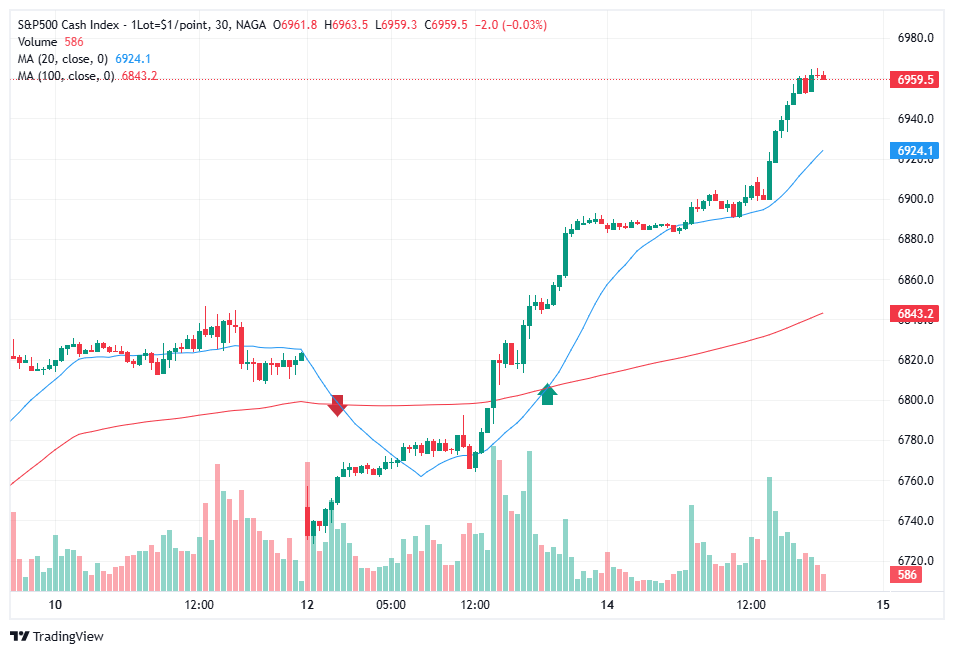
A common example is a moving average crossover strategy, which is widely used in both auto trading and manual technical analysis. This strategy is based on two moving averages: a short-term average and a long-term average.
Strategy Rules
The logic behind this automated trading system can be summarized as follows:
- Buy Signal: When the short-term moving average crosses above the long-term moving average
- Sell Signal: When the short-term moving average crosses below the long-term moving average
- Risk Management: A fixed stop-loss is placed below the entry point, and a take-profit level is set based on a predefined risk-reward ratio
Past performance is not a reliable indicator of future results. All historical data, including but not limited to returns, volatility, and other performance metrics, should not be construed as a guarantee of future performance.
How the Strategy Works in Automation
Once programmed into an automated trading system, the algorithm continuously monitors price data. When the crossover condition is met, the system automatically executes a trade without manual intervention.
This is where automated trading becomes particularly powerful, as it removes emotional bias and ensures that every signal is executed consistently in accordance with the rules.
Why This Strategy Is Used
Although simple, this strategy is popular in auto trading because it is easier to implement, test, and optimise. Traders often use it as a foundation before developing more advanced automated trading systems that include multiple indicators or market filters.
However, like all strategies, performance depends heavily on market conditions, and no automated trading approach guarantees consistent profits without proper testing and risk management.
How to Get Started with Automated Trading
Whether you're exploring automated trading for the first time or looking to scale existing strategies, getting started is about choosing the right approach, setting up your tools, and taking the first step with confidence. Platforms like NAGA.com offer an all-in-one environment where traders can access automated trading systems and copy-trading solutions through a single account.
Here’s how to begin step by step:
- Choose your trading approach. Decide whether you want to build or use automated trading systems, or start with a simpler alternative like copy trading. If you prefer full control over strategy design, auto trading tools may be the right fit. If you prefer a more passive approach, copying experienced traders can be a practical starting point.
- Create your account. To access automated trading features, you need to register and complete a quick verification process. This ensures your account is secure and compliant with trading regulations.
- Fund your account. Once your account is set up, deposit funds in your preferred currency to start trading. This step allows you to activate live trading conditions and explore real-market environments.
- Explore the trading platform. Use built-in tools, charts, and analytics to understand market behavior and test different automated trading systems. Platforms like NAGA.com also provide integrated tools for monitoring performance and managing risk efficiently.
- Start with copy trading or automation. If you're not ready to build your own system, you can instantly participate in the markets by copying top-performing traders through NAGA Autocopy. Alternatively, you can deploy your own automated trading strategies once you're confident in your setup.
Conclusion
Automated trading has reshaped the way modern markets operate by allowing traders to execute strategies with speed, consistency, and precision. Through automated trading systems, decisions are no longer driven by emotion but by predefined logic that can be tested, optimised, and applied across different market conditions. This makes auto trading a powerful approach for those looking to improve efficiency and discipline in their trading process.
At the same time, it is important to recognize that automated trading is not a guaranteed path to profits. Success depends on the quality of the strategy, proper risk management, and continuous monitoring. Whether a trader chooses to build complex systems or start with simpler solutions like copy trading, platforms such as NAGA.com offer flexible tools to explore both automated trading systems and alternative approaches in a structured and accessible way.
Trading tools
Before you start the automated trading, you should consider using the educational resources we offer like NAGA Academy or a demo trading account. NAGA Academy has lots of free trading and investing courses for you to choose from, and they all tackle a different financial concept or process – like the basics of analyses – to help you to become a better trader or make more-informed investment decisions.
Our demo account is a suitable place for you to learn more about leveraged trading, and you’ll be able to get an intimate understanding of how CFDs work – as well as what it’s like to trade with leverage – before risking real capital. For this reason, a demo account with us is a great tool for investors who are looking to make a transition to leveraged trading.
Sources:
- https://www.ecb.europa.eu/home/html/index.en.html
- https://www.imf.org/en/home
- https://www.oecd.org/en/topics/finance-and-investment.html
- https://www.newyorkfed.org/